
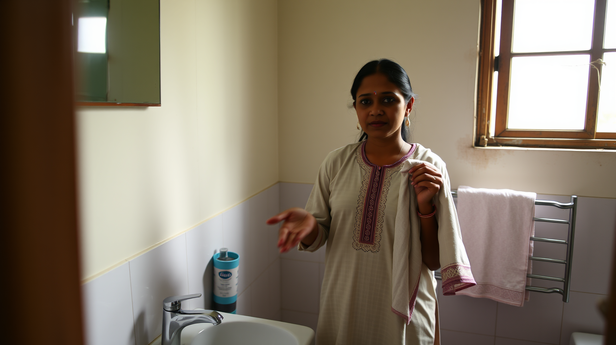
Sharing the same towel or handkerchief
This is the single fastest route conjunctivitis takes through a household. The discharge from an infected eye, whether bacterial or viral, transfers to fabric immediately and survives there long enough to reach the next person who touches it. A 2022 review published in the Indian Journal of Ophthalmology noted that contact with contaminated fomites, including shared cloth, is among the primary drivers of conjunctivitis clusters in community settings. Every member of the household needs a separate towel during an outbreak. Handkerchiefs should be washed in hot water after each use or replaced with disposable tissue.

Reusing or sharing eye drops
The tip of an eye drop bottle touches the eye's surface or the surrounding skin. Once it does, it carries whatever is on that surface, discharge, bacteria, viral particles, back into the bottle. Using the same drops bottle across family members doesn't just fail to treat the infection; it actively passes it along. Even within a single patient, a bottle contaminated this way can re-infect the same eye after it has started clearing. Each person needs their own bottle. Hold the dropper at least one centimetre above the eye and never let it make contact.
Sending an infected child to school
Viral conjunctivitis is contagious from the moment symptoms appear, sometimes before the eye looks visibly red. Indian school classrooms, with 40 to 50 children sharing desks, water taps, and stationery, are efficient amplifiers. A child who wipes their eye and then passes a pencil has already made the transfer. The standard medical guidance is to keep the child home until discharge has stopped for at least 24 hours. Sending them back early doesn't just risk other children, the child returns home carrying whatever else circulated in the classroom.
Rubbing the eyes with unwashed hands
The instinct to rub an itchy, watering eye is almost impossible to suppress. The problem is that hands pick up the infectious agent from one eye and carry it to the other, or from one person's face to a shared surface. A study in Clinical Ophthalmology found that hand-to-eye contact is the dominant transmission route for adenoviral conjunctivitis, the viral strain responsible for most epidemic outbreaks. Washing hands with soap for at least 20 seconds before and after touching the eye area is not optional hygiene during an outbreak, it is the primary prevention measure.
Stopping treatment as soon as the eye looks better
Bacterial conjunctivitis responds to antibiotic drops within two to three days and the eye often looks normal before the course is complete. Most Indian households stop the drops at this point. The bacteria haven't been fully cleared. The infection returns, sometimes stronger, and the incomplete course contributes to antibiotic resistance over time. The full prescribed course, typically five to seven days, must be completed even when the eye appears clear. This applies to children especially, because they are the least likely to complain once the discomfort fades.
Using kajal or surma on an infected eye
Kajal and surma are applied with a stick or finger that goes directly onto the waterline of the eye. During a conjunctivitis infection, this introduces additional bacteria and irritants into an already compromised eye. The same applicator, returned to a shared container, then contaminates the kajal for every other user. This is a specific risk in Indian households where kajal is applied to infants and young children as a daily practice. During any active eye infection, kajal application must stop entirely. The container itself should be discarded if it was used during the infectious period.
Assuming it will clear on its own without identifying the type
Viral, bacterial, and allergic conjunctivitis look similar in the first 24 hours but require completely different responses. Viral conjunctivitis, the contagious kind that drives outbreaks, does not respond to antibiotic drops, which are only effective against bacterial infection. Treating a viral case with antibiotics delays proper management and contributes to resistance. Allergic conjunctivitis requires antihistamine drops, not antibiotics. A doctor's assessment, or at minimum a pharmacist consultation, is needed to identify which type is present before starting any drops. Guessing wrong doesn't just waste time; it extends the period during which the infection remains active and contagious.
Neglecting surface hygiene in shared spaces
Pillowcases, spectacle frames, mobile phone screens, and door handles all carry the virus or bacteria shed from an infected eye. Indian households that are otherwise careful about personal hygiene during an outbreak often overlook these surfaces. A person who washes their hands correctly but then picks up an unwashed phone and touches their face has undone the precaution. Pillowcases should be changed daily and washed separately in hot water. Spectacle frames should be wiped with a disinfectant cloth. Phone screens, which most people touch before and after touching their face, should be cleaned with an alcohol wipe at least twice a day during an active outbreak.
The pattern across all eight mistakes is the same: the household treats conjunctivitis as a minor inconvenience and manages it loosely, while the infection treats the household as an ideal transmission network. Shared objects, incomplete courses, and the assumption that visible improvement equals resolution are exactly what keep the outbreak alive past the first case.







