
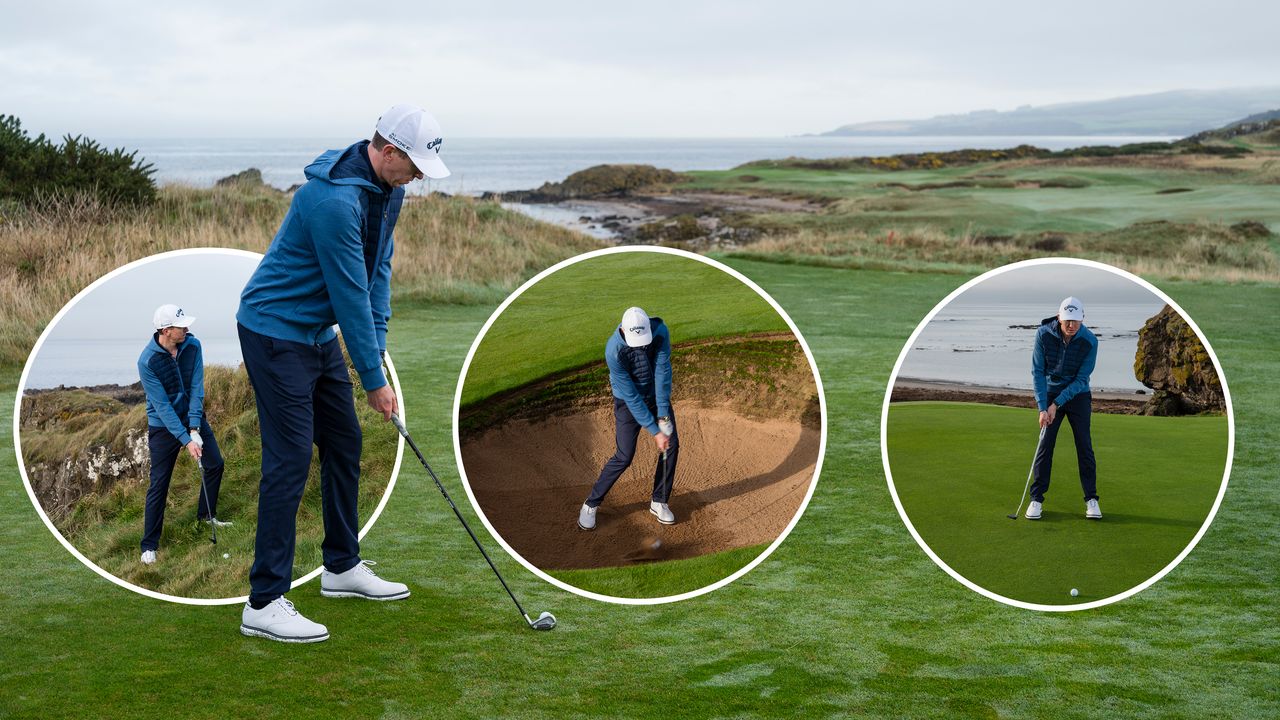
At this time of year, facing testing conditions on the golf course is the reality for many club golfers, but that doesn’t mean you can’t excel and shoot low scores.
You might want to spend the off season trying to boost your clubhead speed or hitting the gym with five fitness exercises that can make you a better golfer, but I say... why not do all of that while also playing great golf whatever the weather.

The key to navigating winter golf like a pro is being able to adapt, so in this video and article, I have seven tips that can help you to play your best.
Through a mix of set-up changes, strategy considerations and the addition of some crucial shots to your winter arsenal, I’m going to help you fight back defiantly against the elements in your next round…
7 Expert Tips To Play Better Golf In Challenging Conditions
1 LOW STINGER OFF THE TEE
The low stinger should be part of every club golfer’s shot repertoire, especially when conditions get tough.
There are a couple of things you need to do at set-up to ensure you don’t expose too much loft. First, you need to get your chest on top of the ball, as you want to compress it to help it fizz through the air.
To achieve this, you need to put the ball position ever so slightly back in your stance and grip down the club to get your hands a little closer to the shaft, which provides more control over the clubhead. You also need to get your hands quite far forward.
A desirable feeling is that your hands are going to stay ahead of the clubhead throughout the entire swing. It is your chest that is really driving this swing – not your hands or arms – to help create a low, stinging compressed shot.

2 DEEP ROUGH
When you find deep rough on the course, particularly when it’s wet, your priority is safety and getting back out onto the short stuff.
You need to make a couple of set-up changes when you’re in the thick stuff, especially if it’s buried and you can barely see the golf ball.
Early contact is key, as you don’t want to hit behind it in this kind of grass. If you do, the club is going to get snagged and the clubface will twist.
At set-up, place the ball really far back in your stance and take a wide, stable base. Move your weight and sternum over your lead side and get your hands ahead of the golf ball.
It’s important to feel a little more steepness in the swing, so pick the club up quickly and slam the clubhead down into the ground, making sure to hit the golf ball first.
You aren’t going to see a big follow-through here, as your only goal is to just stab this thing back out onto the fairway.
3 GOING FOR THE GREEN FROM OFF THE FAIRWAY
When you just miss the fairway and find the semi-rough, you need to check if the lie is good enough to go for the green.
If it’s sitting down, that’s a red light – just wedge it back onto the fairway. If it's a good lie, then that's a green light and a couple of set-up changes will ensure good contact.
Grip down ever so slightly, widen your stance and set your weight distribution a bit more on the lead side to promote a steeper angle of attack.
The club may twist left as it hits the grass, so you could also open the face a little to allow for that. Other than that, just swing normally and commit.
The lie should dictate your next move, so be sure to assess it before making your decision.

4 MUDDY LIE AROUND THE GREEN
As a rule, if you’ve got nothing to go over, don’t try to go over it – keep the ball low and running.
To do this, have your feet nice and narrow, your weight on the lead side and the grip of the club just ahead of the ball. Avoid too much wrist hinge – you want more of a putting stroke action here to nip the ball off the surface.
If you have to go higher over a bunker or hollow, take a more lofted club and stand really tall.
I like to get the toe of the club nice and low, so pick your hands up and open the face slightly, then feel like you’re cutting across the ball with more of an out-to-in swing.
This should slide the ball up the clubface and get it airborne.
5 COMPACT SAND IN BUNKERS
When you encounter a wet bunker that’s full of compacted sand, you need to make a couple of key set-up changes in order to escape unscathed. Crucially, you want to avoid exposing too much of the bounce on your wedge.
But you do need loft to get the ball up quickly, especially in a deep revetted bunker like the one in the video below, so I would stick with your 58˚ or 60˚wedge and make some simple adjustments.
Put the ball back in your stance a little and create a wide base. Really focus on your weight being on the lead side and keep it there throughout the swing.
Pick the club up quickly to encourage a steep angle of attack, but you actually don’t want a big follow-through for this shot.
As you hit the sand beyond the ball, that sand will decelerate the club – but you do need to commit and really hit down deep into the sand after the ball.

6 SHORT-GAME ALTERATION
If you are playing in challenging conditions, excelling around the greens can be particularly difficult.
One of the most essential shots you can play is the low, spinning chip, which not only keeps the ball out of the wind but also helps it to stop really quickly. It’s key in winter.
This is a great drill to understand the role of the wrists and body in this shot. Place an alignment stick straight down the grip and do a few rehearsal swings. I want you to feel that you’re turning your body and not getting whipped by the stick.
Your hands need to be ahead of the ball to take some loft off the club. This will help you to get used to a takeaway and follow-through that is more body-related than centred around the wrists.
To hit the shot, make sure your hands are ahead of the ball, take a wide stance, limit the involvement of your wrists and focus on the body turning back and through.
7 PUTTING ON SLOW GREENS
I would always advise club golfers to make a few important changes to their pre-shot routine and stroke on slow greens to help ensure they have effective acceleration and make good contact.
In the pre-shot routine, make your practice strokes from three or four feet behind the ball rather than next to it, staring at the hole the whole time.
This helps the brain to understand the acceleration needed for the stroke in hand, while appreciating the distance from behind the ball.

As for set-up, ensure the ball is a little further forward in your stance and the handle of the putter slightly ahead of centre. Focus on a centred strike and that feeling of accelerating past the ball.
one of the best golf drills is to place two tees behind the hole and aim for the tees. A short putt is never going to go in, so don’t be afraid of a pace that will get the ball marginally past the hole. Then it’s all about reading the line and watching the ball topple in.