The latest Shot Scope data tells us that there is a clear correlation between adding distance with driver and lowering your handicap, so this should be a priority for all amateur golfers looking to improve their game.
The average driving distance for a 20-handicapper is 222 yards - which is the closest measure to my index.

To reach my goal of playing off 15, I need to add at least 14 yards on average (234 yards) - which I managed to thanks to a golf improvement plan that helped me hit driver over 240 yards (as a 22-handicapper).
Over the winter I have been working hard on increasing my clubhead speed as part of this golf improvement plan that has delivered a 106% power boost - so I can vouch for that fact that this advice really works... especially if you are a high-handicapper.
PGA professional and Top 50 Coach Ged Walters has been coaching for more than two decades and has worked with a number of top local, national and international instructors, including Adrian Fryer and Jeff Ritter, to develop his practice as an elite coach.
With his extensive experience helping amateurs you too can cut your handicap in 2026. Below, Ged shares his wisdom on adding distance with driver... including a great tip for avoiding the biggest driver distance killer for amateur golfers.
7 Tips To Add Distance Off The Tee With Driver In Golf
1. Centred Strike
Let's start with the king of all power tips... ensuring a centred strike with driver.
Hitting the centre of the clubface, or very close to it, will help to optimise ball speed – a significant factor in how far you hit it. Unfortunately, a lot of club golfers have no idea of their strike location.
Sometimes, even if they think they’ve hit a good shot, it has actually come out of the heel or toe and brought the gear effect into play, with the head twisting around its centre of mass, leading to unwanted curvature.
To better understand where you’re striking it, use one of my 10 best golf drills.
Spray some dry shampoo or foot spray on the clubface. Hit a dry golf ball, then see where the mark has been left. This will help you to understand what good strikes feel like to boost your chances of added distance.

2. Grip
Remember this point... your hands release the energy in the golf swing.
You can make the best turn in the world or create incredible swing speed, but if your hands don’t release the energy, the golf club won’t flow or accelerate through impact.
Mastering the perfect golf grip is key to increasing distance.
A lot of club golfers who have a strong grip struggle to hit a driver effectively, often producing low snap-hooks, as the clubface shuts down and de-lofts the club in the downswing.
A great way to think about your grip is for your hands to be in their natural position – if you let your arms hang down, they tend to turn slightly inwards.
The hands always want to return to their natural position at impact, so if you start with them on the club in the incorrect place at set-up with a square clubface, the chances are you won’t return it square at impact.

3. Clubhead Speed
If you can measure your clubhead speed on a launch monitor, or at the driving range if it’s kitted out with the right tech, the data can really help you to track your progress.
The equation is simple; the more clubhead speed you are able to generate, the higher your ball speed is likely to be. And this will equate to more distance, providing your strike location is good.
It's a simple formula for hitting longer drives irrespective of your handicap index.
If you are struggling to ramp up your clubhead speed, you might need to opt for more loft on your driver. This will allow you to keep the ball in the air for longer, as opposed to a lower launch that might not travel as far before contact with the ground.
As your clubhead speed increases, you can reduce your loft accordingly, but many club golfers would definitely benefit from this little gear hack.

4. Set-Up
To generate more distance off the tee, I would focus on three key things at set-up: spine tilt, hip tilt and the correct ball position.
Spine tilt can be identified easily at address by the relationship between your belt buckle and the buttons on your polo shirt. Ideally, you want the buttons on the shirt to be fractionally behind your belt buckle on the trail side.
Too much spine tilt can cause you to hit the ground behind the ball, so be careful not to overdo it. A great way to get a natural spine tilt is to make sure you have the ball just inside your lead heel.
A slight hip tilt, where the trail hip is just a little lower than the lead, will also help to create the strong, athletic position you need to further your quest for more yards with your driver.

5. Spin Control
If you create too much spin, the ball will climb too high and seem to stall mid-flight, but it’s really just losing forward momentum as it’s still climbing.
Reaching peak height too soon is a distance killer, but too little spin can be just as detrimental as the ball starts to fall from the sky before reaching its peak height.
Less clubhead speed needs more spin to keep the ball in the air longer; more clubhead speed wants less spin to reach peak height at the right time. A centred strike with a square face is the ticket to better spin control.

6 . Overspeed Training
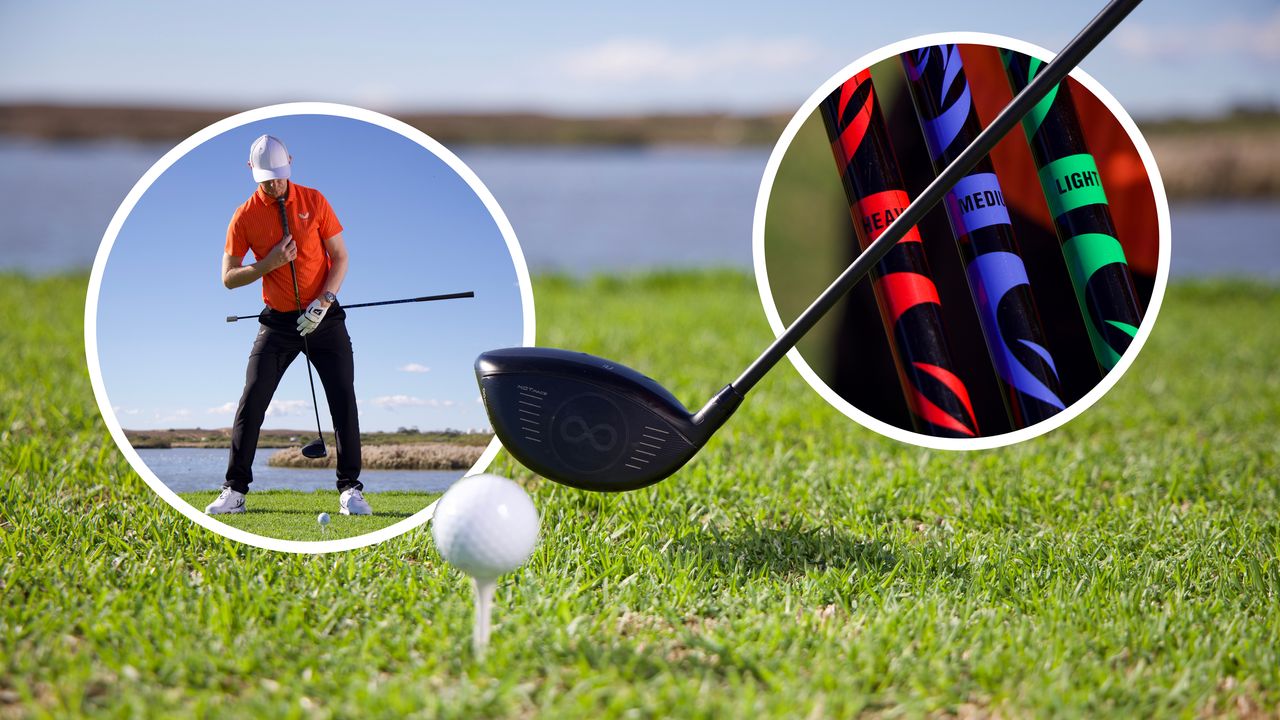
Weighted sticks are ideal for overspeed training. I use the Super Speed golf training set, which reviewed really well when tested by the experts at Golf Monthly.
Importantly, whichever of the best training aids you decide to use, the light stick should be about 20% lighter than a driver; medium around 10% lighter; and heavy about 5% heavier.
Going from light to medium to heavy, make the fastest, most aggressive swings you can to push your speed to the upper limits of your capabilities.
Try it five times with each, then switch back to your driver from the safety of the range and attempt the same speed. Faster speeds take some getting used to and direction will likely be erratic until you retrain your brain, but it will be worth it in the end.

7. Wrist Angle
Improving your wrist set can help you create the angles needed to release the speed.
The idea of this training aid is that the two brackets meet your forearms at the point when your lead arm is parallel to the ground going back.
When you reach the top, your forearms will be in the correct position if they’re still perched in the brackets.
Try to maintain connection with the training aid for as long as possible in the downswing before releasing the energy. Releasing too early will kill your distance potential.