Get all your news in one place.
100's of premium titles.
One app.
Start reading
Bangkok Post
Bangkok Post
National

60 illegal nominee firms found on Koh Samui

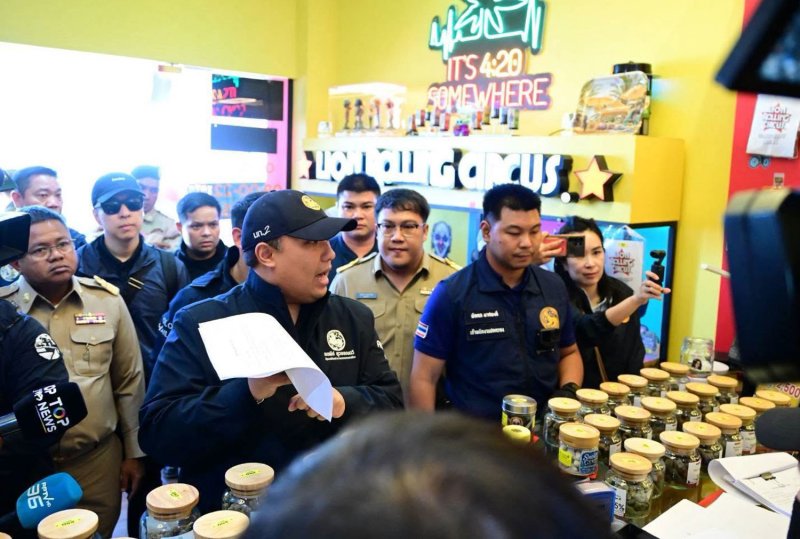
Deputy Interior Minister Polapee Suwunchwee, carrying documents, takes part in a search at a cannabis shop on Koh Samui during an operation carried out to crack down on illegal businesses on Saturday. (Photo: Interior Ministry)

A new crackdown on illegal foreign businesses on Koh Samui has uncovered 60 cases ranging from unlicensed nurseries and luxury pool villas to companies set up to facilitate business visas, Deputy Interior Minister Polapee Suwunchwee said on Saturday.

More than 300 police and officials took part in an operation on Saturday to identify and arrest foreigners operating businesses illegally on the tourist island and using Thai nationals to hold shares or assets on their behalf.
The operation, led by deputy national police chief Samran Nualma, was the seventh in a series of raids carried out in major tourist destinations following in-depth investigations.

Authorities in recent weeks have reviewed all 12,906 registered companies on Koh Samui. They found that 8,254 had foreign shareholders, while 875 had characteristics potentially indicating the use of Thai nominees.

After further screening, officials identified 59 suspicious companies holding 37 plots of land and properties covering 31 rai with a combined value estimated at 1.2 billion baht. The investigation resulted in 60 legal complaints filed against 88 suspects — 26 Thais and 62 foreigners.

14 foreigners arrested

The Koh Samui Provincial Court issued 37 search warrants. Police have so far arrested 14 suspects: four Chinese nationals, four British nationals and one each from Italy, France, the Netherlands, Austria, the Philippines and the United States.

The searches targeted five groups of companies.

The first involved a 19-company network linked to Israeli nationals. Investigators found a complex corporate structure in which Thais held shares on behalf of foreigners. The businesses included unlicensed nurseries for preschool children, as well as the purchase, development, sale and rental of luxury villas to foreign customers.

The second involved four companies linked to German nationals engaged in real estate and construction of luxury villas on steep hillsides, potentially in violation of legal restrictions. Authorities suspect construction permits were obtained improperly. The villas were sold by transferring shares in nominee companies, thereby avoiding land transaction taxes and corporate income tax on the proceeds.

The third group involved 27 companies set up to help foreigners obtain work permits or business visas, which allow holders to stay in Thailand for up to one year. Registration records of shareholders, many of them Thai, were found to be inconsistent with the actual investments.

The fourth group comprised 16 companies initially established entirely by Thais to bypass procedures requiring supporting documentation. Foreign nationals were later added to the shareholding structures to obtain work permits and change their visa status to business visas, despite the companies having no genuine business operations.

The fifth group involved two companies identified following a tip from the French Embassy in Thailand about a French national accused of defrauding French investors in a cannabis farm, causing losses of 21 million baht.

Surat Thani Immigration officials investigated and found that Thai nationals acted as nominees to hold shares on behalf of the foreigner. The companies were allegedly used to purchase land and build a luxury hotel with a swimming pool and tennis court, as well as to establish a company to operate the hotel.

Investigators found that a concealed lease arrangement was used while the property was advertised online for daily stays at rates of 11,000 to 17,000 baht per night. However, no hotel operating licence was found.

Ongoing operation

Pol Gen Samran, who will take over as the national police chief on Oct 1, said the operation was part of an ongoing crackdown on nominee networks in major tourist destinations.

Over the first six phases, authorities had examined 238 companies and 272 plots of land covering 184 rai, with land and property valued at about 2.8 billion baht. A total of 178 arrest warrants have been issued.

He said the operation aimed to regulate business activity in tourist provinces, including Surat Thani, Phuket, Krabi, Phangnga, Chon Buri and Prachuap Khiri Khan, to ensure foreign investment and operations comply with Thai law.

Authorities also aim to prevent foreign investors from taking advantage of Thai nationals or affecting their livelihoods, while continuing to pursue nominee networks and public officials involved in corruption.

Sign up to read this article
Read news from 100's of titles, curated specifically for you.
Already a member? Sign in here
Related Stories
Top stories on inkl right now
One subscription that gives you access to news from hundreds of sites
Already a member? Sign in here
Our Picks
Fourteen days free
Download the app
One app. One membership.
100+ trusted global sources.