Get all your news in one place.
100’s of premium titles.
One app.
Start reading
Times Life
Times Life
Nidhi

5 Reasons Devotees Visit Rameshwaram Before Char Dham

“श्रीराम राम रामेति रमे रामे मनोरमे।

सहस्रनाम तत्तुल्यं रामनाम वरानने॥”

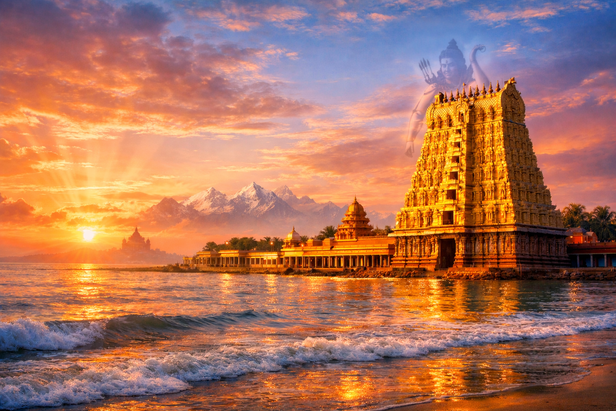
The name of Rama is said to hold the power of a thousand divine names. In India’s sacred geography, there is one place where that name is not only remembered but consecrated in stone, sea, and silence. That place is Ramanathaswamy Temple in Rameshwaram.

For centuries, many devotees have followed a quiet spiritual sequence. Before undertaking the grand pilgrimage of the Char Dham which includes Badrinath Temple, Jagannath Temple, Dwarkadhish Temple, and Ramanathaswamy Temple, they first visit Rameshwaram independently and consciously.

Why begin at a place that is already one of the Char Dham sites? The answer lies not in geography, but in spiritual psychology, scriptural tradition, and ritual purity.

1. The Sacred Link Between Rama and Shiva

Ram
Rama is supreme reality, liberator beyond all.

Rameshwaram holds a rare theological position in Hindu tradition. According to the Ramayana, Lord Rama installed and worshipped a Shiva lingam here before crossing the sea to Lanka. This act was not symbolic. It established a profound spiritual message: even Vishnu in his Rama incarnation bowed to Shiva.

The lingam worshipped here is known as Ramalinga. Scriptures such as the Skanda Purana describe Rameshwaram as a place where devotion transcends sectarian lines. It unites Shaiva and Vaishnava traditions. Devotees believe that beginning the Char Dham Yatra here harmonizes these two streams of bhakti within the pilgrim’s heart.

Before one seeks the blessings of Vishnu at Badrinath or Krishna at Dwarka, one first surrenders ego at Rameshwaram. The journey thus begins with humility.

2. Ritual Purification Before the Great Yatra

Pilgrimage in Hindu dharma is not tourism. It is a purification process. Rameshwaram is considered one of the most powerful places for spiritual cleansing.

The temple complex contains 22 sacred wells known as theerthams. Each well is believed to represent a different holy river of India. Devotees traditionally bathe in these waters after taking a dip in the Agni Theertham, the stretch of sea facing the temple.

Texts describe that bathing here absolves accumulated karmic impurities. Many pilgrims believe that visiting Rameshwaram first ensures ritual purity before stepping into the demanding Char Dham circuit. It is seen as cleansing the inner vessel before filling it with divine experience.

Without purification, the pilgrimage remains external. With purification, it becomes transformative.

3. Completion of Ancestral Duties

Rameshwaram is also one of the most significant places for performing pind daan and tarpan for ancestors. The belief is rooted in both scriptural authority and oral tradition.

It is said that Lord Rama himself performed rituals here for his ancestors before proceeding further. As a result, many devotees follow the same sequence. They complete ancestral rites at Rameshwaram before beginning the Char Dham Yatra.

The reasoning is deeply cultural and spiritual. Hindu thought emphasizes that one must fulfill obligations toward forefathers before seeking personal liberation. Clearing ancestral karmic bonds is believed to remove unseen obstacles in the pilgrimage ahead.

Thus, for many families, Rameshwaram is not just the beginning of a journey. It is the settling of spiritual accounts before embarking on higher pursuits.

4. Geographical and Symbolic Beginning at the Southern Tip

Rameshwaram

Rameshwaram stands near the southernmost edge of India, close to the mythical Ram Setu. Symbolically, starting from the south and moving northward toward Badrinath mirrors an ascent from the material to the spiritual.

Traditional Char Dham Yatra routes often begin from the south because spiritual progress is metaphorically described as an upward journey. Beginning at Rameshwaram and ending at Badrinath represents moving from oceanic vastness to Himalayan stillness.

The journey traces the sacred body of Bharat itself. From the shores of Tamil Nadu to the heights of Uttarakhand, from Krishna’s Dwarka in the west to Jagannath’s Puri in the east, the pilgrim circumambulates the nation as if performing pradakshina of a living deity.

Starting at Rameshwaram sets the direction both physically and spiritually.

5. Scriptural Endorsement and Traditional Practice

Several Puranic references elevate Rameshwaram to a unique status among pilgrimage sites. The Skanda Purana and Shiva Purana describe it as one of the twelve Jyotirlingas, making it intrinsically powerful even outside the Char Dham context.

Traditionally, many acharyas and pilgrimage manuals recommend performing the Rameshwaram darshan and rituals before or after visiting Kashi, creating a spiritual axis between south and north India. In some traditions, water from the Ganga is offered to the Shiva lingam at Rameshwaram, symbolically uniting the two sacred poles of Indian spirituality.

Over generations, this practice evolved into a preparatory step before undertaking the broader Char Dham Yatra. The idea is simple yet profound. One begins by acknowledging Shiva at the site sanctified by Rama, and then proceeds to seek the blessings of Vishnu in his various forms across the land.

It creates theological completeness.

Sign up to read this article
Read news from 100’s of titles, curated specifically for you.
Already a member? Sign in here
Related Stories
Top stories on inkl right now
Our Picks
Fourteen days free
Download the app
One app. One membership.
100+ trusted global sources.