
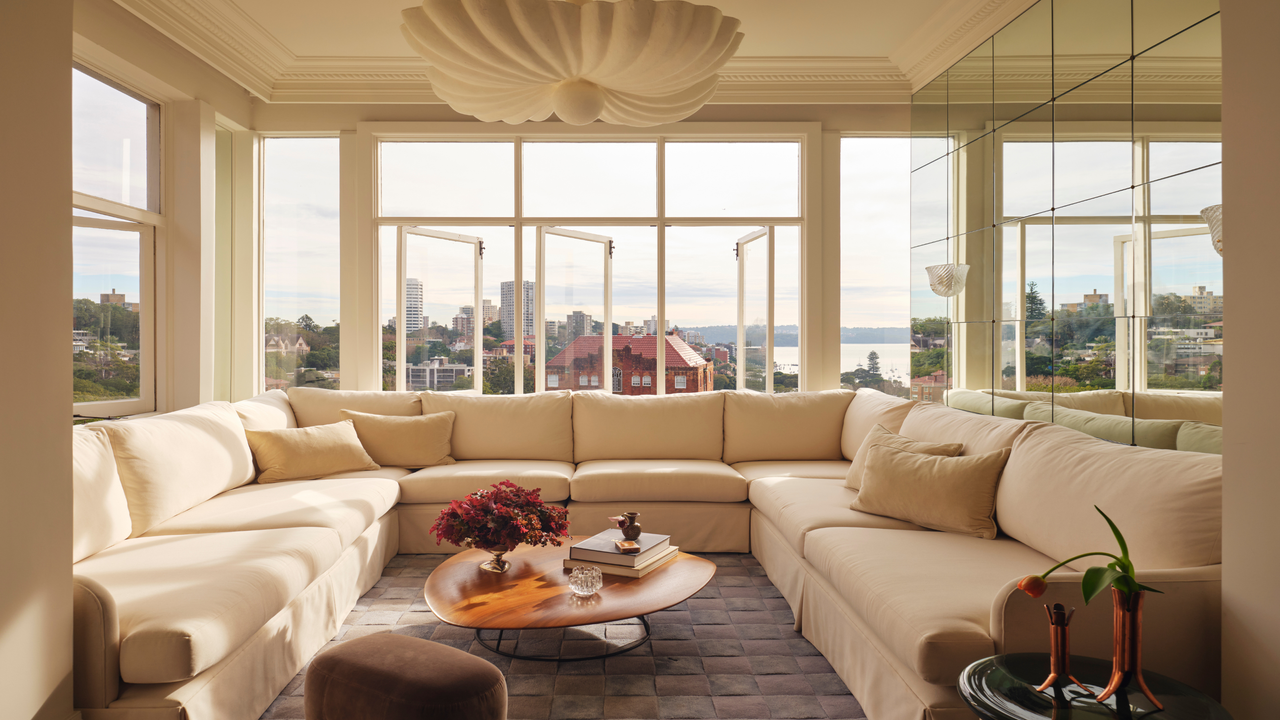
I am a freelance writer, casual teacher, and mother to a very sassy and sparky one-year-old. Hear me when I say: there is no room in my home that incites calm. Aside from the kitchen, which is constantly covered in a rotating array of air-drying plastic containers, the space that really needs a good overhaul is the living room.
There are obvious culprits of visual unrest: the vacuum cleaner, never-plump cushions, Duplo scattered threateningly on the floorboards. I kid you not, there are no less than three pairs of tiny shoes sitting atop the sofa as I write this. However, when I spoke to five expert designers, I discovered that there are so many nuanced features and modern living room ideas I can adopt to cancel the chaos that go beyond a tidy-up.

So if, like me, you're the not-so-proud owner of a living room that feels loud and unrestful, here are five mistakes you might be making — and how to remedy them.
1. High Contrast Everything
Don't get me wrong, I love a bit of contrast in interior design — as do designers. It's what creates visual interest and lifts interiors, preventing them from sitting too comfortably in the neutral (read: bland) zone. But you know what they say about too much of a good thing.
Leaning too heavily on contrast between walls, ceiling, joinery, doors and architectural details can cause each element to read separately, says Eris Koutsoudakis, co–founder of Meraki Design. Instead, Eris suggests dipping your toe into the color drenching trend.
"Using the same color, or closely related tones, reduces the number of visual interruptions and creates a much calmer backdrop," she says.
This doesn't mean you have to paint all four walls and the ceiling in bright hues. If neutral colors are more your thing, a soft, enveloping tone can have the same effect. "It feels like a clean canvas that one can layer onto," says Eris.

2. Too-Bright Lighting
The goal of a living room is to be restful and relaxing, and while it may sound dramatic, your living room's lighting can be the be-all and end-all. Choose lighting that is too cool in tone, and you risk a space that looks and feels clinical. Lighting that is too bright will have you feeling strained. And, in case you missed it, "big lights" are still well and truly out.
"Overhead lighting is not only unflattering, but visually unsettling — more designed for an office to be alert and on task, rather than a living room designed for relaxation and inviting conversation," says Shona McElroy of Smac Studio.
When designing your living room — or any space where tasks aren't performed — the goal is to use as little downlights as possible (ideally, none), and focus on overhead lighting alternatives instead.
"We love to introduce wall sconces, pendants where the light is diffused with glass or is an uplight, and lamps where possible."
Finally, always opt for a warm bulb at the 2700 kelvin mark, says Shona — there is a big difference between warm light vs cool light in how a space feels, and for a calm and relaxing living room, warm lighting is key.

3. "Stuff"
Sounds simple, and it absolutely is: too much stuff is a big no-no. It makes sense; a busy room equals a busy mind, but it goes beyond just collected items and objects.
"Visual noise is often created by practical items rather than decorative ones. Cables, remote controls, chargers, children’s toys and everyday objects can quickly disrupt an otherwise calm room," says Eris.
To avoid living room necessities causing chaos, Eris suggests planning for their presence from the start. "Integrated storage, concealed cable management and furniture with a practical purpose all help to keep the room feeling considered without making it feel overly styled or precious."
For collected objects and homewares, Shona says the solution is cycling.
"Just because you have stuff that has been accumulated over the years, does not mean they all have to be out," she says. "I carefully edit every benchtop, coffee table, side table in my home to include one or two feature 'things' and a collection of softer 'things'."
To narrow down your choice, she recommends using images that inspire the look you're going for for scale and styling, before pulling everything out and putting it back one by one, using your mood board as you do.
"Put everything else away or use it to style other spaces. For example, I have many different vases that suit different floral types, so I have generally a consistent rotation of vases depending on the floral of the week."
Oh, and another hot tip? "I know the scented candle was expensive, but when it's down to its last nub, please don't leave it out; it looks so weird," says Shona.
Noted!


4. Competing Focal Points
Don't get me wrong, I'm all for personality in rooms. There's nothing sadder than a bland, copy-paste interior — but throwing everything into a space isn't the answer, either.
"A statement fireplace, patterned rug, bold artwork, decorative lighting and sculptural furniture can all be beautiful individually, but when they compete, the room can feel erratic," explains Eris.
Instead, establish a clear hierarchy. This might be choosing one piece of furniture or decor as a focal point, intentional repetition of colors (to "distribute visual weight", says Shanna Gatanis of Shanna Gatanis Design Studio), or achieving balance through symmetry.
"Anchoring a space with symmetry, which allows your eye to calmly travel throughout, and also gives concrete places to land," says Liz Hoekzema of KLH Designs. "An interesting or oversized lamp, a sculptural object; anything of the sort speaks much more clearly when it's not fighting with a hundred other disparate items in the room."
The other faux pas to avoid, according to Liz, is discordance between rooms.
When each room is looked at as its own scheme, and new colors and patterns are introduced with no tie-in elsewhere, the end result is a home that feels both choppy and busy," she says.

5. Proportions That Are All Wrong
Have you ever walked into a room that felt wrong in a way that you couldn't quite put your finger on? It's quite likely that the proportions were off.
Too many pieces, as well as the wrong-sized pieces, can really throw the flow of a room, creating a space that feels like far too much. The best way to avoid this, says interior designer Greg Natale, is to take time in the planning phase.
"Start by measuring the room and noting key dimensions, including ceiling height. This will help determine how much furniture the space can comfortably accommodate and whether lower or taller pieces will create better visual balance," he says.
Despite what you might think, visual clutter is not just the result of too-large furniture — pieces that are undersized can create an equally busy effect.
"Oversized furniture can make a room feel heavy and overcrowded, particularly when there is not enough space around each piece," says Eris. "Equally, pushing too many smaller pieces into a room can make it feel cluttered and fragmented. It is important to leave breathing space around the furniture and maintain clear routes through the room."
So, there you have it: five easy but life-changing ways you can flick your living room over from chaos to calm. While you update, take heed of these design-forward but timeless living room trends, too.
And for more of the latest trends and design ideas, why not subscribe to the Livingetc newsletter?