
Walk into any Hindu temple or home altar and you will notice something interesting. Certain gods are almost always placed together. We chant their names in one breath, celebrate their festivals on the same day, and fold our hands before them as a pair. Yet rarely do we pause and ask a simple question: why are they worshipped together?
Hindu worship is deeply symbolic. Every pairing of deities reflects a philosophy about life, balance, responsibility, love, and growth. These divine combinations are not random traditions. They are visual lessons about how the universe works and how human life should be lived.

1. Stillness Needs Strength
The worship of Shiva and Parvati together is one of the most powerful symbols in Hindu philosophy.
Shiva represents pure consciousness, meditation, detachment and inner silence. Parvati represents Shakti, the dynamic energy that drives creation, emotion and action. In many temples, they are seen together, and in the form of Ardhanarishvara they are shown as one body, half male and half female.
This pairing reminds us of something deeply relatable. Calmness alone is not enough. Energy alone is not enough. In our own lives, we need awareness and action, patience and passion, logic and emotion. When one dominates without the other, imbalance begins.
Shiva and Parvati together teach that life flows smoothly only when stillness and strength support each other.
2. Wealth Needs Wisdom
The combined worship of
Vishnuand
Lakshmiis common in households, especially during Diwali.
Lakshmi represents wealth and prosperity. Vishnu represents preservation, balance and dharma. Their pairing carries a clear life lesson. Prosperity without righteousness can create instability. Stability without resources cannot sustain itself.
In everyday life, we all desire success. But this pairing subtly teaches that wealth should be guided by ethics, responsibility and balance. Long lasting prosperity comes where values are protected.
When Vishnu and Lakshmi are worshipped together, the message is simple. Earn, but earn rightly. Grow, but grow responsibly.
3. Duty Needs Compassion
The divine couple Rama and Sita are worshipped together in the form of Ram Darbar.
Rama is known as the embodiment of dharma. His life reflects discipline, sacrifice and commitment to duty. Sita represents devotion, resilience and emotional strength.
In real life, many of us struggle with balancing responsibility and relationships. We focus on doing what is right, but sometimes forget empathy. Or we focus on emotion, but forget structure.
Rama and Sita together show that duty should not become rigid, and devotion should not become blind. True strength lies in combining principle with compassion.
Their pairing reminds us that leadership without sensitivity becomes harsh, and love without integrity becomes fragile.
4. Love Needs Surrender
The names of
Krishnaand
Radhaare spoken almost as one.
Krishna represents divine wisdom, charm and cosmic play. Radha represents the soul’s longing and pure devotion. Their relationship is symbolic rather than worldly. It expresses the highest form of Bhakti.
In human terms, this pairing teaches something universal. Real love is not possession. It is surrender. It is trust. It is deep emotional connection that transcends ego.
Spiritually, Radha symbolizes the human soul seeking union with the divine. Krishna symbolizes the divine responding to sincere devotion.
Together, they show that love becomes transformative only when ego dissolves and surrender begins.
5. Knowledge Needs Clarity
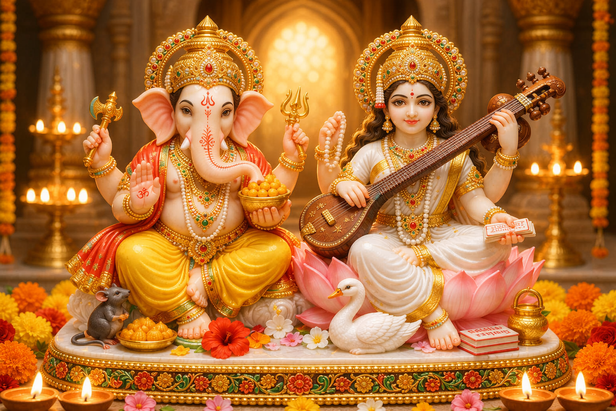
During educational rituals and festivals,
Ganeshaand
Saraswatiare often worshipped together.
Saraswati represents knowledge, art and refined intelligence. Ganesha represents clarity, removal of obstacles and wise beginnings.
This pairing carries a practical life lesson. Before gaining knowledge, the mind must be clear. Before learning, distractions must be removed. Before success, obstacles must be acknowledged.
In our daily lives, we often seek information but forget preparation. We want growth but ignore discipline. Ganesha and Saraswati together remind us that wisdom is not just about learning more. It is about clearing what blocks understanding.
Clarity first. Knowledge next.