
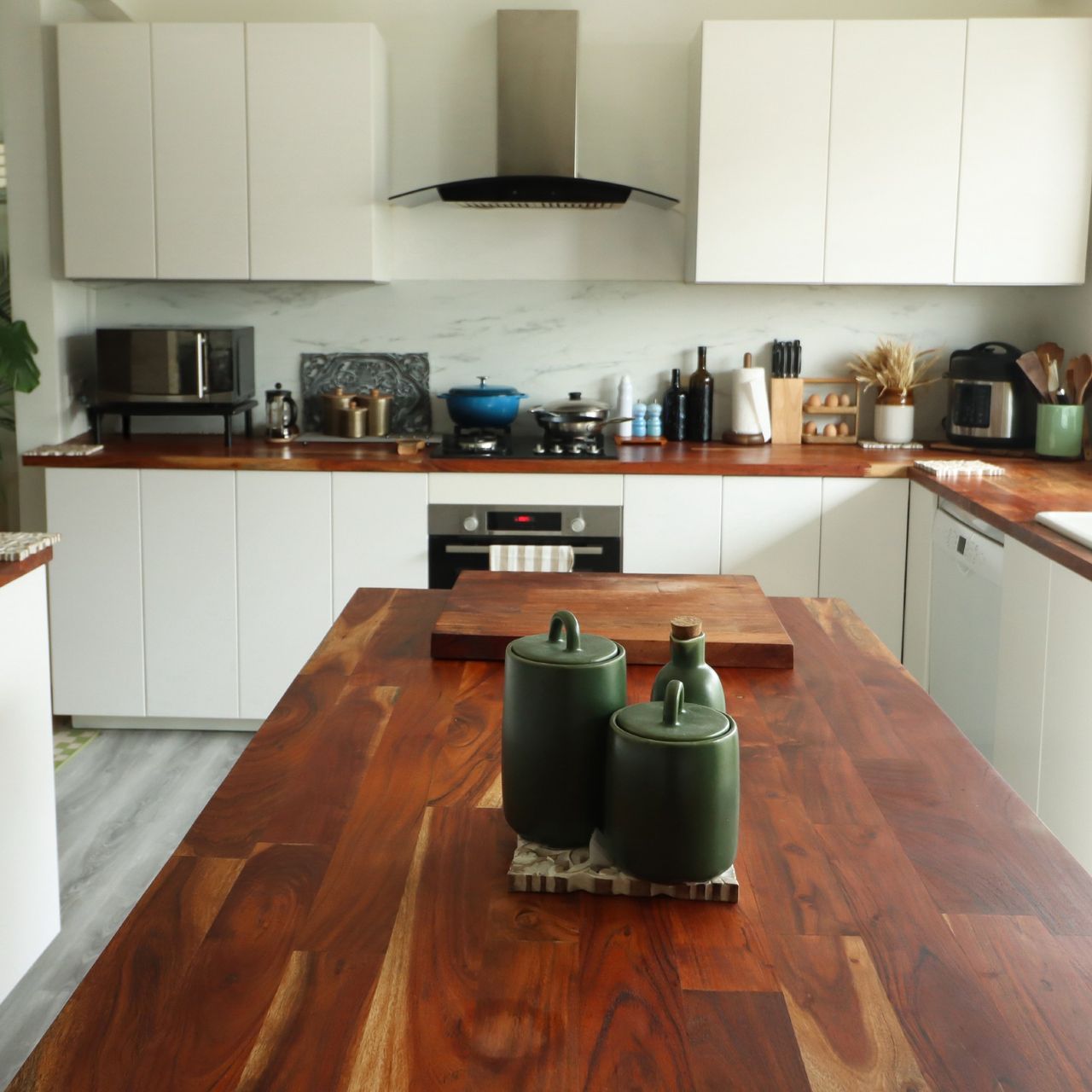
Be honest. Do you turn your counter-top kitchen appliances off when you're not using them?
Like many people, I like to think I'm pretty good at saving energy at home. I've dealt with draughts, use radiator reflectors and I'm meticulous at turning lights off when I leave a room.

However, I've got to admit I am terrible at turning my kettle, microwave and air fryer off at the wall when I'm not using them. And according to the Energy Saving Trust, I'm wasting £45 a year on my energy bills by leaving appliances on standby instead of turning them off properly.
In a bid to form some habits that people with consistently low energy bills have, I asked the experts about the vampire appliances that sit on kitchen counters that should be turned off when not in use.
1. Kettle

'Your kettle is the biggest energy consumer when it comes to counter-top kitchen appliances, costing £105.45 per year based on average usage,' says energy expert Ben Gallizzi from Uswitch. 'Bad habits drive these costs up even more, with 68% of households admitting to boiling more water in the kettle than needed, costing an extra £38 a year on energy bills. Almost three quarters (72%) also reboil the kettle when forgetting to use the water the first time, adding £56 annually.'
I do my best to only boil the water I need in order to use my kettle in the most energy efficient way, but I never think to turn it off at the wall when I'm done.
Even if I upgraded to one of the best kettles around, if I don't unplug the kettle when it's not in use, I'm wasting energy and paying more on my energy bills than I need to. According to data from Electric Radiators Direct, leaving your kettle in stand by mode will cost an additional 41p per month, or £4.97 a year.*
2. Air fryer
Air fryers are hugely popular with those looking to embrace a more energy-efficient way of cooking. I've been using mine on a regular basis for the last six years, but while I love that an air fryer is cheaper to run than an oven, I don't love the idea of how much energy I'm wasting by leaving it on standby mode.
According to Electric Radiators Direct's data, leaving my air fryer plugged in when not in use is costing me around 32p a month, or £3.89 a year.*
3. Slow cooker

Similar to air fryers, slow cookers are another counter-top culprit for wasting energy when they're not actively being used, also costing 32p a month just in standby mode, or £3.89 a year.
'Putting something into standby mode is not the same as totally switching off a device or unplugging it. You’re only really putting the device to sleep,' says energy efficiency expert Stephen Hankinson from Electric Radiators Direct.
'This means that it will be drawing out some electricity in the background, which is where the phrase ‘vampire device’ comes from.
'It sounds so simple but switching your appliances off at the wall really is the best way to ensure you’re not spending your hard-earned income on keeping things in standby mode.'
4. Microwave
My microwave has a digital display, which means it's constantly using energy 24/7, regardless of whether I am cooking or not. And considering my oven also has a digital display and I wear a watch, realistically, I don't need to be able to tell the time from three different sources every time I step into the kitchen.
So I'm definitely going to start turning my microwave off at the wall. By doing so, I'll save myself 40p per month in unnecessary energy use, or £4.75 a year*.
5. Coffee machine

Now I'm not a coffee-drinker myself, but I do understand how investing in one of the best coffee machines is a great way to kick your coffee shop habit in favour of something more cost effective.
But while you might be saving on your daily beverages, leaving your coffee machine plugged in when you're not using will eat into those savings you are making — 16p a month, or £1.97 a year*.
This might not seem like much in isolation, but when you add it together with other appliances you might also be leaving plugged in, and beyond the kitchen, it quickly tots up to a more significant amount of money you are paying in wasted energy.
What can happen if you don't switch off these kitchen appliances?
While leaving these appliances switched on at the plug uses energy unnecessarily, it could pose further risks to your appliances and your safety.
'Turning appliances off standby will help protect your equipment in case of a power surge, which can occur after a storm or power cut,' explains Ben Gallizzi. 'Surges can damage electronics, so taking the time to turn them off standby can help avoid costly repairs in the long-run.
'There is also a key safety element to turning kitchen appliances off standby. While the risk is small, electrical faults can occur and cause house fires. While it may not be essential for everyday use, if you’re going away for extended periods, it’s worth unplugging countertop appliances like kettles, toasters, coffee machines.'
How to turn off your appliances
In many cases, switching off your appliances will be as simple as flicking the switch on your plug socket and pulling the plug out of the wall.
However, not all plug sockets are easy to reach on a regular basis. In which case using a smart plug, like the Tapo P100 (4-pack, £27.20 from Amazon) may be a better solution. This is also an option if, like me, you know you will forget to turn them off.
With more than 13,000 five-star reviews, it's no wonder this is the #1 best selling smart plug on Amazon. The plugs are discreet and can be controlled via the Tapo app or with voice-control once connected to Amazon Alexa. You can also create schedules to turn off appliances at certain times of day, or overnight, when you know you won't be using them.
As well as working with Amazon Echo devices, this smart plug is also compatible with Google Nest or Apple HomePod. It's also small enough that it can be used in a double socket without impeding on the other outlet.
Connect this little plug to the Philips Hue Bluetooth app, and you can control whatever you plug into it via your smart phone. For a more substantial set-up that you can control even when you're not home, you can opt for the Philips Hue Bridge, that acts as a brain for all your Philips Hue plugs.
*based on data from Electric Radiators Direct and an average electricity price of 27p/kWh.
If you enjoyed reading this, sign up for the Ideal Home newsletter for all the latest home decor trends and inspiration delivered straight to your inbox