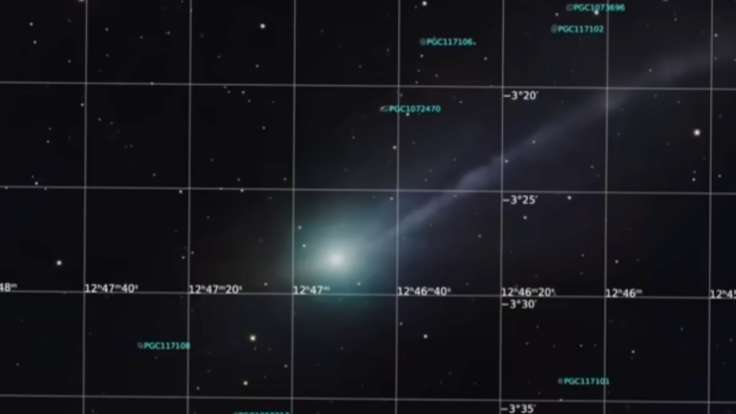
NASA has doubled down on its conclusion that 3I/ATLAS is a comet, even as a growing group of scientists suggest the interstellar object may be far stranger than anything previously observed.
First detected on 1 July 2025 by the ATLAS survey telescope in Chile, 3I/ATLAS travels on a hyperbolic orbit at extraordinary speed, confirming that it originated outside the Solar System. But its unusual chemical make-up, erratic brightness and CO₂-rich coma have prompted debate about whether it fits neatly into known comet categories at all.
As 3I/ATLAS races back into deep space, astronomers are scrambling to decode the mysteries of this rare visitor — only the third interstellar object ever recorded.
Why NASA Says 3I/ATLAS Is Definitely a Comet
According to NASA Science, telescopes around the world observed the familiar hallmarks of a comet: a nucleus wrapped in a glowing coma, a dust-gas tail and active outgassing as it warmed near the Sun.
The James Webb Space Telescope (JWST) provided the most striking findings — revealing an unusually CO₂-dominant chemical profile. Compared with Solar-System comets, which typically display stronger water and carbon-monoxide signatures, 3I/ATLAS is chemically peculiar. NASA officials say this suggests it formed in a distant star system where carbon dioxide ice was abundant.
During a briefing, NASA's Nicky Fox summarised the agency's stance: 'It looks and behaves like a comet. All evidence points to it being a comet.'
The Unanswered Questions That Keep Scientists Awake
Despite NASA's precise position, several researchers insist the object raises too many anomalies to be neatly explained.
Some astronomers have flagged:
- Erratic brightening inconsistent with thermal models
- Non-standard outgassing, including bursts that appear to defy expected timing
- A chemical mix rarely seen in Solar-System comets
Avi Loeb has revived the controversial suggestion that 3I/ATLAS might represent some form of artificial technology — perhaps a probe, fragment or relic. While most scientists reject that idea, they acknowledge that several data points remain unexplained.
Crucially, 3I/ATLAS behaves differently from the only two confirmed interstellar objects before it: 'Oumuamua, which lacked a visible tail, and Borisov, which behaved more like a traditional comet. ATLAS seems to sit between them: comet-like but still highly unusual.
What 3I/ATLAS Reveals About Alien Star Systems
Even without exotic theories, 3I/ATLAS is reshaping scientific models.
The object's extreme CO₂ abundance suggests a birthplace far from its original star — a region cold enough for CO₂ grains to condense and survive. This provides new clues about how protoplanetary discs behave in other solar systems.
Long-term, astronomers believe chemical comparisons between ATLAS, 'Oumuamua and Borisov will help map the diversity of small bodies across the Milky Way. Each new
A Race to Capture the Last Data Before It Vanishes
As 3I/ATLAS continues its outbound trajectory, astronomers are frantically completing final observations. Once it fades beyond the reach of telescopes, the opportunity is gone forever — leaving only the data gathered during these fleeting months.
Whether future analysis confirms NASA's comet classification or nudges scientists toward stranger explanations, 3I/ATLAS has already expanded the boundaries of what we thought possible.
It is rare, mysterious, and fleeting — a reminder that the universe still holds secrets capable of surprising even its most seasoned observers.
Originally published on IBTimes UK