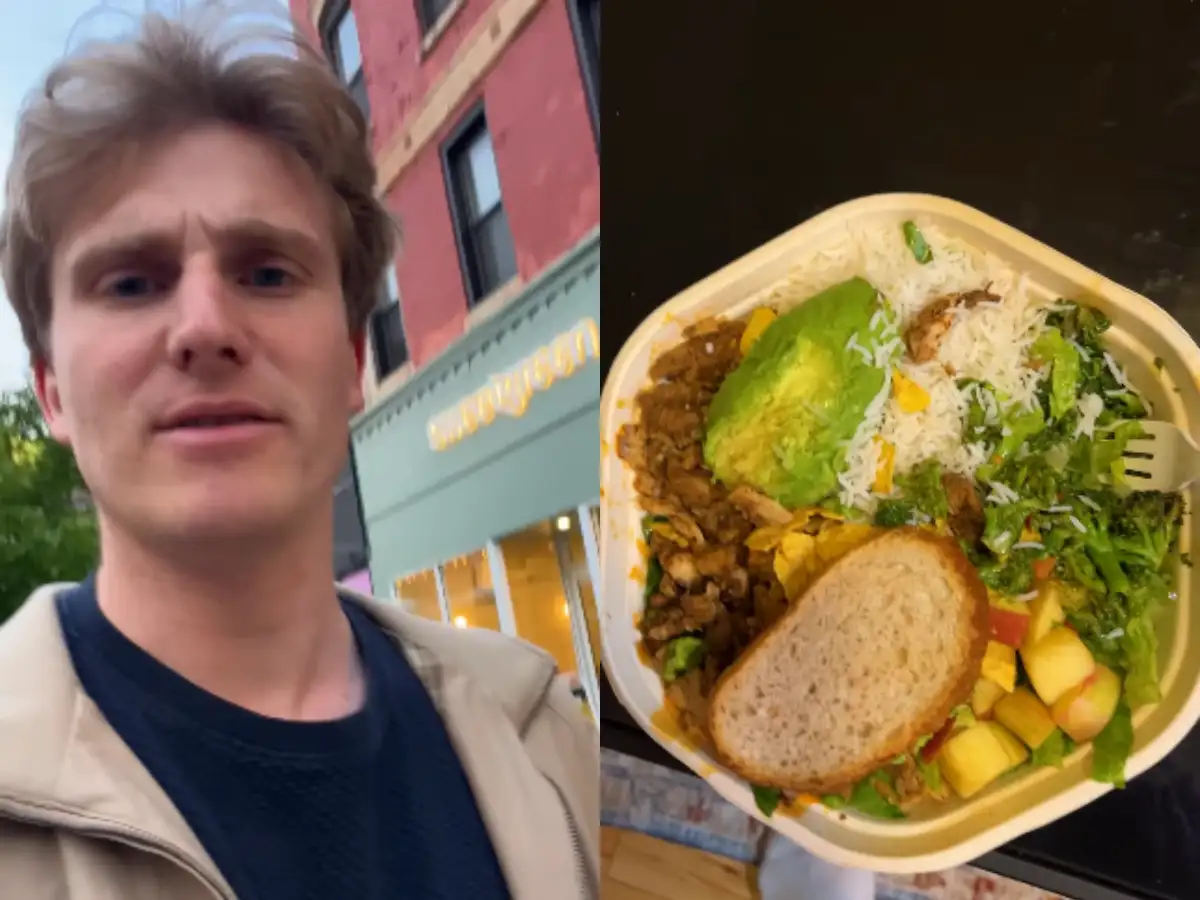
A 27-year-old advertising professional from Hoboken, New Jersey, spent 25 days eating almost exclusively from a fast-casual chain to see what would happen. Tim Donahue initially planned to continue the experiment for 30 days, taking inspiration from Morgan Spurlock’s 2004 documentary Super Size Me . But weddings, work trips and other scheduling conflicts forced him to stop after 25 days.
By the end of the experiment, Donahue said he had lost about nine pounds.
Why Sweetgreen?
Spurlock's experiment famously centered on McDonald's and examined the effects of eating fast food repeatedly. Donahue chose Sweetgreen as a contrasting option.
He was also familiar with the chain through health-conscious co-workers who regularly ordered Sweetgreen for lunch. While they ate salads and bowls, Donahue said he was often bringing fast food to work and was teased by colleagues.
For his own challenge, he established a simple rule: Anything he ate had to be available on Sweetgreen's menu. Black coffee was the only exception.
Although Sweetgreen sells more than salads, Donahue largely focused on its bowls.
The experiment became a logistical challenge
Donahue said the biggest difficulty was not necessarily eating the food itself, but organizing his daily life around the experiment.
He had to plan meals around Sweetgreen's opening hours and adjust social plans. Going out with friends could mean skipping drinks or bringing a Sweetgreen salad with him. Even spending time with his girlfriend required some additional planning.
"The most challenging aspect of the project was not the food, it was the logistics," Donahue told Fox News Digital.
The variety on the menu, meanwhile, made it easier for him to continue eating from the same restaurant for nearly a month.
One particular meal became his favorite.
"I was rocking with the hot honey chicken bowl," he said. "I was getting that all the time."
He lost nine pounds without planning to
Donahue said weight loss was not his primary goal when he started the challenge. Nevertheless, his weight fell by roughly nine pounds over the 25 days.
He also reported feeling that he had more energy during the experiment.
However, the result does not necessarily mean that eating exclusively from one restaurant is an effective or appropriate weight-loss strategy. Donahue himself has emphasized that the experiment was a personal project rather than nutritional advice.
"I would never prescribe this to someone," he said, adding that he is neither a doctor nor a nutritionist.
The experiment was expensive
The financial cost was another drawback.
Donahue said cooking at home and preparing a salad would have cost considerably less. He saved some money by avoiding alcohol and other restaurant meals during the challenge, but still described the experiment as expensive.
"You can cook at home and make a salad at home and spend a significantly smaller amount of money," he said.
"Out of pocket, this is not a sustainable thing to do over groceries," he added.
Donahue also clarified that Sweetgreen did not pay him to conduct the experiment.
Sweetgreen decided to try its own challenge
The experiment eventually caught the attention of Sweetgreen itself.
Nicolas Jammet, Sweetgreen's co-founder and chief concept officer, told Fox News Digital that Donahue's video inspired the company to create its own 30-day challenge. "His video inspired us to launch our own 30-day Sweetgreen challenge," Jammet said.
The company then opened applications for 30 participants who would eat only Sweetgreen for 30 days and document how they felt during the experience. Jammet said the company had already received hundreds of applications.
Then came the pizza
After 25 days of Sweetgreen bowls, Donahue finally returned to one of his favorite foods: pizza. He described the first slice as "incredibly well-deserved."
But the reunion did not go exactly as planned. "It did make me feel quite sick because it’s a shock to your system," Donahue said.
For Donahue, the experiment ultimately became less about proving whether one particular way of eating was better than another and more about documenting what happened when he imposed an unusual restriction on his everyday diet.
"The experiment was largely a fun filmmaking journey for me," he said. "I would never prescribe this to someone."