Get all your news in one place.
100’s of premium titles.
One app.
Start reading
Motorsport
Motorsport

2027 MotoGP bikes may not be slower at half the tracks, claims KTM

KTM technical chief Sebastian Risse believes MotoGP’s new 850cc prototypes could match the pace of the current bikes at roughly half of the circuits on the calendar.

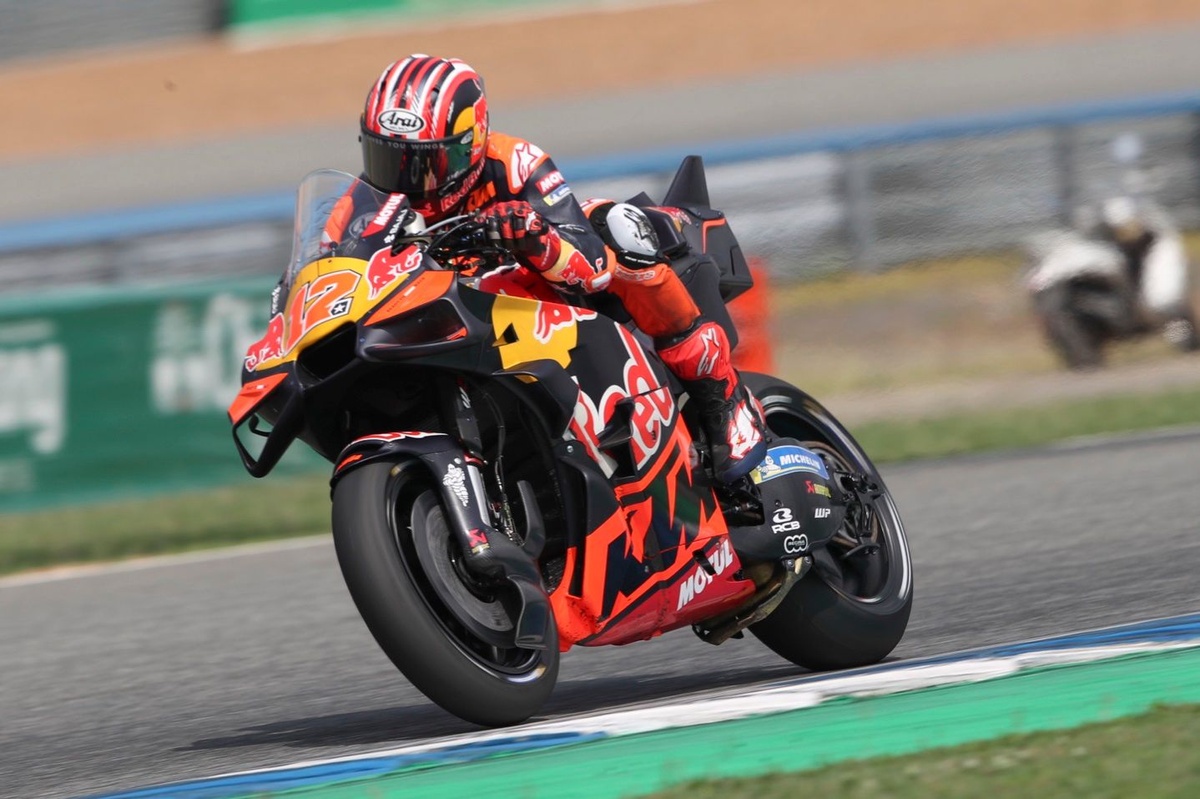
The new breed of MotoGP machines due for introduction in 2027 represents one of the biggest technical overhauls in the series’ history. The current 1000cc engines will be replaced by smaller 850cc motors, while the championship will also cut down on aerodynamics and eliminate ride-height devices entirely. Further, Michelin will replace Pirelli as MotoGP’s official tyre supplier, adding another unknown for the five manufacturers competing in the series.

Due to the reduction in downforce and power levels, it has been widely suggested that the next-gen MotoGP prototypes could be several seconds slower than the current 1000cc bikes, which have broken several long-standing lap records in the last few years.

However, Risse doesn’t completely agree with those predictions, having overseen KTM’s first test with its new 850cc bike at Jerez in December. The German engineer believes that, provided tyre performance remains relatively stable, the new regulations will not compromise the speed at every track.

Asked how much slower the 2027 bikes could be, Risse told Motorsport.com: “It really depends. I think it is too early to say for the tyres, but if you just look at the engine power, there are some tracks where you almost never go full gas with the current 1000cc [engines]. So, if you look at Misano, if you look at Jerez, I don't think they will be slower in terms of lap time. But on [some] tracks they are slower, that's clear.

“So, when you have several long straights, you will suffer from the [loss of] ride-height device and from the lower power. But I think it is quite a healthy way to make them slower because this will not cost the show. 

Seb Risse, Technical Director Red Bull KTM Factory Racing (Photo by: Gold and Goose Photography / LAT Images / via Getty Images)

“So, if I now look at all the learnings we have made and how positive we are at the moment with our new bike, I think on half the tracks we might not go slower than now in terms of lap time.

“On the other half, we will go slower, we still have to figure out how much. But the top speed difference - I think it will be targeted in the rules - will be a decent step, so I’m talking [in the range of] 15-20km/h. 

“Maybe if the development goes on, that's something you have to superimpose, so then it's not that anymore. Then, maybe it’s just 15km/h at a high-speed track. But the effect on lap time will not be so dramatic from that point of view.”

Even if the 2027 MotoGP bikes initially lack outright performance, engineers are expected to claw back some of that deficit through development over the course of the rules cycle.

It remains unclear how much time it will take for manufacturers to close the gap, but Risse feels teams will continue to extract more power from the 850cc engines every season.

“If I look back at the average of our engine development, we find around 5-6hp per year,” he explained.

“So that will apply to this smaller engine also, probably even more because the project is still fresh and there is more room to improve in the beginning, and then it will level off at some point. 

“But from this point of view, if you take 30bhp less now, the 30bhp [deficit] will not be constant in the next five years, that's clear.”

Sign up to read this article
Read news from 100’s of titles, curated specifically for you.
Already a member? Sign in here
Related Stories
Top stories on inkl right now
One subscription that gives you access to news from hundreds of sites
Already a member? Sign in here
Our Picks
Fourteen days free
Download the app
One app. One membership.
100+ trusted global sources.