
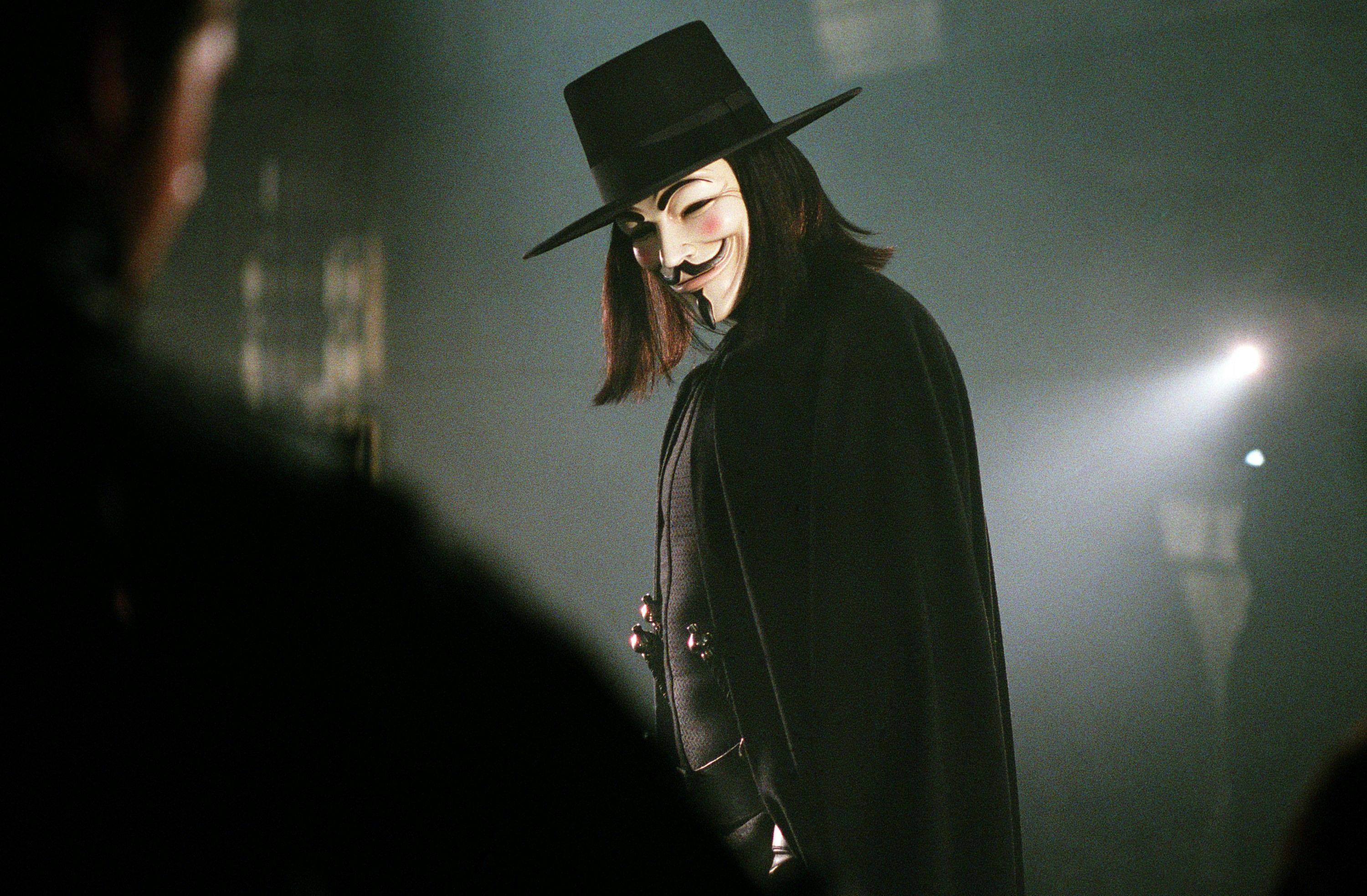
A deadly virus ravages and changes society for the worse. A fascist leader runs the country and his goons are disappearing people off the street. Late night talk show hosts are being silenced for speaking out against the regime. This all describes the plot of V for Vendetta, but it doesn't take more than a cursory reading of the latest headlines to see why the dystopian graphic novel adaptation might feel especially relevant these days, 20 years after it came out. It would be wrong, though, to say V for Vendetta predicted the future, and it's hardly the perfect movie for our times. Instead, the past two decades have emphasized an emotion that was always present in the 2006 movie but may have been buried under the stylized action, iconic mask, and depictions of righteous resistance. V for Vendetta is very sad.
The legendary comics scribe Alan Moore didn't intend for V for Vendetta to be a reflection of America in the 2020s when he wrote the graphic novel in the late '80s. It wasn't meant to be a reflection of America in the '00s and a response to the Bush era and Iraq War, either, though that's certainly what the Wachowskis' screenplay was responding to. Moore, who has disavowed the film the way he has disavowed just about all adaptations of his work, was angry at Margaret Thatcher's Britain and imagined a dystopian English future where a masked anarchistic terrorist fought against a fascist state. Moore, who is famously a crank — and in most cases, justifiably so — probably wouldn't love to hear that a Yankee is finding the movie version of a story he wrote nearly four decades ago so relevant when he wrote the story for a very specific reason. (He's also probably pissed, though not surprised, about the TV adaptation HBO's developing.)













