
Get all your news in one place.
100’s of premium titles.
One app.
Start reading
LiveScience
LiveScience
Kristina Killgrove

2,000-year-old gold ring holds clue about lavish cremation burial unearthed in France

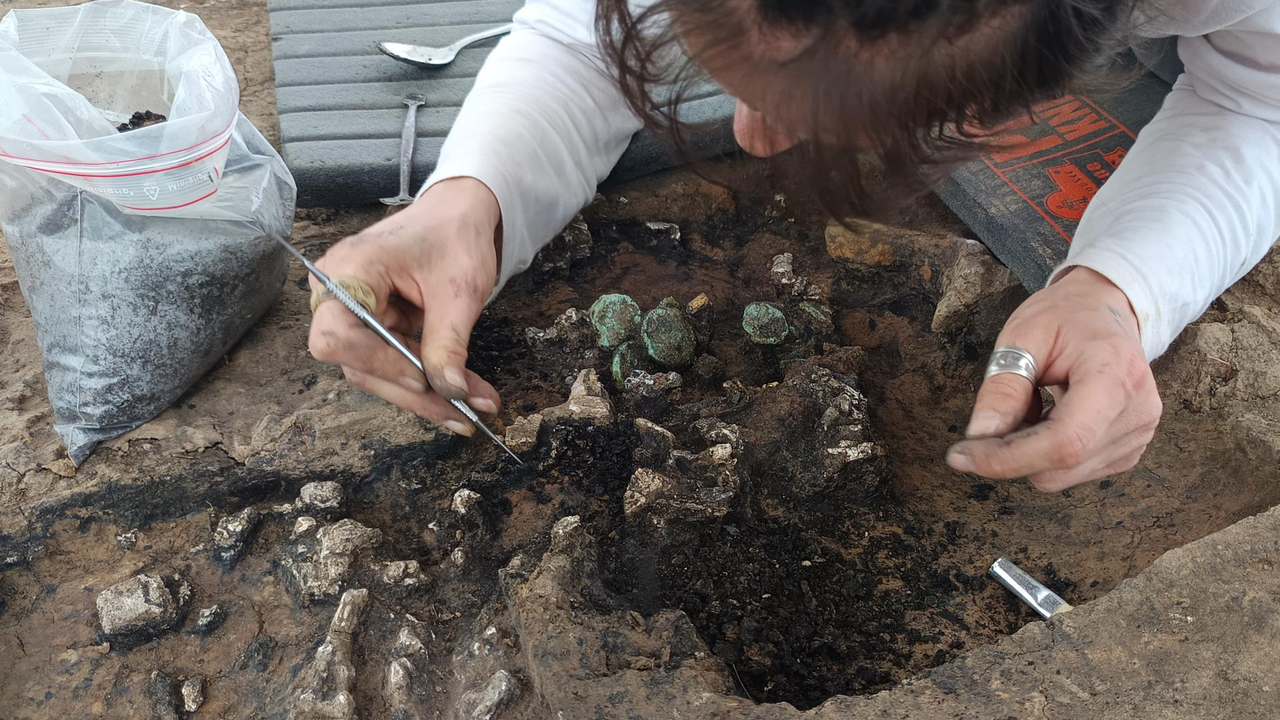
A person with dark hair and light skin excavates oxidized (green) coins with a metal pick.

Archaeologists in France have discovered a Roman-period cremation tomb richly furnished with silver coins, gold jewelry, and a ring inscribed with what is likely the last name of the deceased.

The grave was found unexpectedly during excavations at a medieval settlement in Lamonzie-Saint-Martin, a small town in southwestern France. As the archaeologists excavated underneath the medieval silos, they noticed an unusual burial, according to a Nov. 24 translated statement from the French National Institute for Preventive Archaeological Research (INRAP).

Excavation of the burial revealed it to be a "bustum," a type of Roman-era funeral practice in which the deceased was cremated directly over the grave and then immediately buried. The rectangular bustum measured 7.2 by 3.4 feet (2.2 by 1.05 meters) and was filled with grave goods for the deceased.

In one corner of the burial, archaeologists found a ceramic beaker and a clear glass vial. In another cluster of offerings, archaeologists recovered 10 silver and bronze coins, alongside small gold sheets that may have decorated a purse or case that held the coins. A series of lozenge-shaped crystals was also discovered, likely the remains of a bejeweled leather accessory that has since decomposed, as well as a long, corroded iron object that may have been part of a horse bit, which would have attached to a bridle.

The burial style, pottery and coins suggest that the bustum dates to sometime between the first and third centuries.

Also recovered from the burial were nearly two dozen gold objects, two of which may hold clues to the occupant of the grave.

A piece of rock crystal engraved with a possible surname — Allallé — was found in the burial. (Image credit: Frédéric Prodeo/INRAP)

Archaeologists unearthed a probable "bulla" — a special amulet that was given to male children in ancient Rome nine days after they were born and that they wore until they came of age as Roman citizens at around 16 years old. And the remains of a gold ring, deformed by the heat of the cremation, appear to match up with a small piece of inscribed rock crystal called an intaglio. The Greek inscription on the intaglio reads ΑΛΛΑΛΛΗ (Allallé), which may be the surname of the deceased.

The rich and well-preserved cremation tomb has raised a number of questions that archaeologists will try to answer through further analysis. They will study the surviving human bones to try to determine the deceased's sex and age at death. They will also excavate in the area to look for other graves or dwellings that could help them understand why this tomb full of artifacts, including one that suggests Greek heritage, was placed in this part of France.

Roman emperor quiz: Test your knowledge on the rulers of the ancient empire

Sign up to read this article
Read news from 100’s of titles, curated specifically for you.
Already a member? Sign in here
Related Stories
Top stories on inkl right now
One subscription that gives you access to news from hundreds of sites
Already a member? Sign in here
Our Picks
Fourteen days free
Download the app
One app. One membership.
100+ trusted global sources.