
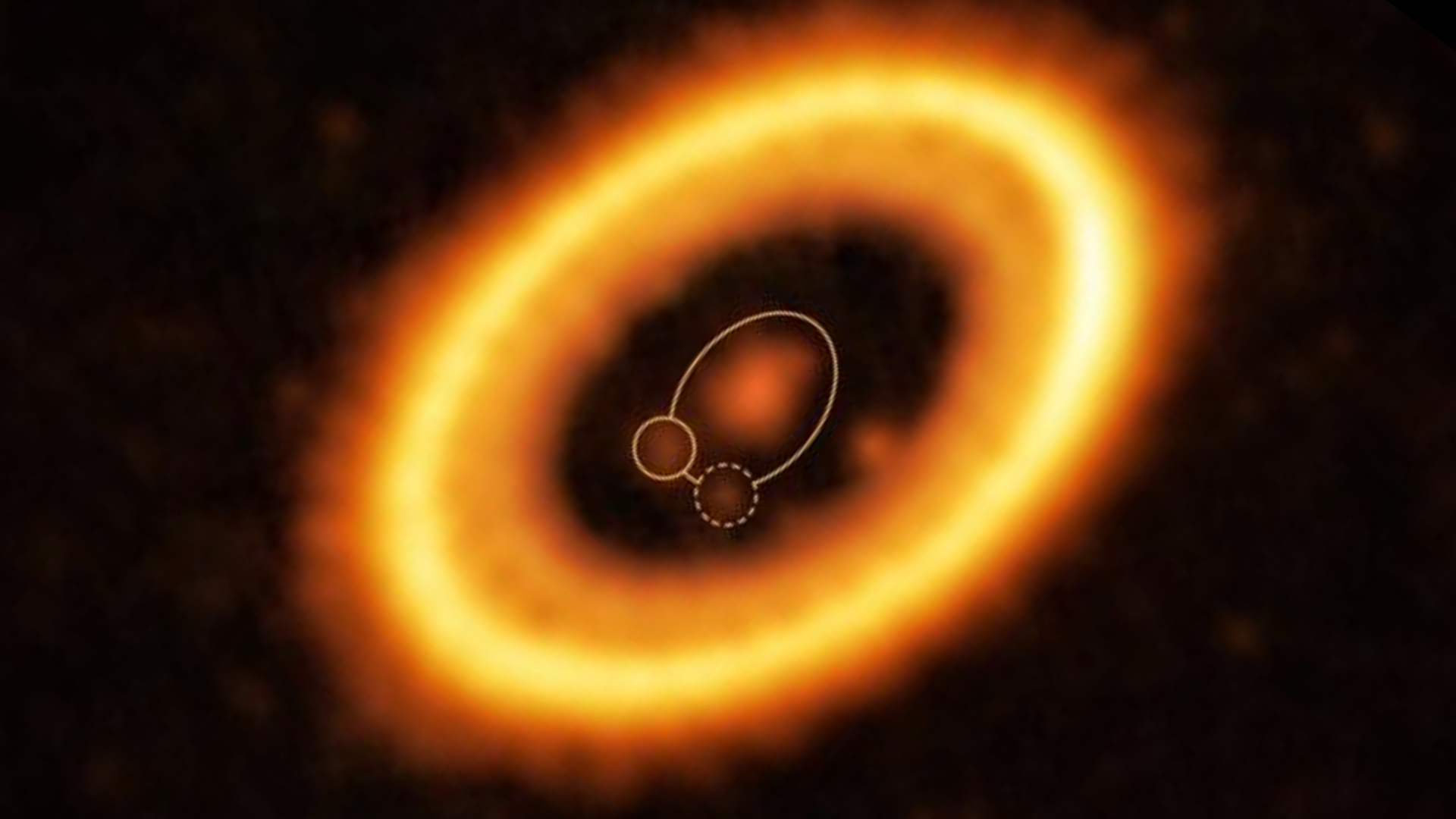
Astronomers have discovered the first evidence of two planetary siblings sharing the same orbit around a star.
The discovery of a possible co-orbital "Trojan planet" is represented by the detection of a cloud of dust sharing the orbit of the distant giant exoplanet PDS 70b, located around 400 light-years from Earth.
This clump of matter with twice the mass of Earth's moon could eventually condense into a planet, resulting in two worlds sharing the same orbit around a star. Alternatively, the cloud could be debris from what was once a planet, meaning this was a Trojan pairing in orbit around the young star PDS 70 in the past, researchers said.














