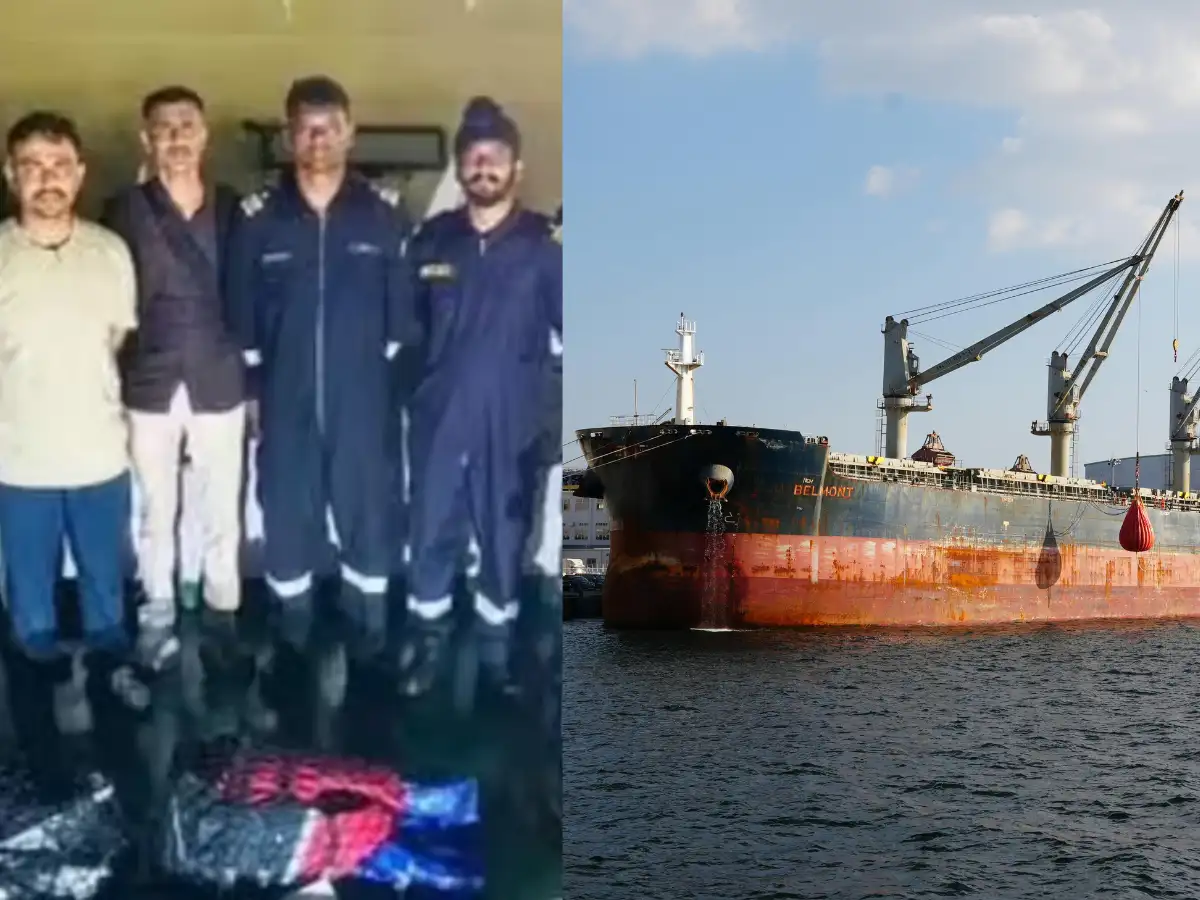
A major maritime drug trafficking case has emerged after Gujarat Anti-Terrorist Squad (ATS) and the Indian Coast Guard intercepted the cargo vessel MV Europe near Mundra port, seizing around 115 kg of cocaine valued at nearly Rs 1,150 crore. Officials say the ship followed an unusually long and complex international route spanning multiple continents before reaching Indian waters, making it one of the largest sea-based narcotics operations detected in the region.
Massive drug haul near Mundra port: what happened?
The interception took place during a coordinated operation between May 25 and 26, when security agencies moved in on the vessel anchored near Mundra. As teams closed in, some crew members allegedly attempted to destroy evidence by throwing packets of cocaine into the sea. Authorities managed to recover five bags containing multiple packets of the drug.
According to a report cited by TOI, ATS officials confirmed that the total seizure stood at 115 kg of cocaine, with investigators now probing whether additional quantities were discarded or lost at sea during the operation.
196-day voyage: how MV Europe moved from South America to India
Investigations have revealed that MV Europe spent nearly 196 days at sea and made around 40 recorded stops across 23 ports in seven countries. The ship’s journey began in South America, with its first documented stop in Sao Vicente, Brazil, on 11 November 2025.
From there, the vessel travelled through multiple ports in Brazil, Argentina, and Uruguay before passing through the Panama Canal. It later continued across the Caribbean and North Atlantic, stopping at locations including the Bahamas, the Dominican Republic, and several ports along the United States’ eastern coastline.
Officials told TOI that the ship repeatedly returned to certain ports, particularly in Brazil, Panama, and the US, suggesting a carefully coordinated and possibly layered smuggling network operating across jurisdictions.
How did ATS and Coast Guard track and intercept the vessel?
Security agencies had reportedly received intelligence inputs as early as May last year, indicating that a large cocaine consignment was being prepared for shipment through international sea routes. The vessel was under surveillance as it moved closer to Indian waters.
The ship eventually reached Jawaharlal Nehru Port near Mumbai on May 19 before proceeding to Pakistan’s Port Qasim on May 22 and finally anchoring near Mundra on May 26.
A senior ATS officer told TOI that continuous surveillance by Indian agencies disrupted plans for transferring the narcotics to another vessel at the outer anchorage, which was expected to complete the onward movement of the contraband.
Where was the cocaine hidden and how was it moved?
According to ATS officials quoted by TOI, the cocaine originated in Brazil and was concealed inside the vessel’s motor room for several months. As the ship travelled across continents, the cargo remained hidden while it moved through multiple international waters.
Investigators believe the drug was intended to be transferred to another boat at sea before being moved inland. Agencies are also probing whether India was the final destination or merely a transit hub in a wider distribution chain.
One ATS officer told TOI that the seized consignment may have been part of a larger global smuggling network, where narcotics are broken into smaller consignments and routed through different channels, including air cargo, for further distribution.
Missing packet and crew link: what is being investigated now?
The probe has now expanded to examine irregularities during the voyage, including reports that one packet of the contraband may have been sold en route by crew members. Sources quoted by TOI said such practices are sometimes used by smugglers to earn quick money during long international voyages.
Authorities are also tracking possible financial trails linked to the suspected sale and investigating whether additional packets were discarded during the interception attempt.
With multiple international stops, a long concealed route, and suspected coordination across continents, officials say the MV Europe case could reveal a wider maritime drug trafficking network operating across South America, Europe-linked shipping corridors, and South Asia.