Get all your news in one place.
100's of premium titles.
One app.
Start reading
Tom’s Guide
Tom’s Guide
Technology
Jason England

'136 grams is not for all-day wearing' — Even Realities CTO sounds off on Snap Specs, and gives details on the future roadmap

Even Realities G2 & Snap Specs.

In a world of AI glasses and VR headsets, Snap Specs are an ambitious (and chunky) meeting point of the two technologies — aiming to bring a generational leap in spatial computing.

But as you well know, everybody has their own ideas of what this new form of wearable will be, and in the eyes of Even Realities CTO, Jian Ouyang, it’s a different, simpler, ambient computing platform that focuses on making sure the glasses look good first.

The company’s G2 glasses have been my daily driver for a few months now, so when I got the time to sit down with him and Developer Relations head, Raag Harshavat, I wanted to get their thoughts on Snap’s radical rethink of smart glasses and also ask how things are going with the team gearing up for Even Realities G3.

Editor's note: This interview has been edited for brevity and clarity.

“Forget the smart part of it, right?”

(Image credit: Future)

So I started by asking him about the biggest news coming out of AWE 2026: Evan’s big Snap Specs debut. “I think from the first look, people can tell we’re [Even Realities] a different category, right? So 132 and 136 grams are not for all-day wearing,” Ouyang commented.

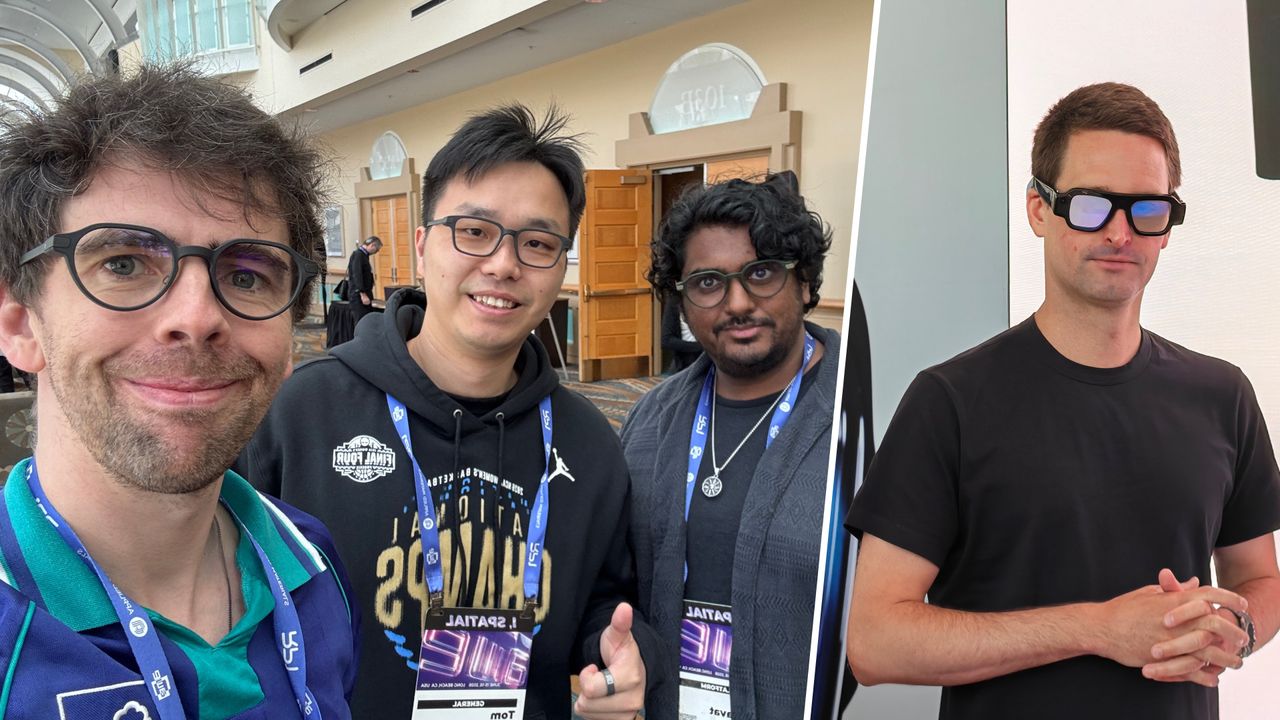
“We did strong ergonomic R&D research from the beginning to see what’s the good form factor for normal glasses to be worn all day — that answer is below 40 grams.” And to be fair to him, you can see signs of this in one of the pictures I took that’s been going viral across different accounts.

(Image credit: Future)

You know this one, right? Where Evan's left ear looks like it's getting crushed a bit by the downward pressure of those stems. Snap's CEO has responded to this image circulating, saying "that's what my ear looks like."

With this looks-first mission, Even Realities took a very different route. “We killed the camera feature, the speaker, and we maintained the display and voice input with all the microphones to get us the right weight,” Ouyang added. “We’re not trying to replace a cell phone because we need to leverage the computational resources and services.”

This was getting interesting, so I dug a little deeper with them — asking about the differences in DNA that make up each of these devices and their companies. “So much of the DNA of Even Realities is what makes eyewear special first. Forget the smart part of it, right?” Harshavat commented. “I think so much about the session-based use vs the quiet tech philosophy that we use…being with someone in moments that they both expect and don’t expect.”

(Image credit: Future / Tom's Guide)

In this, he’s referring to what Ouyang will go on to call ambient computing. This is the idea that a device fades into the background — only to come to life in ways you expect and with features that surprise you in their usefulness (Conversate on Even Realities G2 for example).

It’s a huge, far more simplistic differentiator compared to Snap’s big idea, and Jian is aware of that. “They might think 'one day I’m going to replace it' [the smartphone]. I don’t think it's right or wrong. It’s just up to the user to decide — either I’m going to wear this [pointing to his G2s] all day, or I’m just going to wear this for like 30 minutes for fun. It’s a different application.”

The plan for Even Realities G3

(Image credit: Future)

Then we got to the future of Even Realities’ own glasses. I know they won’t spill all the beans on future hardware like the G3, but I can get a bit of a flavor as to where their heads are.

“I think the overall hardware road map for us is to maintain a good form factor and constantly push for new technologies to get into our platform,” Ouyang responded. “As battery and hardware technology evolves, everything gets smaller, and we may be able to squeeze more features in there.”

With that tantalizing opener, I moved in to ask about the possibility of a camera built-in for more multimodality in the AI, and it’s not seeming likely. Fun fact: Even Realities CTO used to be one of the camera engineers on the iPhone — he knows a thing or two about the power consumption of packing a snapper! And he cautioned that while a camera is something they are “chasing,” they cautioned that getting to the point of one without massive power consumption “might take years.”

(Image credit: Future)

Instead, he talked about the kind of experience he wants to bring with G3 and beyond: your own “personal Jarvis” in agentic AI. “What we foresee is a more open system based on AI with a hardware platform that everything routes through,” Ouyang contemplated.

“This [points to glasses] is the nearest to your eyes and they can hear you, but there won’t be any kind of app. You don’t have to click on something or type in the worlds — all you need to do is imagine like you have your personal Jarvis buying something online, booking tickets and more.”

Outlook

(Image credit: Future)

For years, I always thought that the first real goal to achieve for smart glasses will be taking the computing prowess of a VR headset and smashing it down to something the size of glasses. In reality, that goal has changed drastically over many different interpretations.

Some (like Even Realities) believe in the quiet tech revolution — ambient computing that truly fades into the background — and whoever is right will be up to you when that future comes.

More from Tom's Guide

Sign up to read this article
Read news from 100's of titles, curated specifically for you.
Already a member? Sign in here
Related Stories
Top stories on inkl right now
One subscription that gives you access to news from hundreds of sites
Already a member? Sign in here
Our Picks
Fourteen days free
Download the app
One app. One membership.
100+ trusted global sources.