
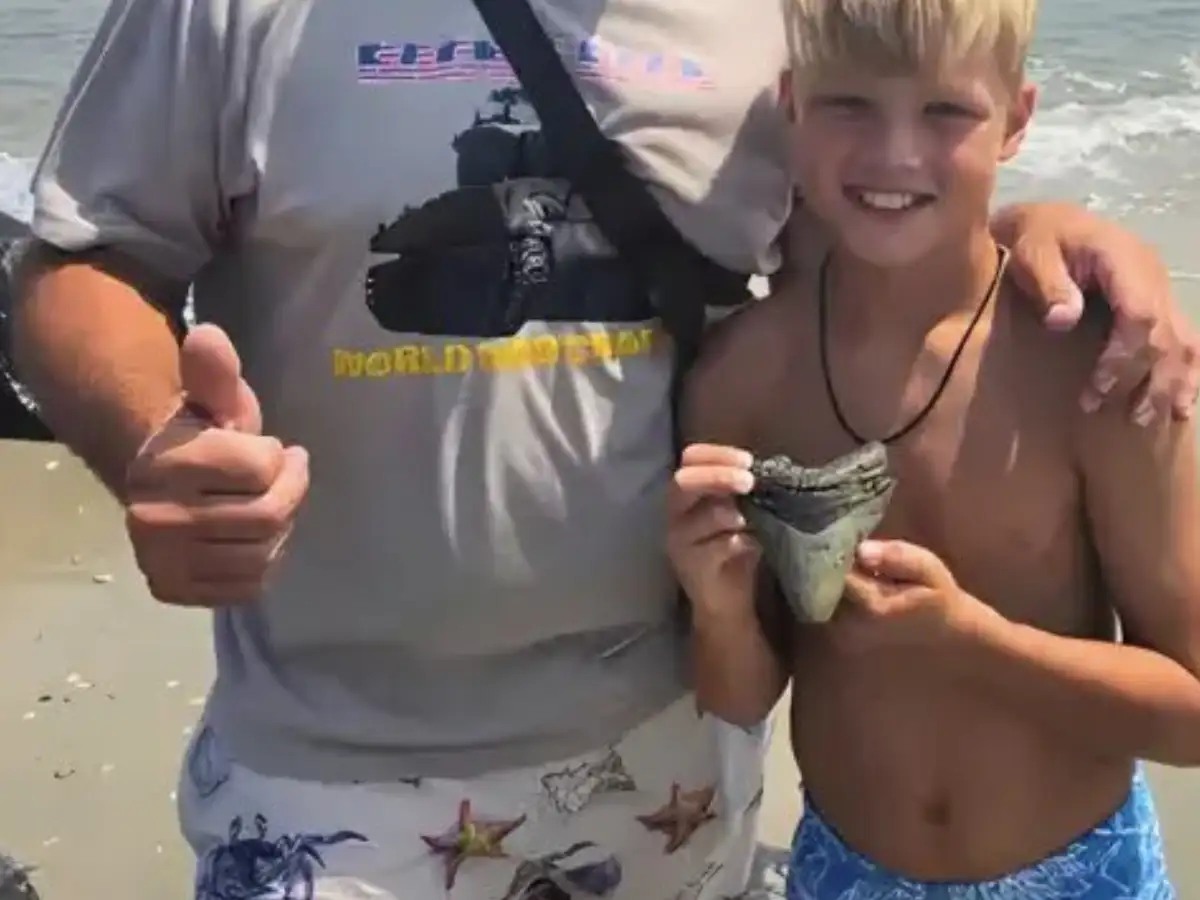
An 11-year-old boy searching for seashells with his father on a New Jersey beach made an extraordinary discovery: a massive megalodon tooth that is millions of years old and only the sixth such fossil recorded on a New Jersey beach.
Bo Bowers found the tooth on August 11 in Sea Isle City after his father, Mike Bowers, spotted something wedged between rocks near the Townsend Inlet. Mike could not reach the object with his larger hand, so he called his son over.
Bo was initially hesitant to reach into the rocks, but grabbed the object after seeing what it was. The tooth was roughly the length of his hand.
Also Read: Father leaves tired 7-year-old son all alone on Mount Fuji
The Pennsylvania family was vacationing in Wildwood when an overcast day prompted them to visit Sea Isle City. The family had been looking for seashells when they unexpectedly came across the prehistoric fossil.
An unexpected discovery
Bo, who enjoys searching for shark teeth, was surprised to learn that his find was millions of years old.
His father said the family "definitely did not expect to find something of that stature."
The family later stopped at the New Jersey State Museum while returning home to western Pennsylvania. An official took them to the museum's fossil lab and examined the tooth.
The official confirmed that it was "100% is a true megalodon tooth."
Dana Ehret of the New Jersey State Museum also confirmed the fossil's authenticity to Fox News Digital.
Ehret said only five megalodon teeth had previously been recorded as being found on New Jersey beaches, making the Bowers family's discovery the sixth.
Why the tooth is so rare
Megalodon teeth are relatively uncommon finds in New Jersey because the state does not have the right-aged sediments preserved at or near the surface, according to Ehret.
He said the Bowers tooth was in "extraordinary good condition for a tooth from New Jersey."
Teeth found in the state are typically substantially worn after spending long periods in the water. Ehret said the newly discovered tooth reminded him of fossils found in North Carolina, where megalodon teeth are much more common.
Megalodon, scientifically known as Otodus megalodon , was the largest predatory shark known to have lived. The species went extinct around 3.6 to 4 million years ago, with some estimates suggesting the largest individuals may have reached roughly 60 feet in length.
Fossilized teeth are among the most common evidence left behind by the prehistoric predator.
For the Bowers family, however, the tooth is more than a fossil. They were allowed to keep it because they found it on a public beach, turning an ordinary family beach trip into a vacation they are unlikely to forget.
The discovery also adds to a growing list of unusual prehistoric finds made by children. Earlier this year, an 11-year-old boy in England discovered a roughly 1.8-million-year-old tooth belonging to an extinct relative of modern elephants while visiting a beach. In Israel, an 8-year-old boy found part of a 1,700-year-old Roman statuette and took it to school for show-and-tell.
For Bo, a search for seashells led to something far older and far rarer: a tooth from one of the most enormous predators ever to swim Earth's oceans.


