Get all your news in one place.
100's of premium titles.
One app.
Start reading
The Economic Times
The Economic Times
Anshika Jain

₹1 crore accidental death claim rejected over alleged income inflation; here’s why wife won against insurer

Can an insurer just turn down a Rs 1-crore accidental death claim by saying that the policyholder lied about his income when he bought the policy?

The District Consumer Disputes Redressal Commission, Kurnool, has said no. The insurance company must prove that the income declaration was intentionally false, was a deliberate material misrepresentation and influenced the company’s decision to issue the policy.

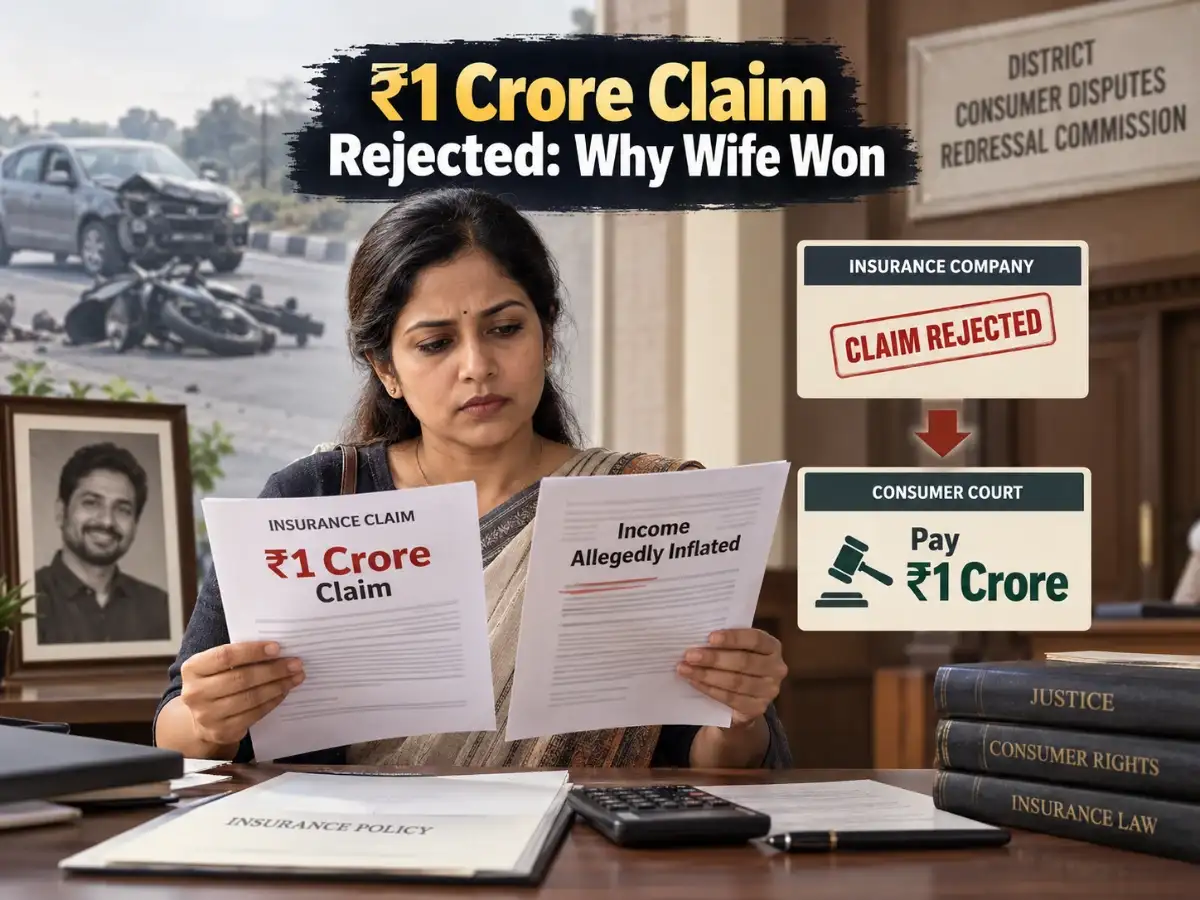
The commission directed HDFC ERGO General Insurance Company Ltd. to pay Rs 1 crore to the nominee of a policyholder who died in a road accident after the insurer repudiated the claim over alleged income inflation. Here’s why the consumer court ruled this way:

Also read: Life insurer rejected Rs 70 lakh death claim, but consumer commission ordered it to refund Rs 7 lakh premium despite a lapsed policy; here's why

Why did HDFC ERGO reject the Rs 1 crore claim?

The complainant’s husband had taken a Koti Suraksha Policy with a sum assured of Rs 1 crore. The policy commenced on March 13, 2024 and was valid until March 11, 2027. He paid an annual premium of Rs 30,365.

According to the terms of the policy, in the event of accidental death of the life assured, the nominee was entitled to the assured sum together with the applicable accidental death benefit.

On July 28, 2025, the complainant's husband was standing by the roadside when a mini truck allegedly hit him. He was taken to Government General Hospital, where he was declared dead. Police registered an FIR, conducted an investigation and later filed a charge sheet.

“The FIR, post-mortem report, inquest report, charge sheet and death certificate consistently established that this was an accidental death,” says Mayank Arora, Partner, The Chambers of Bharat Chugh.

His wife, the nominee under the policy, submitted the claim along with the required documents.

However the insurance company repudiated the claim not because it disputed the accident, but because it alleged that the deceased had inflated his income while obtaining the policy, explains Arora.

What did the insurer allege about the policyholder's income?

The insurer relied substantially on its investigation report and an alleged statement attributed to the deceased's son suggesting that the income of the deceased was increased so that the insured could qualify for the cover of 1 crore rupees.

The Commission scrutinised this alleged statement and said HDFC ERGO had not satisfactorily established that it amounted to a clear and unequivocal admission that the deceased deliberately inflated his income.

The insurer pointed to bank statements and a declaration allegedly provided by the policyholder's wife, claiming that these showed discrepancies in the income disclosed when the policy was purchased. It argued that this amounted to a breach of the principle of utmost good faith governing insurance contracts.

HDFC ERGO also relied on Clause 7 of Section C of the policy, which provided for forfeiture of benefits and premium where a claim involved fraud, a false statement or declaration, or fraudulent means or devices.

However, the Commission said invoking the fraud clause was not enough by itself. The insurer first had to establish the facts that would constitute fraud or a material false declaration. The court noted that the insurer could not invoke the forfeiture clause merely because its investigation raised suspicion about the deceased's income.

The complainant, however, disputed the allegation and submitted that the deceased owned a stone polishing factory, lorries and agricultural land and had sufficient financial resources and income to pay the policy premiums. She argued that the insurer had failed to produce credible evidence of deliberate income suppression.

Why did the consumer commission reject HDFC ERGO's argument?

“The Commission observed that the accident and consequent death of the insured were conclusively established through FIR, postmortem, inquest and death certificate records. The insurer’s defence of income suppression failed, as it did not discharge the burden of proving deliberate and material misrepresentation,” says Kavita Brid Chavan, Partner at Rajani Associates.

The insurer had to establish that the income figure was knowingly false or deliberately inflated and, crucially, that the alleged misrepresentation was material to the insurance contract.

The Commission identified several specific gaps in the insurer's evidence.

It found that HDFC ERGO had not satisfactorily established the deceased's actual income, the extent of the alleged inflation, or the precise underwriting consequence that would have followed if a different income had been disclosed by the deceased, says Arora.

Also read: Life insurer denied Rs 1 crore death claim over earlier policy postponement on medical grounds; here's why family wins in state commission

The insurance company was not able to establish whether the proposal would have been rejected or whether the sum insured would have been reduced if the income was not alleged misrepresented. The investigation report was also held insufficient by itself to prove fraud. An investigator's conclusion cannot substitute for proof of the underlying facts, he adds.

The Commission also noted that HDFC ERGO had not produced convincing contemporaneous evidence showing that documentary proof of income was required when the policy was underwritten or that the deceased had knowingly submitted a false document. It also did not establish that the alleged income discrepancy would necessarily have resulted in rejection of the proposal or materially changed the policy terms.

The Commission therefore drew an important distinction between an incorrect statement and a deliberate material misrepresentation. It held that repudiation of a Rs 1 crore claim could not rest merely on suspicion, inference or an investigator's conclusion.

ET Wealth Online has also approached HDFC Ergo General Insurance Company for its response and inputs on the matter. The insurer's response was awaited at the time of publication.

How much did HDFC ERGO have to pay?

The commission partly allowed the complaint and directed HDFC ERGO to pay:

  • Rs 1 crore towards the assured amount;
  • 9% annual interest from the date on which the complaint was filed, until realisation;
  • Rs 25,000 as compensation for mental agony; and
  • Rs 10,000 towards the cost of the complaint.

The amounts were directed to be paid within 45 days of receipt of the order. The order was pronounced on August 28, 2026.

What does this ruling mean for policyholders?

The ruling does not mean insurers cannot reject claims for material misrepresentation. It means the insurer must substantiate the allegation with credible evidence and show that the undisclosed or incorrect information was material to the insurance contract.

“Policyholders should therefore scrutinise whether repudiation rests on a demonstrable material breach or merely an investigator’s suspicion. Accurate disclosures remain essential, but a fraud clause cannot substitute for proof of fraud,” says Supriya Majumdar, Partner, Elarra Law Offices

This case concerned a personal accident insurance benefit, not an ordinary health insurance reimbursement claim. However, the reasoning on disclosure, materiality and repudiation has wider relevance to insurance disputes, including health insurance, wherever an insurer seeks to reject a claim on the basis of alleged incorrect information in the proposal form.

The key lesson is that policyholders must answer proposal-form questions carefully and accurately. The doctrine of utmost good faith remains important, and deliberate concealment of a genuinely material fact can still provide a valid basis for repudiation to the insurance companies if they are able to prove so, explains Arora.

Sign up to read this article
Read news from 100's of titles, curated specifically for you.
Already a member? Sign in here
Related Stories
Top stories on inkl right now
One subscription that gives you access to news from hundreds of sites
Already a member? Sign in here
Our Picks
Fourteen days free
Download the app
One app. One membership.
100+ trusted global sources.