In a letter dated March 6, 1943, about 1,500 residents of Hanford, White Bluffs and the Priest Rapids Valley in southeastern Washington were informed in writing that their property had been requisitioned by the U.S. government under wartime powers and that they were to vacate within 30 days, giving up homes, farms and orchards built and maintained by generations of their families; evictions for some farms near the edge of the site were deferred until after the fall harvest, according to reporting by the Hanford History Project and the National Park Service, whose account of the displacement also details the evacuation schedule. The valley had been chosen months earlier as the site for the world's first plutonium production plant, part of the Manhattan Project's military effort, a history documented in U.S. Department of Energy records on Hanford and the Manhattan Project.
670 square miles acquired but no right of return

In contrast to other land takings during the war where there was an implicit guarantee of the land being returned eventually, Hanford's displacement did not include any such promise from the start. Oral histories gathered by Washington State University's Hanford History Project explain how security concerns of the Manhattan Project ensured that displaced people would never be able to return, neither when the war came to its end nor after they learned about the size of the facility, as recounted in interviews summarized in the project’s book ‘Nowhere to Remember: Hanford, White Bluffs, and Richland to 1943’. Farmers were not even allowed to stay long enough to harvest their crops; in despair, some cut down their own orchards rather than let the government take them intact.
By the end of January 1943, the government had acquired almost 430,000 acres (about 670 square miles in total) from around 2,000 property owners for the Hanford Site. Many lawsuits concerning the compensation for that land went on for several years thereafter and most of them ended with the court evaluating the value of the land much higher than the one proposed by the government initially. Yet none of those decisions restored the existence of towns that disappeared forever. Most buildings were destroyed using bulldozers and even White Bluffs Cemetery was removed and relocated to the neighboring city of Prosser. Currently, Pre-War Historic Sites Tours organized by the U.S. Department of Energy pass by several surviving structures, among which the ruins of Hanford High School and Bruggemann Ranch can be found, as seen on the National Park Service website about Hanford history.
The Hanford Site produced two-thirds of U.S. plutonium
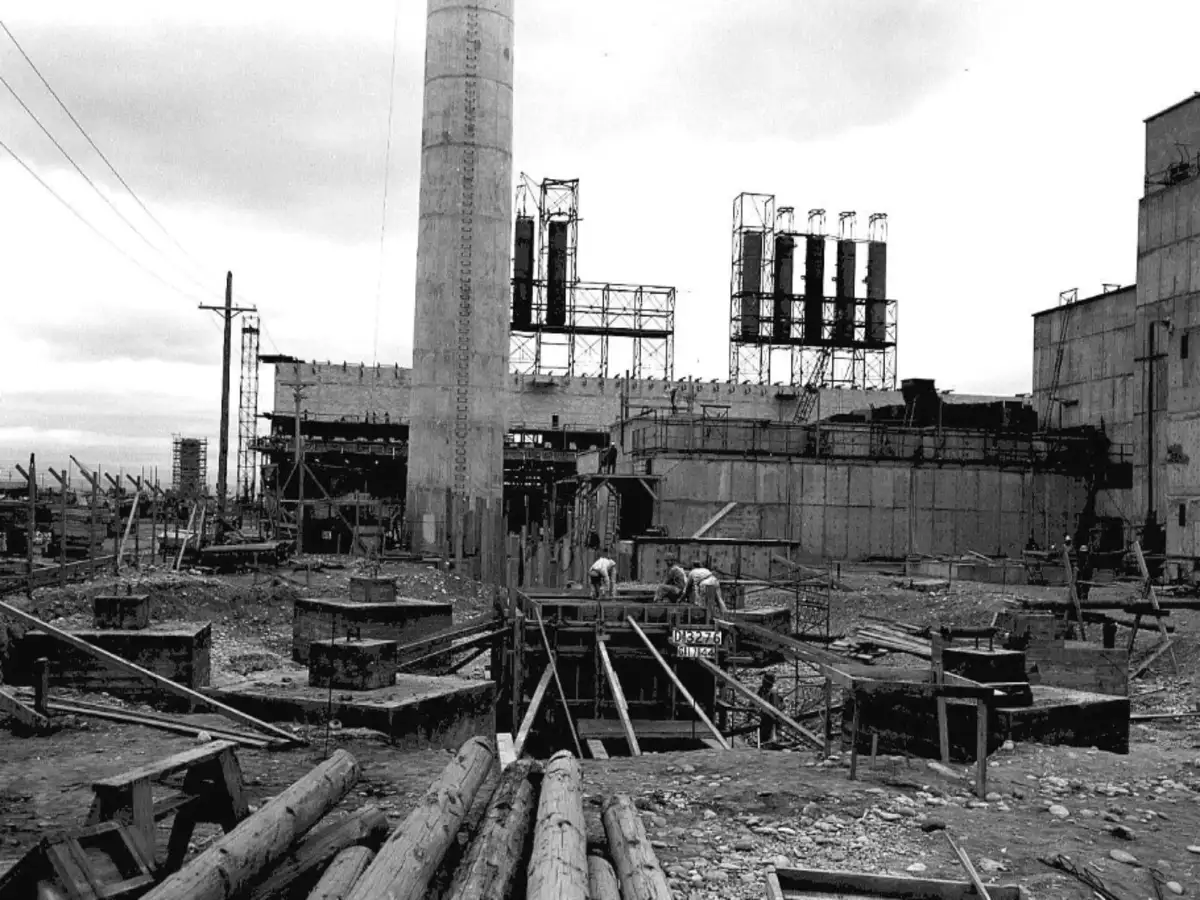
Instead of Hanford and White Bluffs there emerged the Hanford Engineer Works, later known as the Hanford Site, which would go on to produce almost two-thirds of the plutonium used by the United States in its nuclear weapons stockpile during both World War II and the Cold War period, including the plutonium used in the Nagasaki bombing, per the Department of Energy's own history of the site. Production would continue even decades after 1945, increasing instead of slowing down when the Cold War started, and the last of the major production facilities were decommissioned in the early 1990s.
177 tanks, 56 million gallons, three currently leaking
This volume of output left behind a waste disposal issue, which has now long outlasted the war itself. The Washington State Department of Ecology, which co-manages the site's remediation alongside the U.S. Department of Energy, puts the current count at 177 underground storage tanks holding approximately 56 million gallons of radioactive and hazardous chemical mixed waste from plutonium separation. The capacity of the tanks is 55,000 to more than a million gallons; the group includes 149 older single-shell tanks as well as 28 newer double-shell tanks built after 1968.