Get all your news in one place.
100's of premium titles.
One app.
Start reading
The Economic Times
The Economic Times
Maitreyee Thakkar

1,200-year-old coffins hanging from sheer cliffs reveal Asia’s mysterious sky graveyards, and the surprising reason separate ancient cultures chose to place their dead above the earth

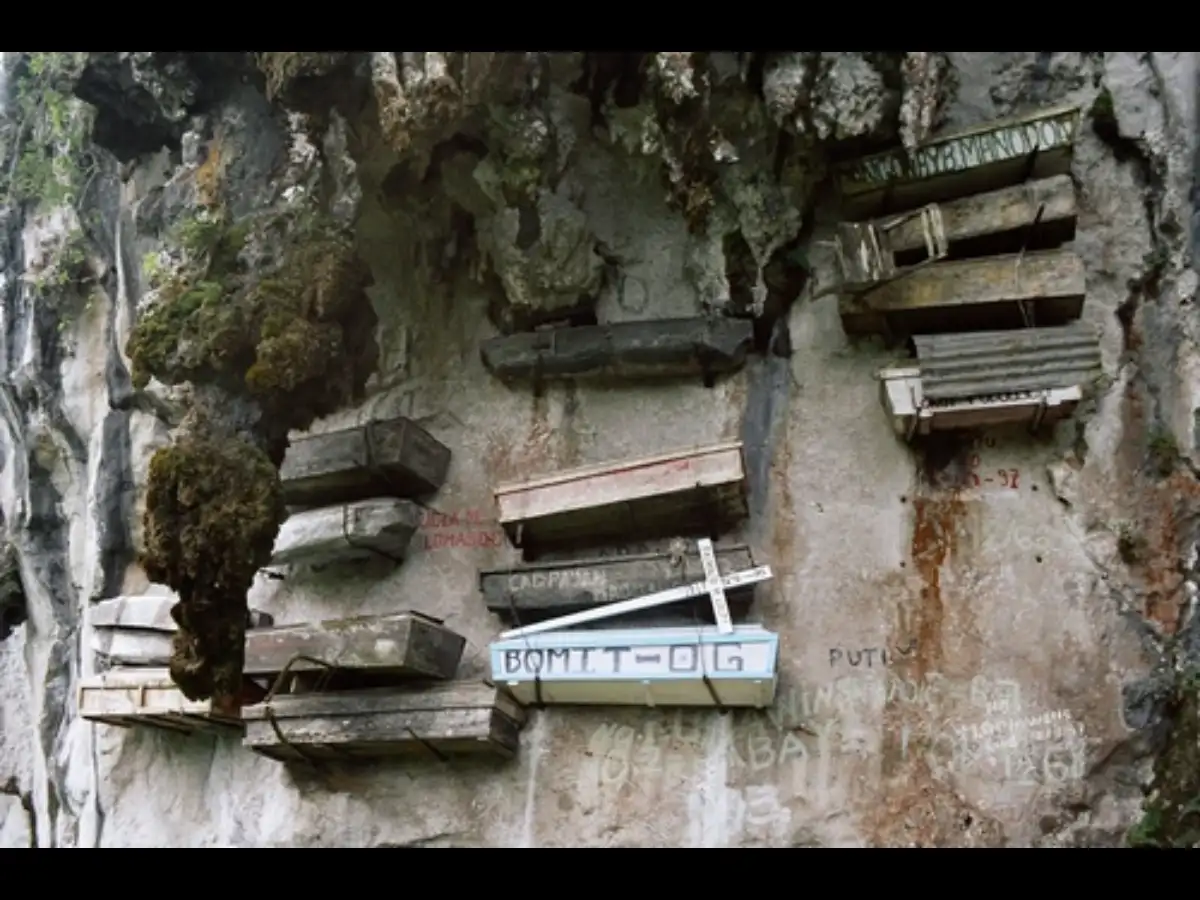
Imagine looking up at a nearly vertical limestone cliff and seeing wooden coffins wedged into the rock hundreds of feet above you. There is no cemetery below. No marked grave. Just weathered wooden caskets sitting on ledges, inside crevices or on beams fixed into the cliff face. These are hanging coffins, one of the most unusual burial traditions found across parts of East and Southeast Asia.

Far from being a single mysterious cemetery, the term describes a broad family of ancient funerary practices in which the dead were deliberately placed in elevated locations, cliffs, caves, rock shelters and natural fissures. Archaeologists have documented examples across southern China and into Southeast Asia.
What exactly is a hanging coffin?

The basic idea is surprisingly simple: instead of placing a coffin underground, communities put it somewhere high above the ground. But the methods varied.

Some coffins were fitted into natural or carved recesses in cliffs. Others were supported by wooden beams driven into holes in the rock. Archaeological evidence from Chinese sites suggests that at least some coffins were lowered from above, rather than hauled up the cliff face. The coffins themselves were generally made from wood, with some carved from large tree trunks.

What makes the Chinese examples particularly striking is their setting. They occur along rugged river valleys and mountainous landscapes in provinces including Yunnan, Sichuan, Guangxi, Fujian and surrounding regions, with archaeological surveys documenting hundreds of hanging coffins across more than 20 counties.

The tradition is far older than the surviving coffins suggest. A 2025 Nature Communications study notes that the earliest securely dated evidence comes from China's Wuyi Mountains, with radiocarbon dates reaching roughly 3,400 years ago.

One of the best-known traditions is associated with the Bo people, an ancient population who lived in parts of southwestern China. For generations, their dead were placed in wooden coffins positioned on steep rock faces. The practice continued for centuries, and archaeological evidence shows that China's hanging-coffin tradition lasted for more than a millennium, with many of the caskets dating to roughly 1,200 years ago.

Why put the dead so high?

Researchers have proposed several overlapping explanations. One possibility was protection. Raising bodies above the ground could have reduced exposure to animals, flooding and other forms of disturbance.

But practicality alone does not explain the extraordinary visibility of many burial sites. The cliffs also appear to have carried symbolic meaning. According to the Refractor report, elevated burial may have placed ancestors closer to the sky and mountains, reflecting spiritual ideas about the journey of the dead. The dramatic locations could also have functioned as visible markers of ancestry and territory.

In other words, the cliffs may have been simultaneously a cemetery, monument and landscape marker.

The tradition was not confined to China

A remarkably similar practice developed farther south. In northwestern Thailand, archaeologists have found enormous log coffins carved from single pieces of teak and placed inside caves and rock shelters. These belong to what archaeologists call the Log Coffin culture, with burials dating roughly from 300 BCE to 1000 CE.

The resemblance is striking: large wooden coffins, elevated or difficult-to-access locations and a deliberate separation of the dead from ordinary ground-level burials.

A 2020 study titled “A Matrilineal Genetic Perspective of Hanging Coffin Custom in Southern China and Northern Thailand,” by Xiaoming Zhang and colleagues, analysed mitochondrial genomes from 41 human remains recovered from 13 hanging-coffin sites in southern China and northern Thailand. The researchers found genetic connections between some of the populations and argued that the evidence was consistent with an origin in southern China followed by the spread of the tradition.

Then there is Sagada

The Philippines has its own famous version. Around Sagada in Mountain Province on northern Luzon, members of Indigenous Cordilleran communities, particularly the Kankanaey, historically placed wooden coffins in limestone caves, rock crevices and on cliff faces.

Unlike the ancient Chinese examples, some of these traditions survived into relatively recent times.

The National Museum of the Philippines notes that wooden-coffin burial was part of wider precolonial funerary traditions in the country, while the Sagada practice became particularly associated with elevated and cave burials.

The precise age of individual Sagada hanging coffins is less certain than the radiocarbon-dated Chinese and Thai archaeological material.

Sign up to read this article
Read news from 100's of titles, curated specifically for you.
Already a member? Sign in here
Related Stories
Top stories on inkl right now
One subscription that gives you access to news from hundreds of sites
Already a member? Sign in here
Our Picks
Fourteen days free
Download the app
One app. One membership.
100+ trusted global sources.