Get all your news in one place.
100's of premium titles.
One app.
Start reading
The Times of India
The Times of India
World

1,000 year old Viking textile hub unearthed in Denmark, revealing an advanced Norse society

Archaeologists have uncovered a vast Viking Age textile production site in Denmark, offering new insight into the scale and organisation of a society often remembered mainly for its warriors and seafarers. According to an Associated Press (AP) report, the discovery is being seen as evidence of a sophisticated production economy that existed alongside Viking expansion, trade and exploration.

Get breaking news anytime, anywhere. Download the TOI app now!

Located in Soften, around 10 km north of Denmark’s second-largest city Aarhus on the Jutland peninsula, the site covers nearly 100,000 square metres and dates back to the late Iron Age and early Viking Age, between AD 600 and 950, AP reported.

Researchers from the Moesgaard Museum said the excavation revealed more than 80 pit houses — partially sunken structures that served as workshops and living spaces — along with dedicated areas for processing flax, the plant used to make linen textiles. The scale of the settlement suggests that textile-making was not a small household activity but a specialised form of production carried out across a dedicated area, according to findings shared by the museum.

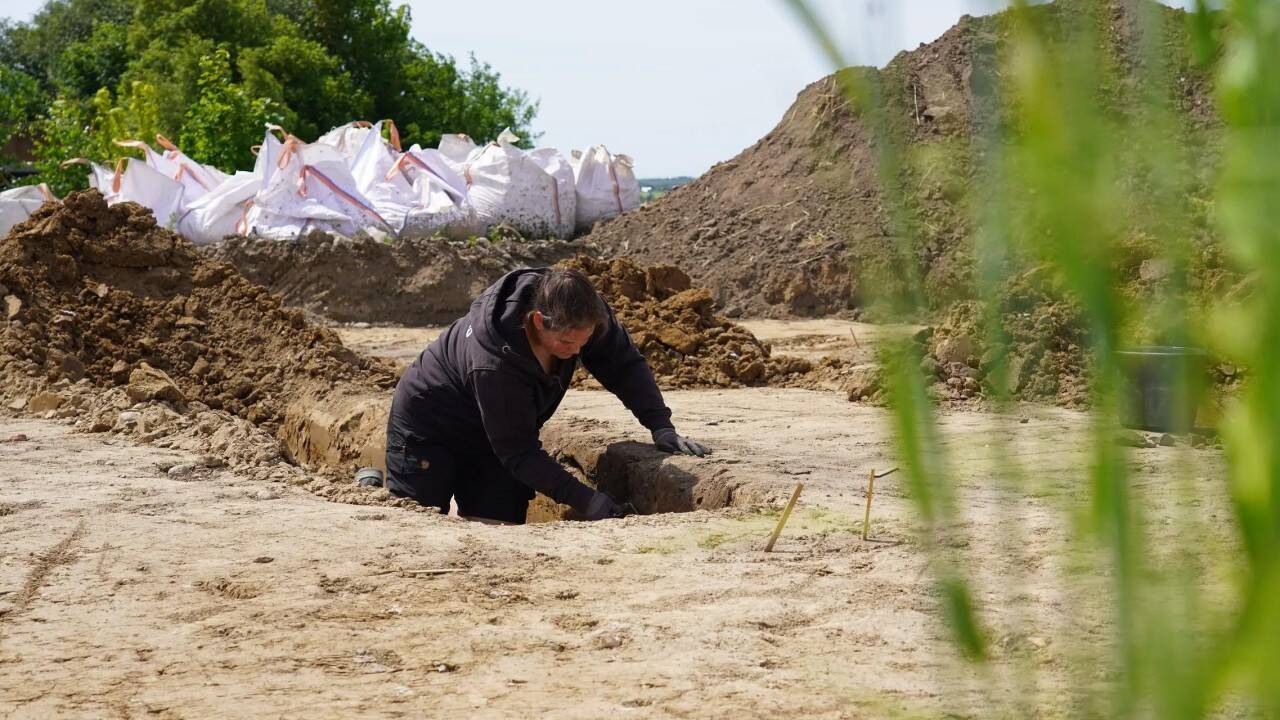
Archaeologist Liv Stidsing Reher-Langberg, who led the 10-month excavation, told AP that the discovery stands apart from other settlements of the period because of its strong connection to textile production.

“We have a clear focus on textile production, which makes this settlement different from other kinds of settlements of this period,” she said.

Archaeologists found spindle whorls and loom weights among the remains, indicating that spinning and weaving were carried out extensively at the site. Other discoveries included silver coins, glass beads and pottery, pointing to wider economic and cultural connections. The presence of trade-related objects also suggests that the settlement was connected to broader exchange networks rather than operating only for local needs.

The layout of the settlement also suggests a structured production system. Separate zones for crafts and manufacturing, along with a larger residential building, indicate that activities may have been supervised by a powerful individual or elite group that controlled resources and production. Researchers believe this arrangement points towards a level of planning and organisation that required control over labour, raw materials and distribution.

The discovery came after years of interest in the area. Over the past three decades, metal detectorists had recovered several silver coins from the region. A trial excavation conducted about 18 months ago, ahead of construction of a new road and industrial area, revealed traces of a much larger settlement.

“We could see in the trenches that it just keeps on going, with these houses and pit houses and textile production features,” Reher-Langberg said.

Moesgaard Museum historian Kasper Andersen said, as quoted by AP, that the site provides another important clue to understanding the economic, cultural and political networks of the Viking Age. He described the discovery as “another piece in the puzzle” in understanding how communities in the region were organised during the period.

During the period, the nearby settlement of Aarhus (then known as Aros) served as a centre for royalty and international trade. Archaeologists last year also discovered another Viking site in Lisbjerg, about 4 km away, believed to have links to the nobility.

Andersen told AP that resources and goods produced at settlements like Soften were likely moved into larger trade networks connecting the region with distant markets. The discovery suggests that rural settlements played a key role in supplying goods that eventually entered wider Viking trading routes across Europe.

“When you have a production site of this scale, it cannot be only because of the local area. It needs to be understood as part of a greater network, a much bigger international perspective,” he said.

Further carbon dating and pollen analysis may help researchers determine the exact nature of textile production at the site, including the types of materials used and how the industry developed. Scientists hope these studies will reveal more about the crops grown in the area, the resources used for textile-making and the timeline of activity at the settlement.

The Viking Age, generally dated from AD 793 to 1066, saw Norse communities expand through Europe and beyond through raiding, trade, exploration and settlement. Archaeologists said, according to AP, that the Soften discovery challenges the image of Vikings as only raiders and warriors. Instead, it highlights their role as skilled craftsmen, traders and participants in complex economic systems.

“To have a place like Soften, you need a very well-organised society with a production line, and you also need a market to have the production,” Andersen said. “The textiles from Soften go into a market that’s much bigger than just the local area.”

Sign up to read this article
Read news from 100's of titles, curated specifically for you.
Already a member? Sign in here
Related Stories
Top stories on inkl right now
One subscription that gives you access to news from hundreds of sites
Already a member? Sign in here
Our Picks
Fourteen days free
Download the app
One app. One membership.
100+ trusted global sources.