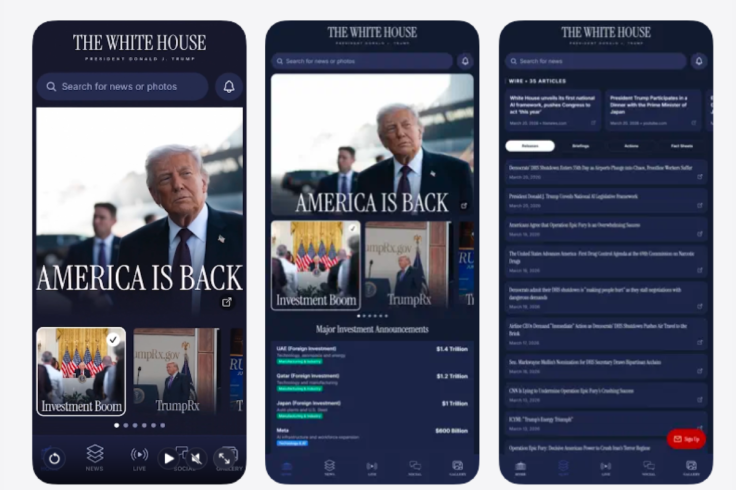
A White House-branded mobile application is facing fresh scrutiny amid claims that it may transmit user location data via a third-party system whose infrastructure extends beyond the United States. What might once have been viewed as a routine piece of political tech has instead prompted a wider debate over how closely government-linked apps should be watched for potential privacy risks.
The controversy centres on code-level findings circulated online, which suggest that the app integrates with OneSignal, a widely used push-notification service. Developers and privacy observers have raised concerns that the system could enable frequent data synchronisation, potentially including location signals. Officials have not publicly confirmed the extent of data collection, but the issue has sparked wider questions about transparency and user privacy.
Third-Party Integration Raises Technical Questions
OneSignal, a US-based customer engagement platform, provides tools that allow developers to send push notifications, track engagement metrics and manage user sessions. According to its official documentation, the service can collect device-level data such as IP address, device identifiers and app-usage statistics.
In its privacy policy, OneSignal states that it may process data through servers located in multiple jurisdictions, including outside the United States. The company notes that 'information may be transferred to, and maintained on, computers located outside of your state, province, country, or other governmental jurisdiction' (OneSignal Privacy Policy).
Developers analysing the White House app have pointed to embedded OneSignal software development kits (SDKs), which are commonly used in mobile applications. These SDKs can, depending on configuration, access device-level signals such as approximate location derived from IP data.
The viral claims referenced in an online post on X (formerly Twitter) allege that the app 'tracks users every 4.5 minutes'. However, no publicly available technical audit has confirmed that precise GPS coordinates are collected or transmitted at that frequency.
‼️🇺🇸: NEW White House app post has been Community Noted because it TRACKS USERS PRECISE LOCATION EVERY 4.5 MINUTES 👀
— Diligent Denizen 🇺🇸 (@DiligentDenizen) March 30, 2026
On top of that, the 3rd-party company the White House app uses OneSignal has MOST OF ITS DATA CENTERS OUTSIDE OF THE US. 🤨 pic.twitter.com/Cp6qh1M2Ac
'No Filter' Claims And Transparency Concerns
The application has been marketed with messaging suggesting direct, unfiltered communication between the White House and users. Critics argue that such claims could be misleading if third-party intermediaries are involved in handling user data.
Privacy advocates note that the use of external platforms such as OneSignal is standard industry practice. However, they emphasise that transparency is critical when applications handle potentially sensitive data, including location-related signals.
'Users should be clearly informed not just that data is collected, but how often, what type, and where it is processed,' said a mobile security researcher in a published analysis on GitHub examining similar SDK integrations.
The White House has not released a detailed technical breakdown of the app's data flows. Without such disclosure, experts say it is difficult to determine whether the system collects precise GPS data, coarse location data or no location data at all.
The distinction is significant. Precise GPS tracking involves continuous or periodic access to device sensors, while IP-based location tracking typically provides only general geographic estimates.
Data Transfers And Overseas Infrastructure
OneSignal's infrastructure relies on cloud-based hosting, including services provided by major global providers such as Amazon Web Services. According to AWS documentation, data may be processed in multiple regions depending on configuration and redundancy requirements.
This means that even if an application is developed in the United States, associated data may be routed through or stored in overseas data centres. Such practices are common in global cloud computing but can raise regulatory and privacy concerns.
Under frameworks such as the EU–US Data Privacy Framework, companies transferring data across borders must meet specific safeguards. While the White House app is not subject to EU regulation unless used by European residents, the broader principle of cross-border data flows remains relevant.
Cybersecurity analysts caution that the presence of overseas servers does not, by itself, indicate improper data handling. However, they stress that users should be informed when their data may leave their home jurisdiction.
🇺🇸 🚀 LAUNCHED: THE WHITE HOUSE APP
— The White House (@WhiteHouse) March 27, 2026
Live streams. Real-time updates. Straight from the source, no filter.
The conversation everyone’s watching is now at your fingertips.
Download here ⬇️
📲 App Store: https://t.co/VC8lwiyO0G
📲 Google Play Store: https://t.co/zFjVcveGOV pic.twitter.com/xxaaSr1irC
What The Evidence Shows — And What It Does Not
The claims circulating online rely heavily on interpretations of application code and network behaviour. While these findings suggest that the app integrates with OneSignal, they do not conclusively demonstrate that continuous GPS tracking is taking place.
OneSignal's own technical documentation indicates that location-tracking features must be explicitly enabled by developers and typically require user permission at the operating-system level. Both Apple's iOS and Google's Android platforms enforce strict controls over GPS access.
Apple's App Store Review Guidelines state that apps must obtain 'explicit user consent' before collecting location data. Similarly, Android's developer policies require clear disclosure and permission prompts for location tracking.
As of 01 April 2026, no official statement from the White House has confirmed whether the app collects precise location data or how frequently any data is transmitted.
The absence of definitive evidence has led some experts to caution against overstating the claims, while still acknowledging that the questions raised are valid and warrant clarification.
URGENT: Do Not Download the New White House App:
— Brian Krassenstein (@krassenstein) March 28, 2026
The app has the tools to access your precise location in the background every few minutes. They literally can track you.
It defines:
Android location permissions:
ACCESS_FINE_LOCATION (precise GPS)
ACCESS_COARSE_LOCATION… pic.twitter.com/FiK3Bi8cZx
Growing Scrutiny Of Government-Linked Apps
The controversy reflects a broader trend of increased scrutiny over government-affiliated digital tools and their data practices. In recent years, both public- and private-sector apps have faced criticism over the use of third-party analytics and messaging platforms.
Security researchers have repeatedly warned that even standard integrations can introduce privacy risks if not properly configured. These risks include unintended data exposure, insufficient user-consent mechanisms and unclear data-retention policies.
In this case, the combination of 'No Filter' messaging and third-party infrastructure has heightened public concern. Experts say that clear communication from developers and officials will be essential in addressing those concerns.
The questions surrounding the White House app highlight the growing tension between digital engagement tools and public expectations of transparency in how user data is handled.