Members of the US supreme court peppered lawyers for the former Monsanto Company with a barrage of questions over pesticide regulation on Monday, wrestling over whether federal law preempts state actions that permit consumers to sue companies for failing to warn of product risks such as cancer.
The case, Monsanto v Durnell, centers on glyphosate – a weedkilling chemical used in the popular Roundup brand and numerous other herbicide products sold by the former Monsanto company, which is now owned by Germany’s Bayer.
The chemical has been scientifically linked to cancer in multiple studies, and was classified a probable human carcinogen by an arm of the World Health Organization in 2015.
Bayer, has spent the last decade fighting more than 100,000 lawsuits by people who developed non-Hodgkin lymphoma they blame on exposure to Monsanto’s glyphosate weed killers. The company has paid out billions of dollars in jury awards and settlements.
In the Durnell case, as well as many others that have gone to trial, the jury found that Monsanto had failed to warn the plaintiff that glyphosate could cause cancer.
While maintaining that its products don’t cause cancer, Monsanto is asking the supreme court to rule that under the Federal Insecticide, Fungicide, and Rodenticide Act (Fifra), it cannot be held liable for failing to warn of a cancer risk if the Environmental Protection Agency (EPA) has not found such a risk exists and not required such a warning. The EPA’s position is that glyphosate is “unlikely” to be carcinogenic.
If Monsanto prevails before the high court, it would make it harder for consumers to file such lawsuits, not just against Monsanto, but against other pesticide makers as well.
In arguing before the court, Paul Clement, a Monsanto attorney, told the justices that provisions within Fifra are “crystal clear” in barring pesticide makers from changing safety warnings on a pesticide label without EPA approval, and thus cannot be held liable for not issuing a cancer warning.
“Congress plainly wanted uniformity when it came to the safety warnings on a pesticide’s label,” Clement told the justices. “Ignoring Congress’ clear direction here would open the door for crippling liability and undermine the interests of farmers who depend on federally registered pesticides for their livelihood.”
Clement argued repeatedly that the EPA process of approving a pesticide is rigorous and that its position that glyphosate is not carcinogenic is supported by other regulatory agencies “around the globe”.
Also arguing in favor of Monsanto’s position was Sarah Harris, principal deputy solicitor general for the Department of Justice. Harris told the justices that states can’t try to “second guess or undermine” the EPA’s process.
In opposition to Monsanto, attorney Ashley Keller told the justices that “the United States is wrong” and said that Fifra does not provide the blanket authority claimed by Monsanto with “preemptive force”. He additionally told the justices that the EPA’s registration process has significant flaws and said that it has not updated its glyphosate registration review every 15 years as the law calls for. Things “slip through the cracks with that agency”, he said.
He also said that the EPA’s findings regarding human health and glyphosate were vacated by the ninth circuit court of appeals in 2022 for failing to follow established guidelines for determining cancer risk and ignoring important studies.
Sometimes interrupting mid-argument, the justices quizzed the attorneys on multiple fronts. Some pressed Monsanto’s lawyer on how labeling issues should be handled when new science showing harm arises in between EPA reviews, while others asked about the fairness of retroactively penalizing a company for a lack of a warning on a label approved by the EPA.
The court’s three liberal justices appeared skeptical of Monsanto’s argument, but it was less clear how the rest of the justices might rule.
“Both sides put on a good case,” said Daniel Hinkle, senior counsel for policy at the American Association for Justice, who attended the oral arguments. “I thought they asked some serious questions and were really grappling with the implications of the case.”
Bayer has said a favorable supreme court ruling will help it put an end to the litigation. Bayer issued a statement after the supreme court hearing expressing appreciation for the “court’s careful consideration of Fifra’s uniformity language and how its federal preemption provision applies to state-based label warnings”.
“We believe the US government and the company made persuasive arguments that state-based warning claims ‘in addition to or different from’ warning labels approved by EPA under FIFRA, as in Durnell, are preempted, and this is necessary to avoid a patchwork of 50 different warning labels,” the company said. “Companies should not be punished under state law for complying with federal label requirements. The security and affordability of the nation’s food supply depend on farmers’ and manufacturers’ ability to rely on the science-based judgments of federal regulators.”
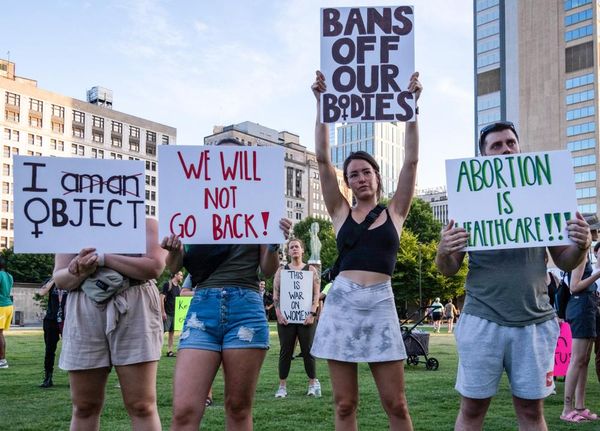
Both before and during the hearing, protesters affiliated with the Maha movement rallied outside the court to protest against the Trump administration’s support for Monsanto, citing the solicitor general’s backing of Monsanto’s position as well as Trump’s recent executive order declaring protection of glyphosate production a national security issue. Some shouted “people over poison” and others waved signs with slogans such as “Roundup the guilty” and “Make Monsanto pay”.
“It’s crucial right now to show up and let not just the supreme court know but also our legislative branch and our executive branch that we will not stand for being poisoned … any more. These companies must have accountability and it starts today,” said Zen Honeycutt, founder of Moms Across America and a Maha leader.
Alexandra Munoz, an independent toxicologist, was also marching with the protesters. “I’ve read the literature on glyphosate and it is definitely a carcinogen. The evidence is really clear.”
Chellie Pingree, a Democratic US representative from Maine, was among multiple lawmakers joining the rally. “These are issues I’ve been fighting on for a very long time,” Pingree told the Guardian. “To have an actual rally in front of the supreme court, to have so many people show up from all over the country and to have so many Republicans and Democrats who are united about keeping poisons out of our food, out of our environment, out of our agriculture system, it’s a big day.”
A ruling is expected this summer.
The supreme court hearing comes as the US House of Representatives rules committee takes up the new Farm Bill, formally known as HR 7567, the Farm, Food and National Security Act of 2026.
Pingree and Thomas Massie, a Republican representative from Kentucky, last week announced an amendment to the Farm Bill that would remove provisions to shield chemical manufacturers like Bayer from lawsuits and “preempt state and local warning label laws or usage regulations for potentially harmful products”.
This story is co-published with the New Lede, a journalism project of the Environmental Working Group