Fifa’s willingness to bow to the wishes of Donald Trump by lifting the suspension of USA striker Folarin Balogun from the host’s last-16 World Cup tie against Belgium was strongly criticised on Monday, with European politicians, football associations and governing body Uefa condemning the decision.
In an unprecedented intervention in the middle of a tournament, Uefa accused Fifa of crossing “a red line” by making an “incomprehensible and unjustifiable” decision to rescind Balogun’s automatic one-match ban, which it claimed undermined “the integrity of the game and the credibility of the competition”.
As reported by the Guardian on Sunday, Trump repeatedly lobbied for Balogun’s suspension to be lifted, with sources disclosing that the US president made three calls to Fifa urging an intervention after the 25-year-old was sent off in the USA’s last-32 win over Bosnia and Herzegovina last Wednesday. The New York Times has reported that lawyers who have previously worked for Trump were engaged by US Soccer to challenge Fifa’s disciplinary regulations, with their correspondence said to invoke the rights of the United States as a nation and threaten a further appeal to the court of arbitration for sports (Cas).
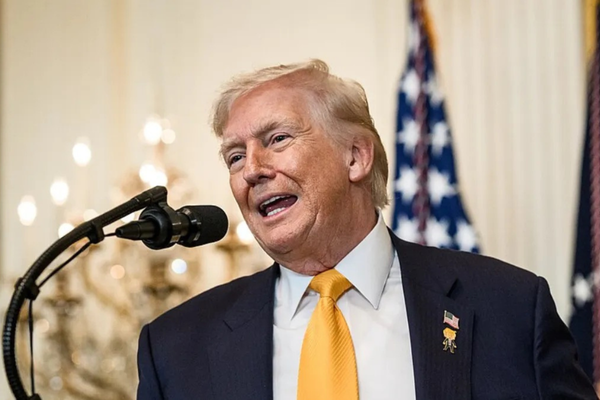
Trump confirmed on Monday his involvement, telling a press conference at the Oval Office that “I asked for a review from Fifa” as “it wasn’t a foul”, adding: “All I did was ask for a review, I didn’t say you have to do this. That wasn’t even an infraction. That was two guys running full speed that happened to crash into each other.
“We’re going to have a full team, and Belgium is going to have a full team, and you know what? If they beat us, then they can be really proud. The other way, if they beat us ... I say it was rigged, just like the election was rigged in 2020.”
Fifa had previously said that US Soccer had no right of appeal, but announced on Sunday that Balogun’s ban had been lifted for a 12-month probationary period, another unprecedented decision during a tournament which was explained by a brief reference to Article 27 of Fifa’s disciplinary code, which gives its judicial committee the authority to “fully or partially suspend the implementation of a disciplinary measure.”
In a move that will reignite their long-simmering conflict with Fifa, Uefa claimed that the world governing body had ignored their own rulebook for political reasons. “Football, like any other sports, relies on rules, which are the basis for fair, honest and transparent competition,” read a statement. “Sometimes rules are open to interpretation. In this case not.
“A minimum automatic suspension of one match following a red card is not a discretionary option and does not require the decision of a competent body to be enacted. It is a principle embedded in regulations, which cannot be made subject to exceptions, let alone in the middle of a tournament where several other players have been in the same situation and regularly served their suspension.
“When the certainty of rules is no longer guaranteed by its guardians, the integrity of the game is at stake and the credibility of a competition is undermined. We express our disbelief at such an unprecedented, incomprehensible and unjustifiable decision.”
The Royal Belgian Football Association (RBFA) expressed its own “astonishment” at the decision, with national team manager Rudi Garcia comparing it to an April Fools’ Day joke. The RBFA has also received strong support from some of their European counterparts. The German Football Association (DFB) questioned whether the outcome was the result of political interference, and said that Fifa’s credibility was at stake. “The impression that there has been active political interference in sport must be dispelled swiftly and conclusively,” read a statement. “The integrity of the competition and the credibility of Fifa are at stake.”
The Football Association declined to comment when contacted by The Guardian, but England manager Thomas Tuchel criticised the decision following his side’s thrilling 3-2 win over Mexico that secured their place in the last-16, where they will meet Norway in Miami on Saturday. “Where does it end now?” he said. “Do we appeal if a yellow card is not a yellow card? Do we think it’s not a red card or who thinks so? Where does it start and where does it end? I don’t have an answer. It’s just strange for me. We just want to have consistency in the decisions.”
Trump’s involvement first emerged after he publicly thanked Fifa for “reversing a great injustice” on Sunday afternoon. The White House official X account then responded to Trump’s post by writing: “USA-USA-USA” next to an image of a bald eagle.
The close relationship between Trump and Fifa’s president, Gianni Infantino, has been a recurring theme of the World Cup and the buildup to the tournament, most notably when the former was awarded the inaugural Fifa Peace Prize at the World Cup draw in Washington DC last December. While Fifa has used that relationship to secure some tax exemptions for competing teams from the US government, it has not everything it wanted from the Trump administration and suffered some major embarrassments, such as the host’s treatment of the Iran national team and refusal to grant a visa to the Somali referee, Omar Artan, on national security grounds.
Infantino’s predecessor, Sepp Blatter, who resigned in disgrace following FBI raids on Fifa’s headquarters in 2015 and was subsequently banned from football, was another to criticise Trump’s role in the process. “Red cards are not overturned by political phone calls,” Blatter wrote on X. “They are overturned by rules, evidence and independent bodies. If a US president intervenes with the Fifa president – and a player is suddenly cleared before a World Cup knockout match – the question is unavoidable: Quo vadis [where are you going], Fifa?”
Several European politicians took a similar stance, with Belgian foreign minister Maxime Prévot accusing Fifa of violating the rules of football. “As a former football referee, I have always been committed to upholding the rules and ensuring decisions are fair,” Prévot told POLITICO. “This decision clearly raises many questions. If a phone call is really the reason for this incomprehensible decision, it would be a blatant violation of the most basic rules of football and sport”.
Glen Micallef, European commissioner for intergenerational fairness, youth, culture and sport, also voiced his opposition. “Decisions on sporting rules and sporting matters belong to sporting bodies, not politicians,” he said. “Influencing sporting decisions would undermine the autonomy of sport.”
The RBFA have launched an appeal but that is unlikely to be the end of the matter, as the organisation has made clear it is exploring further legal action against Fifa, including going to Cas.