The US supreme court has ruled that Louisiana will have to redraw its congressional map, in a landmark decision that effectively guts a major section of the Voting Rights Act, the landmark 1965 civil rights law that prevents racial discrimination in voting.
The court’s 6-3 decision is a major upheaval in US civil rights law and gives lawmakers permission to draw districting plans that weaken the influence of Black and other minority voters. Some states may even rush ahead to try to redraw districts before this year’s midterm elections.
The White House called the decision “a complete and total victory”.
“The color of one’s skin should not dictate which congressional district you belong in,” Abigail Jackson, a White House spokesperson, said in a statement. Asked by reporters on Wednesday whether states should redraw their congressional maps in response to the ruling, Donald Trump said: “I would.”
Opposite reactions have poured in from lawmakers and civil rights groups, condemning the supreme court’s decision, including the National Association for the Advancement of Colored People (NAACP), which called the ruling “a major setback for our nation”.
Barack Obama warned that the decision frees “state legislatures to gerrymander legislative districts to systematically dilute and weaken the voting power of racial minorities – so long as they do it under the guise of ‘partisanship’ rather than explicit ‘racial bias’”.
US supreme court ‘demolishes’ Voting Rights Act
The US supreme court has ruled that Louisiana will have to redraw its congressional map, in a landmark decision that effectively guts a major section of the Voting Rights Act.
In a 6-3 decision along partisan lines, the court rendered ineffective section 2 of the Voting Rights Act, the last remaining powerful provision of the 1965 civil rights law that prevents racial discrimination in voting. Section 2 specifically has long been used to ensure minority voters are treated fairly in redistricting
Hegseth defends Iran war as cost to US hits estimated $25bn
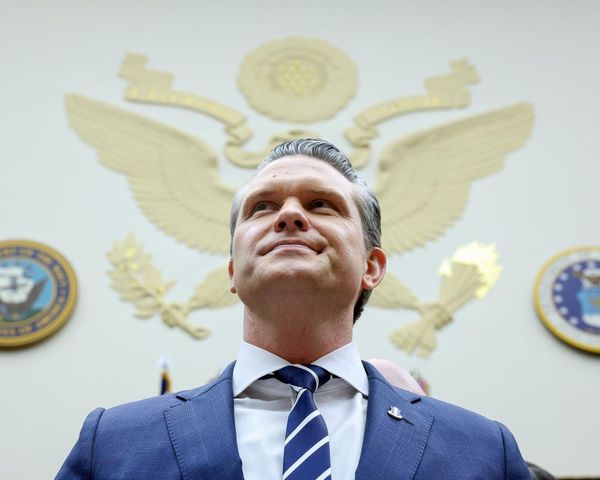
Pete Hegseth has denied that the US-Israel war on Iran is “a quagmire” and claimed critics of the operation posed a greater threat to the US than Iran itself, as he came under pressure to set out Washington’s strategy for the conflict. Appearing before the House armed services committee alongside Gen Dan Caine, chair of the joint chiefs of staff, the US defense secretary asked lawmakers to approve a $1.5tn budget in military spending – and then described some of them as “the biggest challenge” to the war effort.
James Comey surrenders to authorities after being charged for social media post
James Comey, the former FBI director and political enemy of Donald Trump, surrendered to authorities on Wednesday at the eastern district of Virginia after the justice department indicted him this week for a second time.
Prosecutors seek detention of alleged White House dinner shooter
Federal prosecutors provided in a filing Wednesday the most detailed account to date of Cole Tomas Allen’s alleged weeks-long plan to kill Donald Trump, who had joined more than 2,500 members of the Washington press corps for their annual White House correspondents’ dinner.
Florida approves US House map meant to boost Republicans in midterms
The Florida legislature approved a new congressional map intended to maximize Republicans’ advantage in the state as part of the national redistricting battle that Donald Trump launched before this year’s midterms.
Trump threatens to reduce troop numbers in Germany amid Nato spat
The US may reduce its number of troops deployed in Germany, Donald Trump has announced, days after the country’s chancellor said the US was being “humiliated” by Iran.
Jerome Powell to stay on Fed board as central bank holds rates steady in defiance of Trump
The US Federal Reserve chair, Jerome Powell, will remain on the central bank’s rate-setting board after his term as chair ends in May, a contentious move that signals continued uncertainty at the Fed.
Powell made the announcement after the Fed board on Wednesday left interest rates unchanged for the third time this year, despite Donald Trump’s continued demands for rate cuts.
What else happened today:
The US supreme court sided with the operator of Christian faith-based anti-abortion “crisis pregnancy centers” in New Jersey that is trying to impede a state investigation into whether the facilities engage in deceptive practices.
Kevin Warsh, Donald Trump’s pick to lead the Federal Reserve, cleared a key procedural hurdle, opening the way for him to succeed Jerome Powell in the coming weeks.
The House oversight and government reform committee has said that former attorney general Pam Bondi will now appear before the panel on 29 May to answer questions about the Department of Justice’s handling of the Jeffrey Epstein investigation and its release of the Epstein files.
Families of seven victims of a mass shooting at a secondary school in British Columbia are suing OpenAI and the company’s CEO for negligence after it failed to alert authorities to the shooter’s troubling conversations with ChatGPT.
Average US gas prices have hit a new high at $4.23 a gallon, their highest since 2022 and a record since the start of the war with Iran, according to the motor club AAA.
The US supreme court heard oral arguments on Wednesday over whether the Trump administration can strip the temporary protected status (TPS) of hundreds of thousands of immigrants from Haiti and Syria, under a program that has shielded them from deportation owing to safety concerns in their countries of origin.
Catching up? Here’s what happened Tuesday 28 April.