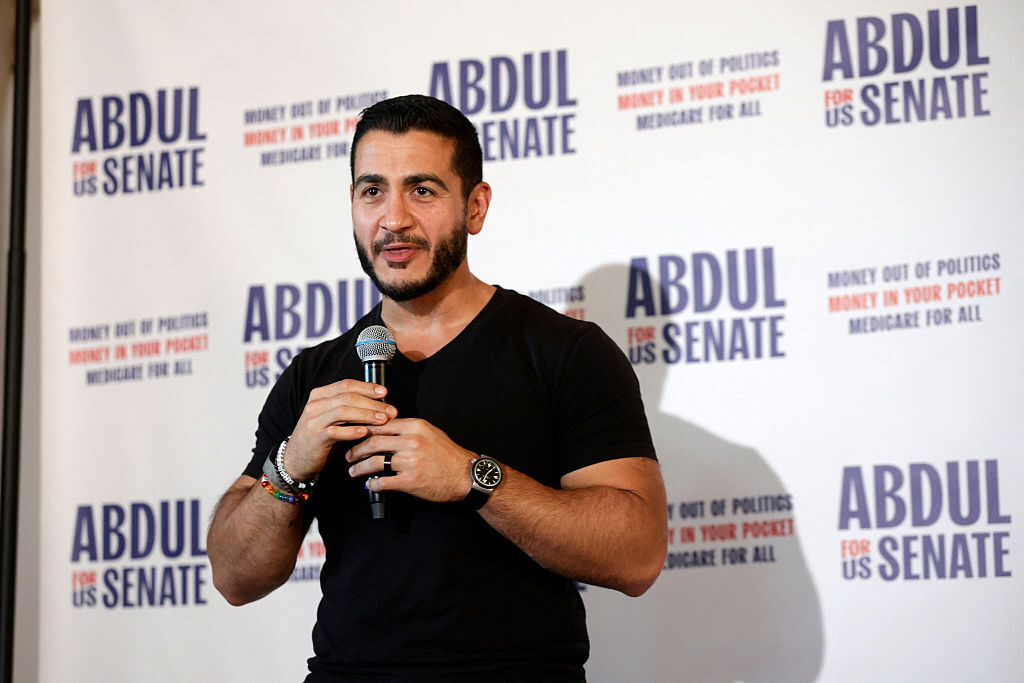
Former local public health official Abdul El-Sayed has won a high-profile Democratic primary for Michigan’s open Senate seat, advancing to a general election that will test whether a progressive Democrat can win statewide in a key Midwestern battleground.
El-Sayed, a former public health official, was leading Rep. Haley Stevens by less than a point, 48.4 percent to 47.5 percent, when The Associated Press called the race Wednesday before 10 a.m. Eastern time. Former state Sen. Mallory McMorrow, who dropped out of the race last month but remained on the ballot, had 4 percent.
He will next face former Rep. Mike Rogers, who was unopposed in the Republican primary, in a race that could determine which party controls the Senate next year. Senate Democratic hopes of flipping the chamber likely rest on them retaining this seat, which Sen. Gary Peters is vacating after two terms.
Elsewhere in Michigan, progressives also celebrated a pair of wins in closely watched Democratic House primaries, with state Rep. Donavan McKinney defeating Rep. Shri Thanedar in a Detroit-area district and activist William Lawrence winning a three-way primary for a battleground Lansing-based seat.
But it was the Senate primary that drew the lion’s share of national attention. The intense and expensive race pitted the Democratic establishment against its progressive wing and drew more than $80 million in spending.
While several polls in the race’s final days showed El-Sayed in the lead, the final result was much tighter. El-Sayed, a progressive backed by Sen. Bernie Sanders and Rep. Alexandria Ocasio-Cortez, criticized Stevens, who had endorsements from Gov. Gretchen Whitmer and Senate Minority Leader Charles E. Schumer, for being too closely tied to corporations and the American Israel Public Affairs Committee.
El-Sayed’s win marked a major loss for AIPAC, which invested more than $30 million in the race to support Stevens through its super PAC, the United Democracy Project. As the war in Gaza has become a dividing line among Democrats, El-Sayed, who would be the first Muslim senator if elected, has accused Israel of committing genocide in Gaza and criticized Stevens over her votes to continue funding Israel’s military.
The contest, at times, also saw the candidates lob personal attacks against each other, which could make it more challenging for El-Sayed to unite the party heading into the general election.
Speaking to supporters early Wednesday morning at an election night party, El-Sayed urged “manganamity in victory,” saying Democrats needed to begin mending fences after the bruising primary.
Stevens also called on her supporters to rally behind El-Sayed, saying in a statement Wednesday, “We need to win this Senate seat, because Elissa Slotkin deserves a partner like Abdul in the U.S. Senate.”
Republicans, meanwhile, have sought to brand El-Sayed as a socialist, although he does not consider himself one, and a radical. The National Republican Senatorial Committee on Wednesday released a digital ad casting El-Sayed as dangerous and sympathetic to terrorists.
Rogers, a former seven-term congressman who lost a bid for the state’s other Senate seat to Slotkin in 2024, has built a $4.5 million war chest heading into the general election. El-Sayed, meanwhile, reported $2.5 million on hand as of July 15.
“Abdul doesn’t represent a vision for the future,” Rogers said in a Wednesday statement. “He’s leading a movement grounded in ideological fanaticism. His agenda would make our communities less safe and our state less affordable.”
Inside Elections with Nathan L. Gonzales rates the race a Toss-up.
13th District
Thanedar became the latest House incumbent to lose a bid for renomination, as McKinney defeated the second-term congressman in the Democratic primary for the Detroit-based 13th District.
McKinney, a self-described democratic socialist, was leading Thanedar, 52 percent to 48 percent, when the AP called the race at 9:55 a.m. Eastern time Wednesday. He’ll be the heavy favorite to win the deep-blue seat in November.
Thanedar’s loss comes after a trio of House Democrats in New York and Colorado lost primaries in June to challengers backed by more progressive groups.
A member of the Congressional Progressive Caucus, Thanedar who is Indian American, was first elected to the plurality-Black district after winning just 28 percent in the 2022 Democratic primary, when several Black opponents split the remaining vote. Two years later, he scraped by with 55 percent against two primary opponents who had significantly fewer resources.
But he faced a tougher challenge this year in a one-on-one race against McKinney, who is Black and argued that majority-Black Detroit needs Black representation in Congress. McKinney also campaigned on an unabashedly progressive agenda and rallied with Sanders, Ocasio-Cortez and neighboring Rep. Rashida Tlaib. He received outside support from groups like the Justice Democrats PAC, which spent $889,000 on the race, and the Working Families Party PAC, which spent $293,000.
Thanedar, a multimillionaire former pharmaceutical executive, had a significant financial advantage against McKinney. He mostly self-funded his campaign but also received $2 million in outside support from Protect Progress, a crypto-backed group.
7th District
Progressives also claimed victory in the battleground 7th District, based in Lansing, with Lawrence, a co-founder of the Sunrise Movement, winning a three-way Democratic primary.
With more than 95 percent of votes in, Lawrence was leading with 44 percent, the AP reported, while a pair of centrists with national security backgrounds split the remaining vote. Bridget Brink, a former U.S. ambassador to Ukraine, was at 29 percent and retired Navy SEAL Matt Maasdam had 28 percent.
Many establishment Democrats saw Lawrence’s opponents as stronger general election candidates against Republican Rep. Tom Barrett in a district that narrowly backed Trump in 2024. Maasdam won a late endorsement from Sen. Elissa Slotkin, who represented the district for three terms, while Brink had the support of several Lansing-area officials. Lawrence, whose backers included Sanders and Tlaib, also drew criticism during the primary over his past comments criticizing Black Democratic leaders.
Barrett, who was unopposed for the GOP nomination Tuesday, has proved to be a strong fundraiser and had $2.9 million on hand as of July 15, according to Federal Election Commission records. He flipped the 7th District in 2024, winning the seat by about 4 points two years after losing his first congressional bid to Slotkin.
Republicans were optimistic that Barrett’s path to reelection will be easier against Lawrence, whose progressive policy stances they have argued are out of step with the district.
“The Democrats’ path to the House majority is evaporating in real time,” National Republican Congressional Committee spokesman Mike Marinella said in a statement.
Inside Elections rates the race a Toss-up.
10th District
Former special victims prosecutor Christina Hines won the Democratic nomination for the 10th District, an open battleground seat north of Detroit vacated by Rep. John James, who clinched the GOP nod for governor Tuesday.
With more than 95 percent of the vote in, Hines was leading a three-way field with 47 percent, the AP reported, ahead of former Commerce Department attorney Eric Chung, who had 30 percent and former state House Minority Leader Tim Greimel with 23 percent.
Hines will face Republican Army Mike Bouchard, who easily won his primary after consolidating party support following endorsements from Trump and the National Republican Congressional Committee.
Both parties see the 10th District as competitive, while Inside Elections rates the race Tilt Republican.
Other races
The fall matchup was set in Michigan’s 4th District in the state’s southwestern corner, with Republican incumbent Bill Huizenga and Democratic state Sen. Sean McCann easily winning their primaries. Inside Elections rates the race Lean Republican.
And in the battleground 8th District, the Republican primary delivered a rare loss for Trump, when his chosen candidate finished behind a rival who had stopped campaigning last month. With more than 95 percent of the vote in, retired engineer Thomas Smith was leading Trump-backed Navy veteran Amir Hassan, 50 percent to 33 percent, when the AP called the race shortly after 10:30 a.m. Wednesday. Smith will next face Democratic freshman Kristen McDonald Rivet.
And in the race to succeed Haley Stevens in the House, state Sen. Jeremy Moss prevailed over more progressive challengers in the 11th District. He will be strongly favored in the fall in the deep-blue suburban Detroit seat and become the first openly gay member of Congress from Michigan.