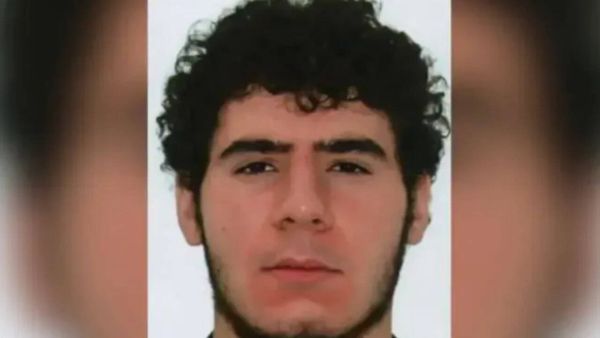
A 43-year-old Army veteran is facing a federal arson charge after prosecutors say he spent seven months preparing an attack on the entrance of 26 Federal Plaza, the Lower Manhattan tower that houses New York City's largest immigration court and an ICE holding facility. Andrew Arrabaca appeared before a federal magistrate on Tuesday, two days after a fire and the explosion that followed it sent smoke pluming above the block during Monday's morning commute.
A Cart Built for Damage, and a Message
Federal agents say Arrabaca didn't come alone — he wheeled a utility cart to the scene loaded with two hatchets, a mallet, a hammer, a machete, several knives, a BB rifle and a supply of fireworks, including one multi-shot firework labeled "Nuclear Warhead," according to by BNO News. He wore camouflage pants and a tactical belt stocked with BB pellets and carbon dioxide cartridges, prosecutors said. Fastened to the cart, officials say, was a handwritten sign reading "ICE Off Our Streets." FBI Assistant Director in Charge James Barnacle summed up the discovery to reporters: "He had a cart; he had anti-ICE literature on it."

Assistant U.S. Attorney Samantha Fry told the court Arrabaca began assembling his arsenal in January, traveling upstate New York for a pellet gun and into Pennsylvania for fireworks, according to ABC News. Prosecutors say he considered several other city locations before settling on the Jacob K. Javits Federal Building, then traveled downtown on Sunday and slept overnight in a park near the Holland Tunnel, per Gothamist. Investigators say he later acknowledged in a post-arrest interview that he understood the attack could have killed him along with others, a detail prosecutors used to argue he acted with intent rather than impulse.

What He Reportedly Told Investigators
During that interview, Arrabaca allegedly told agents he was driven by anti-government convictions and a belief that federal authorities were harming people without legal justification, according to NY1's account of the criminal complaint. FBI officials separately described him as holding anti-government, anti-ICE views based on statements he made both before and after his arrest.
Coverage of the case cites two different addresses for Arrabaca, which can look contradictory but isn't. The Justice Department's charging documents identify him as a Poughkeepsie, New York resident, while NYPD Commissioner Jessica Tisch told reporters his most recent address was in Harlem, where his black Toyota RAV4 was later found parked near West 124th Street. These describe two different things — a hometown of record versus a more recent, informal address — and every account that mentions both agrees he had been living out of his car in the days before the attack.

Three Hurt, a Citizenship Ceremony Called Off
The fire and subsequent explosion injured three people — two federal employees and a civilian who had arrived for his own immigration hearing — with one victim suffering a cut to the back of the head from flying debris. (One outlet, citing the fire department, put the civilian injury count at four rather than the more widely reported total of three — see the fact-check note above.) The disruption also forced organizers to cancel a naturalization ceremony that had been scheduled inside the building that morning.
Flanked by federal public defenders who asked the court to send him to a Veterans Affairs hospital instead of jail, Arrabaca watched Magistrate Judge Robyn Tarnofsky reject that request, calling the case "troubling" and ordering him held at the Metropolitan Detention Center in Brooklyn, according to Courthouse News. Explaining her reasoning, the judge told the defense, per CBS New York: "I don't think it is sufficiently clear that you would necessarily comply with treatment."
One early account, from Fox News, reported the opposite outcome — that Arrabaca had been released to psychiatric care. That version conflicts with the detention order independently confirmed by CBS New York, CNN, Courthouse News, NY1 and NBC New York; this rewrite follows the majority-corroborated account.
Tarnofsky did direct the jail to arrange a mental health evaluation within 48 hours, while acknowledging the facility isn't well equipped to provide that treatment, per Courthouse News. Defense attorneys told the court Arrabaca had been diagnosed with a mental illness in 2020 and had since stopped taking his medication, according to NY1. Before ending the hearing, the judge remarked that Arrabaca had served the country and appeared genuinely unwell, notwithstanding the seriousness of the allegations.
The Charge, and What's Next
Arrabaca faces a single count of destroying government property by fire or explosives, which carries a mandatory minimum of seven years in prison and a maximum of 40 if convicted, according to the Justice Department. He entered no plea Tuesday and is due back in court Aug. 4.
A Building Already at the Center of the Deportation Fight
The attack landed squarely inside a long-running dispute over 26 Federal Plaza's role in the current administration's deportation push. The tower houses Manhattan's largest immigration court alongside an ICE holding area that detainees have described as overcrowded and difficult to access counsel from. ICE agents spent months stationed outside 12th-floor courtrooms to arrest immigrants as they left hearings — a practice U.S. District Judge P. Kevin Castel largely halted in May, ruling that arrests could continue only under narrow public-safety or flight-risk exceptions. Even so, Courthouse News reported that ICE had carried out at least six arrests inside Manhattan immigration courts in the two months since that ruling.
U.S. Attorney Jay Clayton said Arrabaca had "caused a scene of destruction and mayhem" at a building that houses thousands of federal workers and receives hundreds of visitors on an average day, according to the Justice Department's announcement.