
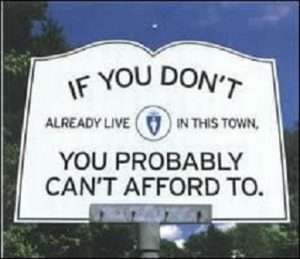
A broad consensus of experts agree that zoning restrictions on the construction of housing are extremely harmful, and need to be cut back. In a recent City Journal article, Harvard economist Edward Glaeser—arguably the nation's leading scholar on this subject—describes how the problem has gotten worse in recent years, with regulations tightening in many areas:
The overregulation of American housing markets began in the nation's coastal, educated, productive enclaves. Over time, however, barriers to building have spread. Tony suburbs of Phoenix and Austin, which once left their builders free to construct plentiful affordable housing, have now become almost as restrictive as the Boston area.
The expansion of land-use regulations will have an enduring impact on the cost of American housing. The web of restrictions pushes prices up by limiting the number of houses that can be built and deters development through the uncertainty that it creates. Since the permitting process often allows only tiny one-off projects, American builders can't exploit the economies of scale that have made almost every other manufactured good far more affordable.
The consequences of land-use regulations go beyond high housing costs. Since people can't afford to move into areas that don't build, America's most productive places have remained too small. The nation's gross domestic product is therefore lower than it could be with a more rational housing system, and poverty too often gets frozen. Housing-price bubbles are more extreme when the housing stock is fixed, too, so the country courts financial chaos by refusing to make building easier…
While the coasts were the initial epicenters of overregulation, 61 percent of the non-coastal West and 53 percent of the non-coastal East became substantially more regulated between 2006 and 2018. By contrast, 34 percent of the non-coastal East and 28 percent of the non-coastal West reduced regulation; 52 percent of the Sunbelt became more regulated, and 33 percent less regulated……
Across the country, the biggest regulatory changes were seen in minimum lot sizes and the number of entities required to approve any rezoning. In 2006, 28 percent of communities had a minimum lot size of one acre. By 2018, 39 percent of communities in the sample had a minimum lot size greater than one acre. The share of communities where a rezoning required approval by at least three entities went from 22 percent to 45 percent.
This creep of regulation means that restrictive zoning is no longer just a problem for New York and San Francisco. Regulatory curbs on new building are now part of life around much of the United States, and that has pernicious effects that go far beyond just pushing up prices….
This closing of the metropolitan frontier has macroeconomic implications. Again, restricting the supply of something that is in demand will make asset bubbles far more likely—and these, if large enough, can have a massive destructive impact when they burst, as they did in 2007…..
The second macroeconomic point is that restricting housing growth means limiting the movement of poor people to rich, productive places. Throughout our history, Americans have moved in search of economic opportunity….. That process of relocation has slowed greatly because poor people cannot buy or rent homes in the prosperous areas of technological progress, such as Silicon Valley…
Local land-use regulations also make America more unequal. My colleague Raj Chetty and his coauthors have produced an "opportunity atlas" that shows where poor Americans have the best chances of growing up to be successful. Their primary measure of opportunity is the adult income of children whose parents were poorer than three-fourths of their contemporaries at the time when the child was born…. [L]and-use regulations are strictest in areas that offer poor children the most economic opportunity.















