Get all your news in one place.
100's of premium titles.
One app.
Start reading
The Economic Times
The Economic Times
Trending Desk

‘Zombie Worm’ awakens after 24,000 years: Scientists revive a frozen worm that can survive freezing, starvation and even reproduce without partner

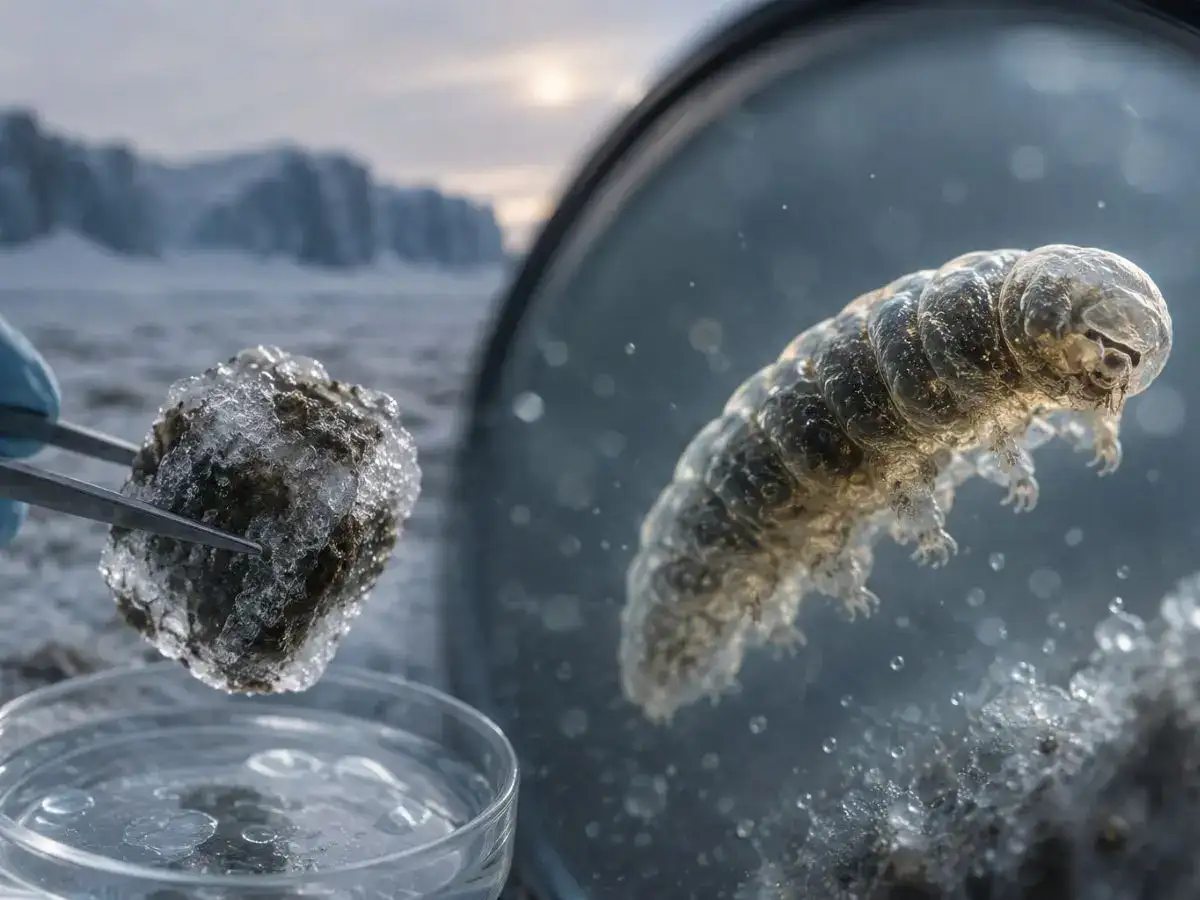
A tiny “zombie worm” pulled from deep Siberian ice after nearly 24,000 years has once again sparked global curiosity after reports of the experiment resurfaced in April 2026. Scientists have revived the microscopic organism in a laboratory. As per reports, the microscopic worm revived after thousands of years and even reproduced without a partner. While social media has turned it into a “zombie worm” story, researchers say the real issue goes far beyond shock value. The finding has renewed attention on Arctic permafrost, which stores ancient microbes, carbon and organic matter beneath frozen ground that is now slowly thawing because of climate change.

“Zombie Worm” not a horror creature, but a microscopic survivor

The animal at the center of the story is a bdelloid rotifer, a tiny multicellular organism usually found in freshwater habitats. It is so small that it can only be seen under a microscope. Despite the dramatic nickname circulating online, scientists say the rotifer is not some dangerous prehistoric creature emerging from ice.

What makes it remarkable is its ability to survive brutal conditions. Bdelloid rotifers can endure freezing temperatures, dehydration, starvation and even low oxygen levels by shutting down most of their biological activity.

In simple terms, the organism entered an almost suspended state for thousands of years and resumed functioning once conditions improved.

The moment that stunned researchers

Researchers used radiocarbon dating to estimate that the rotifer recovered from Siberian permafrost was around 24,000 years old. Earlier studies had shown similar organisms surviving frozen for years or even about a decade. But surviving across millennia pushed scientific understanding into entirely new territory.

After thawing, the rotifer from the genus Adineta managed to reproduce through parthenogenesis, a process in which offspring are produced without mating. Scientists said that detail made the experiment even more striking because the animal did not merely survive — it regained enough biological function to create new life.

The science behind the “pause button”

Scientists describe the survival mechanism as cryptobiosis, a condition where metabolism nearly stops. It is not resurrection or immortality, but an extreme biological defence system.

To study the process further, researchers froze and thawed modern rotifers in laboratory conditions. The tests suggested the animals could tolerate slow ice crystal formation without severe damage to their cells and organs.

Stas Malavin from the Soil Cryology Laboratory in Pushchino, Russia, described the discovery by saying, “It is the strongest proof to date that multicellular animals can withstand tens of thousands of years in cryptobiosis.”

Even now, scientists admit many questions remain unanswered. Researchers are still trying to understand exactly what internal mechanisms allow such delicate organisms to survive for so long under frozen ground.

Why melting permafrost worries scientists

The story has also reopened discussion around permafrost, the permanently frozen soil spread across regions such as Siberia, Alaska and northern Canada.

Permafrost acts like a giant natural freezer, preserving ancient biological material, microbes and enormous amounts of carbon for thousands of years. Scientists warn that rising global temperatures are destabilising this frozen layer.

According to the United Nations Environment Programme, global permafrost contains around 1,500 gigatons of carbon, roughly twice the amount currently present in Earth’s atmosphere. As frozen ground melts, part of that carbon can be released as carbon dioxide and methane, both major greenhouse gases linked to global warming.

The Arctic Report Card 2024 by NOAA also noted that the Arctic tundra has become a source of carbon dioxide emissions when wildfire emissions are included, while continuing to release methane.

Ancient microbes and real-world fears

Scientists caution against turning the rotifer discovery into an apocalyptic tale. The microscopic animal itself poses no threat to humans.

Still, experts say thawing permafrost deserves close monitoring because ancient microbes and pathogens trapped in ice could potentially re-emerge. UNEP previously highlighted the 2016 anthrax outbreak in Siberia, which was linked to thawing ground exposing an infected reindeer carcass buried decades earlier.

Andrea Hinwood, chief scientist at UNEP, summed up the uncertainty by saying, “We’re on a scenario of yes and maybe.”

That cautious wording reflects the balance scientists are trying to maintain: avoiding fear-driven narratives while acknowledging that climate-driven thawing could carry risks that are not yet fully understood.

No, scientists are not reviving mammoths

Researchers also stressed that the rotifer experiment does not mean frozen mammoths or humans can soon be brought back to life.

Malavin made that clear by saying, “For mammals, it is not currently possible.”

Scientists explain that larger and more complex organisms are far harder to preserve without irreversible damage during freezing and thawing.

Instead, the discovery may help researchers improve cryopreservation techniques for cells, tissues and organs. The findings are also attracting attention in astrobiology, a field exploring how life might survive in extreme environments beyond Earth.

The bigger environmental message

The tiny Siberian rotifer may look insignificant, but scientists say it represents something much larger. Frozen Arctic landscapes are not just remote stretches of ice; they store biological history, climate records and massive carbon reserves that influence the planet’s future.

As those frozen systems weaken, the consequences are not limited to the Arctic alone. Scientists link thawing permafrost to rising emissions, worsening heat, wildfires and broader climate instability already affecting people across the world.

The “zombie worm” headlines may grab attention, but researchers say the deeper story is about climate pressure, environmental monitoring and the growing urgency to protect fragile polar ecosystems before more of Earth’s frozen archive begins to thaw.

Sign up to read this article
Read news from 100's of titles, curated specifically for you.
Already a member? Sign in here
Related Stories
Top stories on inkl right now
One subscription that gives you access to news from hundreds of sites
Already a member? Sign in here
Our Picks
Fourteen days free
Download the app
One app. One membership.
100+ trusted global sources.