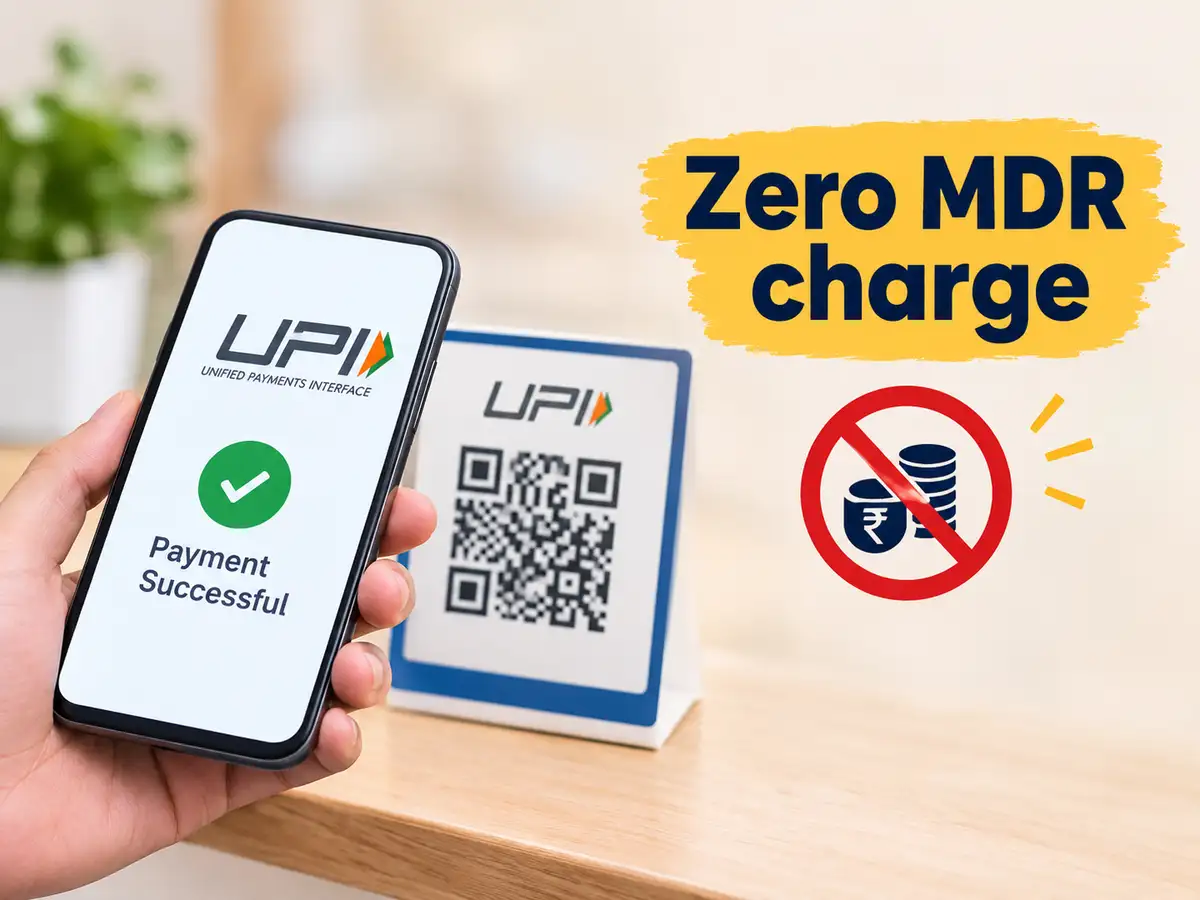
Starting October 15, 2026, the new Merchant Discount Rate (MDR) framework will apply to certain Unified Payment Interface (UPI) transactions made by merchants. The MDR will not be the same for every merchant, as the applicable rate will depend on the industry or the category in which the merchant operates.
This does not mean that customers will have to pay a charge every time they use the UPI. The MDR charges are aimed at selected merchant transactions and are linked to transactions above the prescribed limit. In other words, regular UPI payments will not automatically attract an MDR simply because the payment is made through the UPI.

Also read: UPI MDR: 10 UPI transactions that will attract MDR charges; what’s the maximum you will pay
Here are the few transactions which continue to remain free of MDR charges-
1. Person-to-Person (P2P) transfers:
Sending money directly to friends and family that is person to person is free for any amount.
2. Receiving money
Receiving funds to your bank account via UPI
3. Small merchant payments
Small merchants including street vendors receiving up to Rs 1 lakh per month through UPI QR codes under the Person-to-Person-Merchant (P2PM) category will continue to enjoy zero MDR on all transactions
4. Small-ticket purchases
All person-to-merchant (P2M) transactions up to Rs 2,000 will remain free of MDR.
5. Large merchant purchases
Buying items below 2,000 from standard merchants will remain free however above Rs 2,000 means the 0.4% fee is paid by the business, not you.
6. UPI AutoPay
Setting up recurring subscription or bill payments stays free of MDR charges.
7. Payments on essentials
Transactions below Rs 2,000 in essential and thin-margin sectors, including railways, telecommunications, insurance, fuel and agricultural inputs will remain free of MDR.
Who will pay MDR charges?
Banks have been advised to ensure that merchants do not pass MDR charges on to customers. UPI application providers are expressly prohibited from imposing platform fees or hidden charges. Individuals will continue to have unlimited free usage, with no monthly quotas, volume restrictions or tiered caps on free UPI transactions.
Standard UPI limits
Daily transaction limits prescribed by banks and National Payments Corporation of India (NPCI) generally range from Rs 1 lakh to Rs 5 lakh depending on the nature of transaction.
The standard UPI daily transaction limit is Rs 1 lakh for regular person-to-person (P2P) transfers. For new users, the limit is capped at Rs 5,000 for the first 24 hours of account.
Higher transaction caps apply only to specific verified categories per day and limit is up to Rs 5 lakh per transaction and up to Rs 10 lakh daily cumulative depending on the sector):
Medical and hospitals: Up to Rs 5 lakh per transaction.
Educational institutions: Up to Rs 5 lakh per transaction.
Capital markets and insurance: Up to Rs 5 lakh per transaction, max Rs 10 lakh per day.
Tax payments & IPOs: Up to Rs 5 lakh
For small transactions UPI Lite limits
For daily low-value expenses, you can use UPI Lite, which allows PIN-less transactions.
Per transaction limit is Rs 1,000 and wallet balance limit is Rs 5,000.