European leaders are to take part in a call with Volodymyr Zelenskyy and Donald Trump on Saturday as part of a growing push for a peace deal that will see the Ukrainian president head to Florida on Sunday.
The European Commission president, Ursula von der Leyen, is to join a call on Saturday, a commission spokesperson told Reuters, ahead of the Ukrainian president’s trip to Florida for a Sunday meeting with Trump that Zelenskyy said would focus on some of the most sensitive parts of the peace talks. Key sticking points include Ukrainian security guarantees and reconstruction, plus territorial discussions regarding the Donbas region and the Zaporizhzhia nuclear power plant.
Sunday’s meeting is “specifically intended to refine things as much as we possibly can”, Zelenskyy said on Friday. He added that the proposed 20-point peace plan was “90% ready”. “Our goal is to bring everything to 100%,” Zelenskyy said. “As of today, our teams – the Ukrainian and American negotiating teams – have made significant progress.”
Zelenskyy is willing to hold a referendum on the peace plan if Russia agrees to a ceasefire of at least 60 days, Axios reported, following an interview with the Ukrainian president on Friday. Zelenskyy reportedly said he would need to seek approval of the Ukrainian public if he fails to secure a “strong” position on territory.
Against the political backdrop, powerful explosions were heard in Kyiv in the early hours of Saturday, hours after Zelenskyy spoke of his US meeting. The Kyiv Independent reported that the capital came under attack from Kinzhal hypersonic missiles, Iskander ballistic missiles and Kalibr cruise missiles. Eleven people were injured, local officials said, including two children. The strikes affected seven locations across the city, the head of Kyiv’s City Military Administration Tymur Tkachenko said in a statement on Telegram.
A fire broke out in an 18-storey residential building in the Dnipro district of the city, and a 24-storey residential building in the Darnytsia district was also hit, Tkachenko said, and more fires were reported in the Obolonskyi and Holosiivsky districts. In the wider region, power outages were reported in and around the town of Brovary.
Ukraine’s air force also announced a countrywide air alert, saying on social media that drones and missiles were moving over several Ukrainian regions, including the capital.
The Russian strikes forced Polish fighter jets to scramble, and two airports in south-eastern Poland – Rzeszów and Lublin – were temporarily closed.
The latest peace efforts follow a burst of diplomatic activity last weekend in Miami, where Trump’s envoy Steve Witkoff met separately with Russian and Ukrainian representatives, as well as Trump’s son-in-law Jared Kushner.
The latest plan is considered an updated version of an earlier 28-point document agreed several weeks ago between the US envoys and Russian officials, a proposal widely viewed as skewed towards the Kremlin’s demands.
Ukraine has pushed for security guarantees modelled on Nato’s Article 5 mutual defence pledge under any proposed peace deal with Russia, though it remains unclear whether Moscow would accept such terms.
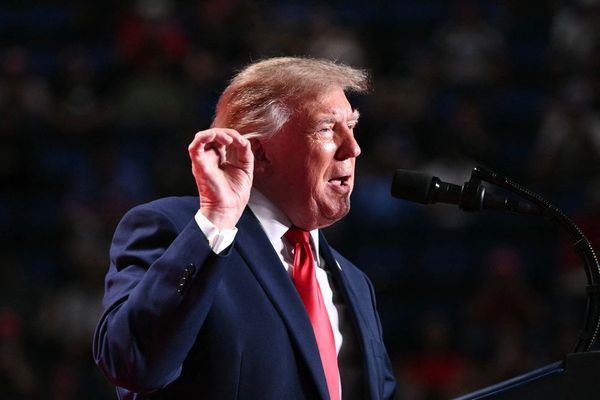
In an interview with Politico on Friday, Trump said he anticipated a “good” meeting with the Ukrainian leader, though he offered no endorsement of Zelenskyy’s plan. “He doesn’t have anything until I approve it,” Trump told the news website. “So we’ll see what he’s got.”
The Russian deputy foreign minister, Sergei Ryabkov, used a Russian television appearance on Friday to criticise Zelenskyy and European allies on their work on the peace plan. “Our ability to make the final push and reach an agreement will depend on our own work and the political will of the other party,” Ryabkov said. “Especially in a context where Kyiv and its sponsors – notably within the European Union, who are not in favour of an agreement – have stepped up efforts to torpedo it.”
He said the proposal drawn up with Zelenskyy’s input “differs radically” from points initially drawn up by US and Russian officials in contacts this month. “Without an adequate resolution of the problems at the origin of this crisis, it will be quite simply impossible to reach a definitive accord,” Ryabkov added.