
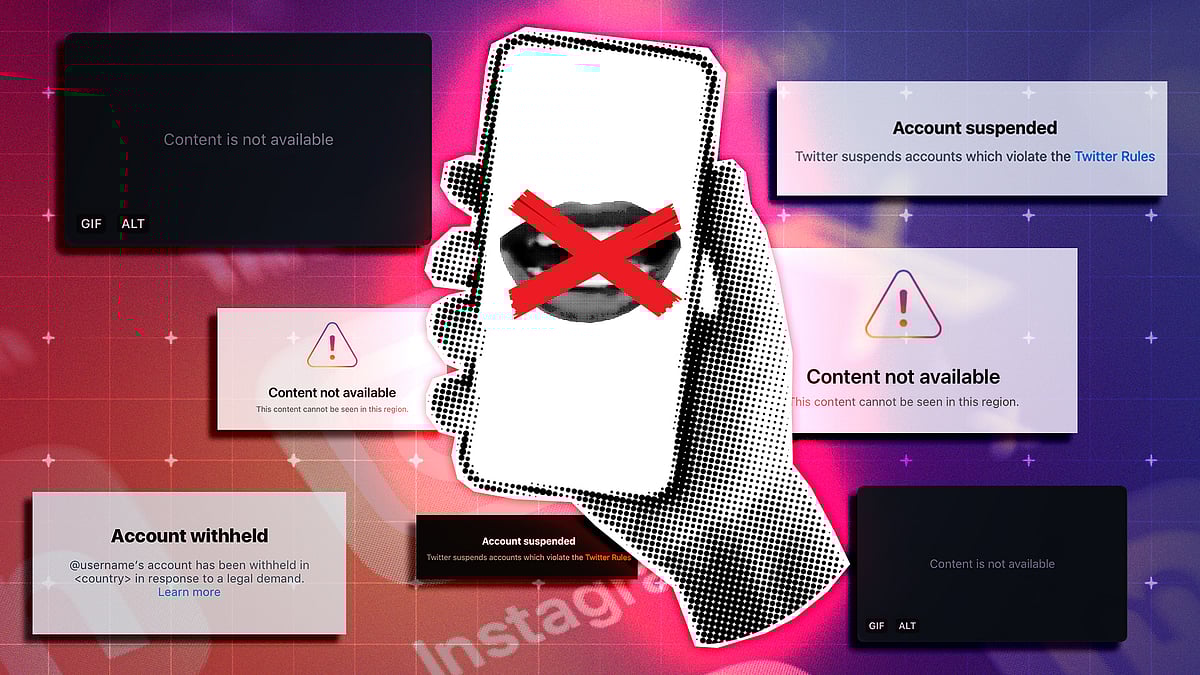
While the government has already been using the IT Rules 2021 to block online content and creators, its powers are about to expand significantly — potentially applying to any user who posts on “current affairs or news”.

On March 30, the Ministry of Electronics and Information Technology (MeitY) moved to formalise this expansion by releasing a draft of the Information Technology (Intermediary Guidelines and Digital Media Ethics Code) Second Amendment Rules, 2026.
The government issued this proposal just days after it blocked the accounts of satirists, cartoonists, and political commentators in late March. Authorities used Section 69A of the IT Act to justify these withholdings, citing concerns over sovereignty and public order.
What the new amendments propose
The government describes the amendments as “clarificatory and procedural,” intended to improve “legal certainty” and “strengthen enforceability”. But the draft fundamentally alters who is regulated, how actions are triggered, and the speed at which platforms must comply. Here’s a look at some of the provisions in these draft rules:
1) Rule 8(1) proviso — Extends news regulation to user content
The amendment expands Rule 8(1) to apply Rules 14, 15, and 16 (blocking and oversight provisions) not only to publishers but also to intermediaries and to user-generated “news and current affairs” content.
Example: A journalist’s tweet thread on a protest or a Dhruv Rathee YouTube explainer could now be reviewed and blocked using the same system earlier used for news publishers.
2) Rule 8(1) + Part III — Platforms and users under the same framework
By extending Part III of the IT Rules to users, the draft brings platforms (such as X, Instagram, and YouTube) and non-publisher users under the same regulatory framework as digital news media.
Example: Earlier, a Newslaundry report could face scrutiny — now, even an individual explaining a court judgment on Instagram could fall under the same mechanism.
3) Rule 14(2) — IDC can now examine “any matter”
The Inter-Departmental Committee (IDC), which earlier handled complaints, can now examine any “matter,” including those referred directly by the government.
Example: A ministry can directly flag a viral video criticising a policy and send it for review, even if no one files a complaint.
4) Rule 14(2) & 14(5) — Govt-triggered action (suo motu)
By replacing “complaints” with “matters,” the rules allow the government to initiate action on its own, without waiting for grievances.
Example: As seen during the BBC documentary controversy (2023), content can be blocked proactively — this kind of action now gets a clearer legal basis.
5) Rules 15 & 16 — Blocking and emergency powers extend to posts
Authorities can now more clearly apply the formal blocking process (Rule 15) and emergency blocking powers (Rule 16) to individual social media posts and accounts, moving beyond just websites or publishers.
Example: During protests or unrest, posts sharing on-ground reporting could be blocked immediately, without prior hearing.
6) Rule 3(4) — Govt advisories become effectively binding
A new clause requires platforms to comply with MeitY-issued advisories, directions, SOPs, and guidelines, even if they are not formal laws, as part of their due diligence obligations.
Since these directions are not always made public, users may not know why their content was removed or how to challenge the decision.
Example: Government advisories on AI or deepfakes – like those issued in 2024 – would now act as mandatory rules for platforms.
7) Rule 3(4) + Section 79 — Safe harbour linked to compliance
Compliance with these directions is tied to safe-harbour protection under Section 79 of the IT Act, which increases legal pressure on platforms to act quickly. (Safe harbour refers to the legal immunity that prevents platforms from being held liable for what their users post.)
Example: When X resisted blocking orders in 2021, it faced threats of losing legal protection, encouraging faster, sometimes excessive, compliance.
8) Rule 3(1)(g) & 3(1)(h) — Expanded data retention
The draft clarifies that data retention obligations under the IT Rules apply in addition to requirements under any other law, thereby expanding the period during which platforms must store user data.
According to the Internet Freedom Foundation (IFF), this could increase the risk of surveillance and sensitive data leaks after extended storage.
Example: User posts, metadata, and account details may be stored longer and accessed during investigations.
9) Structural shift — From publishers to the entire ecosystem
Together, these changes expand regulation beyond news publishers to platforms, users, and content ecosystems, increasing the scope of oversight.
Example: Instead of targeting a news website directly, authorities can restrict its reach by getting related posts removed across platforms.
10) Overall effect — Continuous, proactive oversight of speech
The system shifts from a complaint-based model to one that allows ongoing monitoring, flagging, and action on online “news-like” content. Effectively, what was once an occasional intervention is becoming a permanent state of digital oversight.
Example: Recent blocking of satire and parody accounts reflects how online discourse is increasingly monitored — a trend the draft formalises.
Newslaundry spoke to a few digital media journalists to understand how they see this proposal.
‘Signs of a paranoid and insecure government’
Speaking to Newslaundry, Seema Chishti, The Wire’s editor, said, “The first reaction is not one of surprise about direction and intent. This government has made that very clear time and time again.”
“My problem with this is fundamental, which is at the heart of our digital rights. If I’m having a conversation with my friend, a discussion is going on at a tea shop, or a son is talking to his mother, none of these conversations should be under surveillance. Now, just because tech has moved these conversations online, that does not give the government the right to a new sort of censorship – that ultimately has a chilling effect and silence,” she added.
On being asked if this will curb journalism, Chishti said, “Journalism will be curbed very effectively if these rules are finalised. Their idea is to curb all non-big media that they've not been able to curb for precisely these reasons, that you want to take down a fact-check before it gets any traction - that's why this is censorship.”
“We can spend 8 to 18 days working on a story, and the government can take it down in a few hours without any discussion? If these rules go through, it would confirm that the government is paranoid and insecure. This is definitely not in line with the claim of being the ‘most popular Prime Minister in the world’.”
Chishti also remarked that the government is essentially “shaping the internet,” because the government is not just removing current content, but “it can be from any time”.
“It could be about the 1984 riots or the 2002 riots. The government affects the information environment without having the right to do so. This cannot be the promise of Digital India. After all, Digital India cannot only be about UPI,” she added.
Manu Sebastian, managing editor at LiveLaw, told Newslaundry, “The new move is to bring even regular users under the ambit of the IT rules. So far, a wide compliance mechanism has existed for digital media publishers and platforms – like grievance redressal mechanisms, having a compliance officer, signing certain reports with the government and more.”
“Now, what the government is trying to do is that even regular individual users who post news content will be brought under these rules. But such persons won't have the organisational strength or support, etc., to comply with all these things,” he added.
“Just last week, for example, a girl from Galgotias University had posted a reel about how they were asked to attend PM Narendra Modi’s inauguration event at the Jewar airport in exchange for extra attendance. Since she pointed out that the audience was mostly made up of such students, that reel was also taken down. Now, this was personal stuff and not news,” Sebastian explained.
Sebastian warned, “There is also a lot of ambiguity because when does a regular internet user become a news publisher, or when does their content become news? In effect, people would be deterred or discouraged from posting such content on social media, which would lead to self-censorship.”
The Internet Freedom Foundation (IFF) described this trajectory as “digital authoritarianism” in a recent statement: “We are deeply distressed by the continuing expansion of unchecked executive power… The proper course is to await judicial determination of the pending challenges, respect interim protections granted by constitutional courts, and pursue regulatory objectives through parliamentary legislation rather than subordinate instruments that exceed the parent statute.”
Manu Sebastian echoes this concern in a recent column, noting that while misinformation and child pornography are “grave menaces” that must be addressed, the lack of safeguards creates a risk of “overkill”. He goes on to add: “Since most of the mainstream media have adopted a sycophantic approach towards the executive, dissenting voices survive only in the limited online space. If the IT Act powers are used for an overkill, the bustling online space will soon have the unanimity of a graveyard – something which might please the powers that be, but will ultimately dig the grave for our democracy as well.”
This trend is also drawing international scrutiny. In a recent report outlining “significant foreign trade barriers,” the US Trade Representative (USTR) flagged India’s content takedown regime, noting that global platforms like Meta, Google, and X have faced a surge in requests that appear “politically motivated”.
Making matters worse, these draft rules arrive in an already tightening environment. Just last month, the government shortened the window for platforms to remove “unlawful” content from 36 hours to a mere two to three hours – a timeframe that critics say makes human editorial review nearly impossible.
For now, the government has sought stakeholder feedback, asking citizens to submit their objections to itrules.consultation@meity.gov.in by April 14, 2026. You have only 10 days left. Make your voice heard!
Newslaundry takes pride in its subscription-based model – because when the public pays, we serve you. Soon, however, the government may cut our reach or block our stories or stop you from sharing them without due process. So, make sure you raise your voice!
Newslaundry is a reader-supported, ad-free, independent news outlet based out of New Delhi. Support their journalism, here.







