The honor of being the first SLRs with automatic exposure control was shared by two little-known and short-lived French-made cameras - the Royer Savoyflex Automatique and the Focaflex Automatique of 1960. Both employed selenium-cell exposure meters and the basic “trap-needle” method of aperture control used by previously introduced point-and-shoot cameras. Surprisingly, no other SLR would follow in their footsteps until the Konica Auto-Reflex.
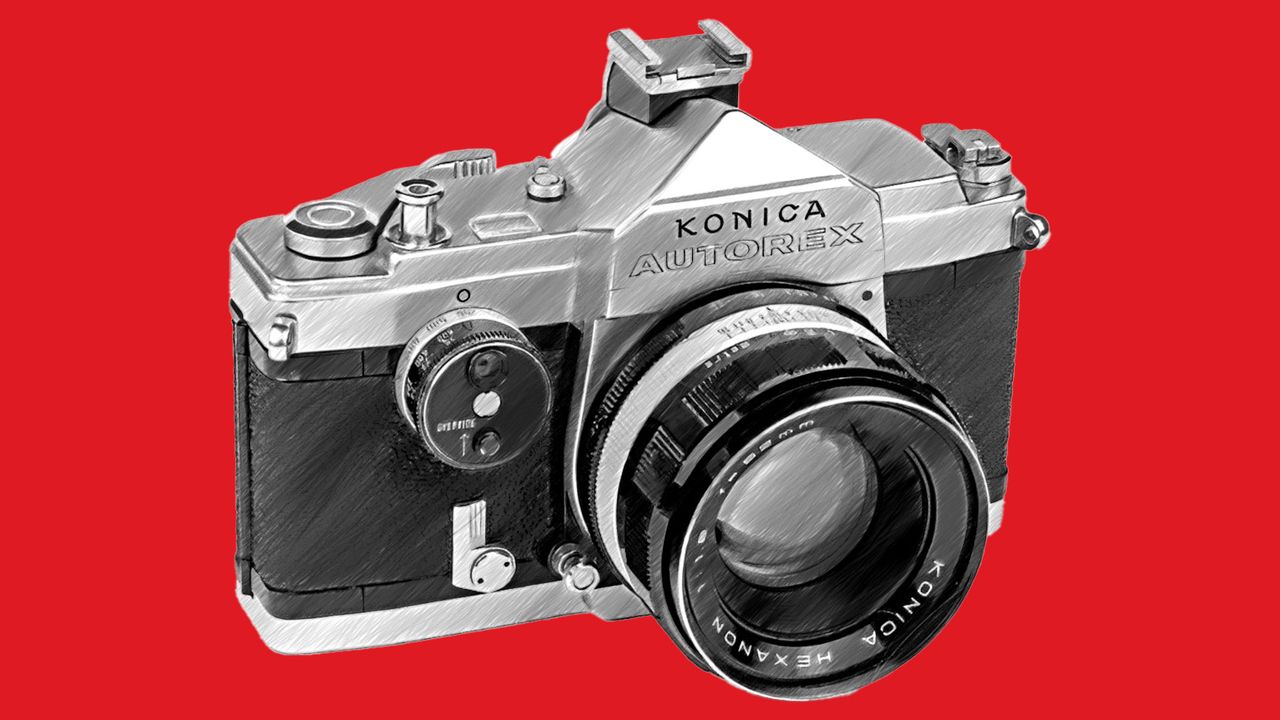
In 1965, Konishiroku introduced its Konica Autorex to the Japanese market. It was the first high-quality, widely available SLR with a focal-plane shutter and automatic exposure control.
With the shutter speed and film speed set, the camera selected the correct aperture, which it indicates by a needle over a scale in the viewfinder. However, the shutter release button was rather long, and the mechanism required substantial pressure, as it had to also move the trap-needle mechanism and transfer that setting to the lens, in order to make the auto-exposure system work.
The dual-format Autorex could switch from full to half-frame, even with film in the camera, and not skip a beat. A lever to the right of the lens moved a plates at both sides to reduce the film gate, changes the gear ratio of the film advance, and adjust the frame counter. Two reminder “teeth” would appear in the viewfinder to indicate a half frame, and the exposure counter would begin counting in half frames. So you could shoot 72 half-frame images on a 36-exposure roll, or any number in between, as you could switch systems as many times as you liked.
But... you had to use this lever with care. You had to wind the film first, before you flipped from full to half frame, and Flip first, before before going from half to full frame. Do it right, and you’ll have an 11mm gap in the negatives. Get it wrong and you’ll end up with overlapping images. I suspect it was this quirk that caused Konica to drop the feature in later models.