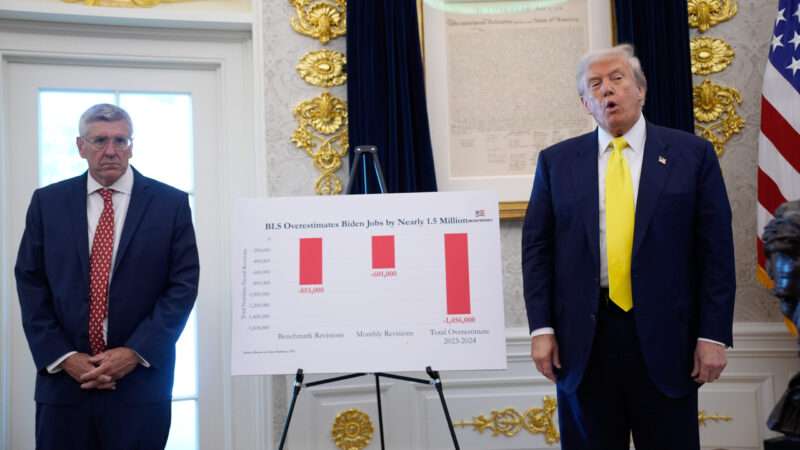
The trustworthiness of the Bureau of Labor Statistics' (BLS) data on inflation, employment, wages, productivity, and consumer spending has historically been a concern only for cranks and conspiracy theorists. Unlike many other nations, the United States has long been able to shield its government data collection processes from partisan political wars. We may debate who is to blame for employment trends, yet no credible critic would argue that the BLS is faking the jobs numbers. That is, until President Donald Trump fired BLS Commissioner Erika McEntarfer in August in response to a weak jobs report that Trump claimed was "rigged." Trump then nominated as a replacement E.J. Antoni, a Heritage Foundation economist widely considered to be a partisan apparatchik with scant qualifications in labor economics. Antoni's nomination was pulled in October due to bipartisan Senate opposition.
Republicans have since attacked the BLS' monthly jobs reports for requiring subsequent revisions. However, such revisions are a feature, not a bug. In order to measure 163 million workers out of 340 million Americans, the BLS surveys establishments and households. However, delayed replies and declining response rates mean that an initial monthly estimate will be revised as later survey responses arrive. Avoiding these future revisions would require skipping the initial jobs reports altogether and waiting months until a critical mass of surveys has been received—a point at which a given month's jobs data would be too outdated to be useful.