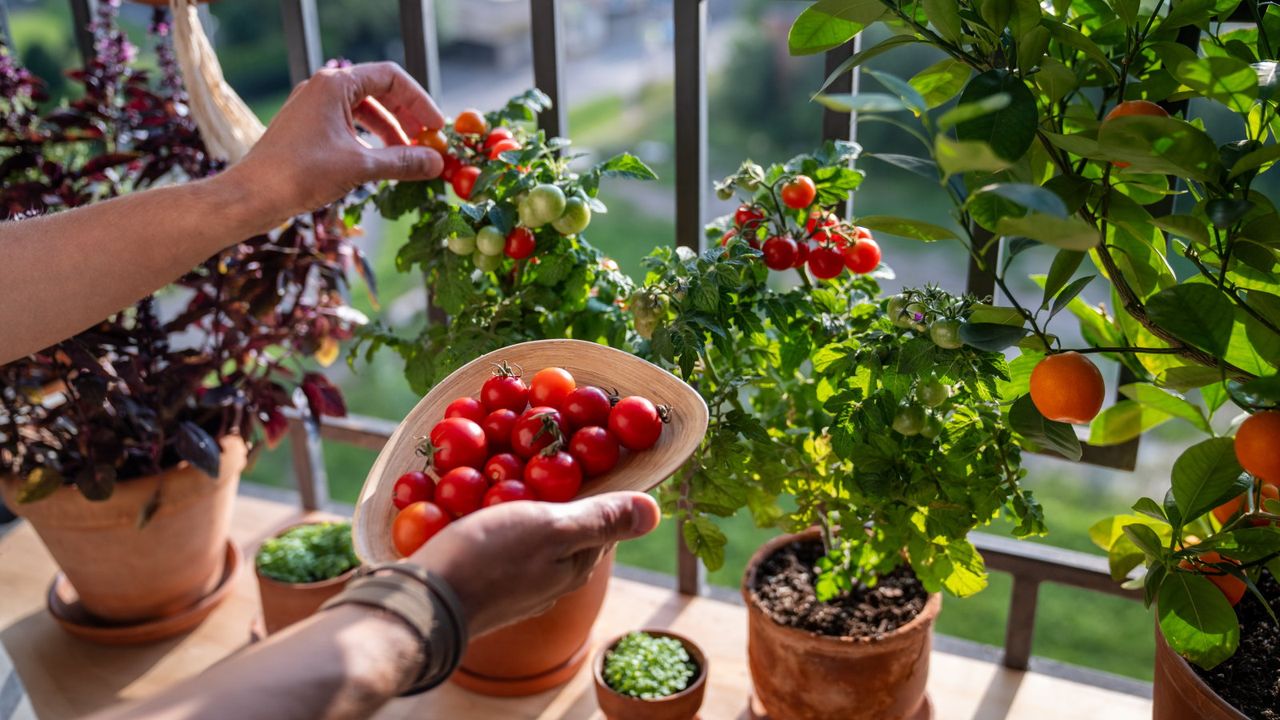
You’d assume that having a balcony would put you at a disadvantage when growing tomatoes. However, you can enjoy great homegrown tomato harvests by making carefully curated decisions about how you grow your plants.
A balcony can offer a sunny, sheltered spot to grow many crops, albeit on a smaller scale than in a larger vegetable garden. But size isn’t everything, and if you make sensible choices on varieties, containers, and aftercare, you can enjoy great success growing tomatoes on a balcony.

I have been fortunate in my professional career to have greenhouses and polytunnels to grow tomatoes. On the other hand, I also spent many years enjoying growing tomatoes in pots on a patio and in a courtyard at home. I learned a lot about small-space gardening during that time, and I've consulted with experts to put together these tips on how to grow tomatoes on a balcony.

1. Small Varieties Are Best

There are lots of different tomato varieties to pick from. However, despite the hundreds of varieties and cultivars to choose between, a smart decision when growing tomatoes on a balcony is to pick compact, or bush varieties.
To make life easier, a giveaway is that they often have words like ‘bush’, ‘tiny’, or ‘patio’ in their name.
Jeremy Hill from Gooseberry Bridge Farm is a fan of patio tomatoes, and says: ‘There's a patio yellow and a patio red cherry tomato that we really like. They produce a lot of fruit without a whole lot of leggy leaves and vines, so that's something to consider for small balconies.’
You can get ‘Patio Choice’ tomato seeds at True Leaf Market and ‘Sweetheart of the Patio’ tomato seeds at Burpee, both of which are ideal for growing as balcony tomatoes.
Elsewhere, there is a great variety of tomatoes to plant in containers for big harvests in small spaces. Whether you want balcony tomatoes to climb up supports, cascade over the edges of pots, or even thrive in a window box, there are suitable compact varieties available.
For example, ‘Bush Early Girl’, ‘Veranda Red’, and ‘Tumbling Tom’ can all also make great balcony tomatoes.
See the range of tomato seeds at Amazon
See the range of tomato seeds at Walmart
See the range of tomato seeds at Botanical Interests
2. Look for Lighter Containers

When you grow tomatoes on a balcony, you are working with restricted space. Ideally, you want to keep the required pots as small as possible. Yes, tomatoes do have vigorous roots, but opting for smaller varieties means they can survive without large containers.
Smaller pots remove the need for extra weight on your balcony or for carrying extra bags of compost to fill them. In smaller spaces, you can grow tomatoes in pots that hold at least five gallons of soil, but the larger the variety, the larger any container needs to be.
You can use containers of any material, such as terracotta, ceramic, wooden, metal, plastic, or grow bags. It is worth remembering that it will be windier on a balcony, though, and terracotta pots and grow bags will dry out quicker than other materials.
Weigh up the pros and cons of each material. For example, you can get more root space for less cost with grow bags (such as this pack of 10 10-gallon grow bags at Amazon), and they are also lighter, but you may need to water them more.
3. Give Plants Sufficient Sunlight

Tomatoes are sun-loving plants, and they need the same amount of sunlight on a balcony as they would need out in the vegetable garden. For any success with balcony tomatoes, you need to give them at least what they need to thrive.
Jeremy Hill claims that means 'at least’ six hours of sunlight, if not more. He says: ‘In reality, tomatoes like more than eight hours of sunlight, so the biggest question of whether or not you can grow tomatoes on your balcony is answered by how much sunlight they can get.
‘If they don't get at least six, preferably eight hours of sunlight, then they're probably not going to do well on a balcony.’
While tomatoes like warmth, balconies can get too hot for them. A balcony can intensify heat, as buildings generate ambient warmth, concrete floors absorb and retain heat, and glass doors can reflect sunlight. It all leads to increased temperatures that can potentially cook tomato plants.
‘In hotter climates, full sun becomes less of a gift and more of a dare. In the desert, we learned quickly that tomatoes prefer filtered light, afternoon shade, and not being cooked alive. Tomatoes want warmth, not a trial by fire until cooking time,’ says Siobhan Shaw from Growing to Give.
You can cover plants with shade cloth, available at Amazon, to protect them from the sunlight and give them respite on hotter balconies.
4. Regular Watering Is Crucial

Growing tomatoes on a balcony will require lots of watering. The plants want consistent moisture, and you don’t want the soil to dry out, as inconsistent watering risks blossom end rot. Tomato plants need regular watering in sunny and windy sites, which you are likely to find on a balcony.
Using potting mixes formulated for container gardening is a must, such as this organic potting mix from Burpee, because such products are designed to retain moisture.
Going forward, you should regularly check the moisture levels a few inches under the soil surface with your fingers when watering plants in containers. Balcony tomatoes may need watering twice a day in the height of summer, when a soil moisture meter (available at Amazon) may be your best friend to keep the levels even.
Siobhan Shaw admits that balcony tomatoes are ‘known for drying out quickly’ but offers one potential solution to help ease watering woes.
‘Systems like root tubes showed me that container tomatoes don’t have to live in a constant state of thirst,’ she says. ‘Once roots are insulated and fed properly, watering becomes manageable, and stress drops dramatically.’
You can get watering stakes at Amazon that deliver water and air directly to the plant’s roots to keep them healthy and hydrated.
It is advisable to place a large saucer underneath your container. Not only will this protect your patio from damage, but the excess water caught in the saucer can be absorbed by the soil over a hot day.
You also need to fertilize tomatoes regularly. Feed your balcony tomatoes with a liquid tomato fertilizer, like this Miracle-Gro water-soluble tomato food at Amazon, at least once a week once they start flowering.
5. You Must Deal With Pests

An advantage of growing tomatoes on a balcony is that the plants are out of the reach of soil-dwelling pests like slugs and snails. Unfortunately, that does not mean there aren’t flying tomato pests that can find your plants and will need dealing with.
‘If pests are being drawn to your balcony, they may make their way inside your home since it’s right there,' warns David Joles from PURCOR Pest Solutions. ‘Some of the most common insects drawn to tomatoes are aphids, tomato hornworms, stink bugs, whiteflies, and spider mites.’
To get rid of aphids on tomato plants, as well as other small pests like whiteflies and spider mites, you can easily spray them with a jet of water to knock them off the plant, or spray them with insecticidal soap. For larger pests, like the tomato hornworm, you may need to hand-pick them, but insecticidal soap (you can get bottles of ready-to-use insecticidal soap at Walmart) can be effective against young caterpillars.
To keep plants protected from many pests, you can try companion planting your tomatoes. Adding marigolds, geraniums, or nasturtiums deters many pests and attracts beneficial insects that feed on the unwanted visitors.
Birds may be attracted to balcony tomatoes. Hang something shiny or add reflective pinwheels, like these at Amazon, to containers to deter birds from the plants.
Wind was mentioned earlier as an issue for balcony tomatoes. As balconies, particularly on high-rise buildings, are often much windier than the ground level, you do need to take precautions. This includes tying plants and stems to a trellis, structure, or the balcony railing with soft ties (such as these soft ties at Amazon) to prevent them from snapping, especially when laden with fruit.
However, one advantage of wind is that it helps with pollination; you won’t have to tap tomatoes to spread pollen and boost your yield.
This collection has seeds for six different types of cherry tomato: Black Cherry, Large Red Cherry, White Cherry, Yellow Pear, Orange Cherry, and Bi-Color Cherry