
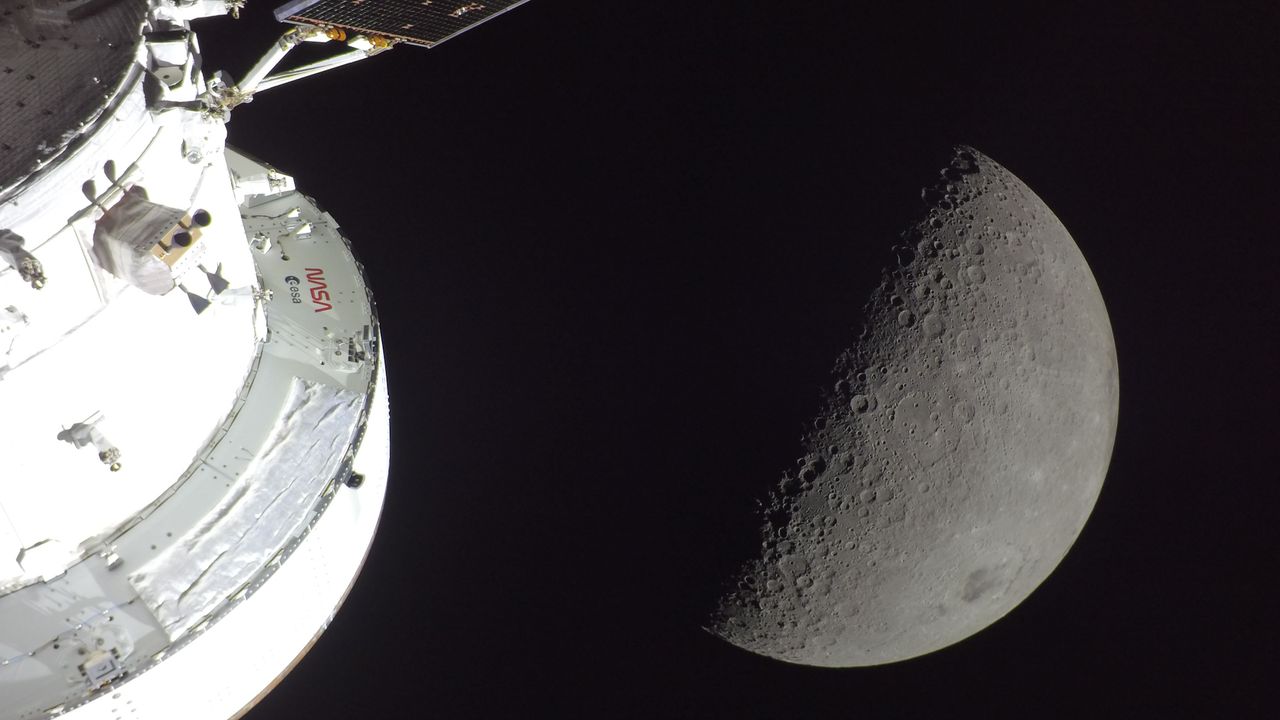
NASA has enough technology to send humans around the moon – but that doesn’t necessarily mean that Artemis II is outfitted with the latest camera technology. Among the 32 cameras aboard, at least one of them is a GoPro Hero4 Black, which launched in October 2014.
The insight comes from the metadata attached to the photos the Artemis II crew have sent back to Earth, which shows that the photos showing part of the Orion spacecraft were captured on a GoPro Hero4 Black. To put things in perspective, the Hero4 is from back when GoPros needed extra housing to actually be waterproof and topped out at 4K 30fps and 12MP stills.

The Hero4 isn’t the only older camera that the Artemis II is using. The crew’s main camera is a Nikon D5, a decade-old DSLR, though a mirrorless Z9 and the iPhone 17 Pro Max are also responsible for some of the Artemis II images. Orion is outfitted with 32 cameras, NASA says.

Getting a camera approved for space isn’t as simple as going to an electronics store. The cameras aboard the Artemis II spaceflight need to be able to withstand the rigours of space, including microgravity and increased radiation. Temperature swings and radiation can damage electronics, and the last place you want to experience a camera failure is on a history-making space mission.
Cameras mounted on the outside of the Orion need to withstand even more, as the friction as the Orion re-enters the Earth’s atmosphere will create excessive heat. According to GoPro, four specially modified GoPros are mounted outside the Orion on the solar array wings. Besides beaming back images that show the spacecraft with the moon and Earth in the distance, the cameras are also used for the crew to visually inspect the exterior of the spacecraft.

When GoPro shared that four cameras were mounted outside Orion and that several were also inside as part of a National Geographic project documenting the daily life during the mission, the company hadn’t shared which GoPros made it aboard. Now, thanks to the metadata attached to images, we know that at least one of those GoPros is an older Hero4 Black.
The older DSLRs and GoPros are likely on board because the cameras have already been proven in space on previous space excursions to the International Space Station. While a more modern Nikon Z9 managed to make it aboard the mission last minute, Nikon has been working with NASA on a modified Z9 since 2024, originally aiming to use the camera with Artemis III – though it’s unclear if the Z9 aboard the Artemis II is a modified one.

I can remember just a few years ago telling someone that I still had the Hero4, and how baffled they were that I still had such an “old” camera. I’ve since updated to the Hero12 Black. But NASA’s use of older cameras serves as a reminder that getting great images doesn’t require updating every time a new model comes out. That should make photographers who have older gear in their bags feel a lot less pressure to upgrade.
While it’s undoubtedly important that the crew has a full-frame camera with a wide dynamic range, excellent low-light performance, and a 400mm zoom to closely inspect the dark side of the moon, an older rugged GoPro is still sending back rather epic-looking images from the mission.
You may also like
Can't get enough Artemis II? Make sure you didn't miss this epic shot of Earth, the recreation of the iconic Earthrise photo, or the views of the total solar eclipse from the mission. Or, take a look at the best action cameras.