
There are more drawing tablets around than ever before, from compact pen displays to Android tablets designed for art creation (like XPPen's own Magic Drawing Pad), and so standing out isn’t easy. Which is why the launch of the XPPen Artist Pro 27 (Gen 2) doesn’t try to be subtle or attempt to find a niche, like the recent Huion Kamvas 22 (Gen 3). This is a big, ambitious, and clearly targeted pen display that wants to draw people away from Wacom’s Cintiq Pro series.
This 26.9-inch 4K pen display is XPPen’s most confident push yet into territory long dominated by Wacom’s Cintiq Pro series, and crucially, at $1,899 / £1,699, it undercuts its direct rival. But despite the price, it’s loaded with tech, including a 120Hz refresh rate, colour volume up to 149% of sRGB, 350-nit brightness, and ten-finger multitouch. Is it as good to use as those specs suggest? Well, that’s always the question.

Having tested everything from entry-level displays to pro-grade studio tablets, found in my best drawing tablets guide, I’ve seen plenty of devices promise ‘pro performance for less’ and always reveal a few caveats to make you think. Few genuinely deliver everything. Now, having used it for a number of weeks, the Artist Pro 27 (Gen 2) comes closer than most; this is genuinely XPPen planting a flag on Wacom’s lawn and declaring ‘game on’.
If you're interested in the Artist Pro 27 (Gen 2), it's worth visiting XPPen's website for bespoke deals.
XPPen Artist Pro 27 (Gen 2): in the box

As is the norm with XPPen, you get everything you need in the box to get set up and start drawing. There are two styluses – the X3 Pro Smart and the X3 Pro Slim - with a pen case and spare nibs, as well as the wireless Quick Key remote (which features 10 programmable shortcuts), USB-C, HDMI, and DisplayPort cables, a Bluetooth receiver, and a power adapter.
With this included, along with the built-in stand, there’s no need to budget for extras. Whether you’re using a desktop or laptop setup, Mac or PC, connectivity is flexible and surprisingly easy to set up. In the past, I'd have fiddled and struggled with settings and cables, but you get what you need, including easily downloaded driver software.
XPPen also bundles its ColorMaster software and colour calibrator, reinforcing its focus on colour accuracy. It’s also a bit of a flex; XPPen is confident its tablet meets the colour accuracy required for pro work, especially for print jobs.
Both styluses use XPPen’s X3 Pro EMR technology and support 16,384 pressure levels, 60-degree tilt, and a 3g activation force – all impressive specs and a little overkill for many, but it means you're set.
XPPen Artist Pro 27 (Gen 2): setting up

Setup is mostly straightforward, though not flawless. There were a few early hiccups during testing, likely due to cable swapping, refresh rate tweaks, and fiddling with Windows settings (Microsoft has its own issues with tablets and touch setup), but once configured, stability is solid and reliable.
The driver software handles pen settings and shortcut mapping and supports four app-specific profiles. However, I feel like it lacks the depth and sophistication of Wacom’s broader software ecosystem and options; while top-level adjustments are fine, granular changes are lacking. It works, however, and XPPen has made great leaps in the last few years to catch up, but it just doesn’t feel as fully versatile as you may have come to expect from Wacom.


For example, while you may be used to having everything under one control panel on Wacom and using Wacom Bridge for more flexible studio work, here on XPPen, calibration across the tablet, Quick Key remote, and colour calibration are handled via separate driver apps. It's not a huge problem, but not quite as seamless as you may want. How much you really need to fiddle and adjust is debatable, and comes down to personal needs too – for me, XPPen does enough
Also, while some software works well with XPPen out of the box, Photoshop and ArtRage, for example, some apps I use – Rebelle, being one – needed some refinement in software, particularly around multi-touch control, to get them working perfectly on the XPPen Artist Pro 27 (Gen 2).
But overall, setting up the XPPen Artist Pro 27 (Gen 2) is easy, especially for a large, complex tablet like this. By and large, it's simply a case of plugging in the cables and getting going. Pro artists will want to play with colour calibration and dig further into the options, and you can, but overall, you'll be up and running in no time at all.
XPPen Artist Pro 27 (Gen 2): design and build

• 26.9-inch 4K (3840 x 2160) LCD
• 120Hz refresh rate
• 5ms response time
• 1.07 billion colours (8-bit + FRC)
• 99% Adobe RGB, 99% sRGB, 97% DCI-P3
• Colour volume up to 149% sRGB
• Delta E < 1, Calman Verified
• 350 nits brightness
• Full lamination
• Etched anti-glare glass (0.7mm)
• Ten-finger multi-touch
At 7kg and 44mm thick, this is a serious lump of hardware. It’s not something you casually move around your desk, and honestly, if you’re buying this tablet, you need a decent studio space or large desk, but that’s all a part of the appeal. Once it’s in place, Artist Pro 27 (Gen 2) feels planted and stable, with no wobble or drift.
The integrated metal stand is a standout for me and a welcome addition. Adjustable from 16 to 72 degrees via a smooth pull-lever mechanism, it moves easily and holds firm at any angle, even when near vertical. Just as importantly, it saves you from buying a separate stand, an added cost with many competing displays.

On-trend wide bezels give you room to rest your hand without triggering touch input, and discreet buttons on the top-right edge handle brightness, touch toggling, and sleep mode. Around the back, a cable cover keeps things tidy, though it’s a little fiddly to secure.
At the top of the panel are slots for stylus holders, a nice touch and one that many new tablets offer. (The included stylus case still doubles as a s stand if needed.) There's currently no option for a keyboard holder, but I'd wager XPPen is already on this.
The lack of on-frame Quick Keys means you need to rely on the included remote, which is a solid little gadget with 10 programmable keys and a digital dial, handy for zooming and brush cycles. You can access floating virtual Quick Keys and set where on the screen these appear, which is a nice touch and a level of sophistication I really appreciate, and there's also a virtual keyboard too – all accessed quickly using three-finger touch control.
Overall, the Artist Pro 27 (Gen 2) continues XPPen’s push for clean, industrial design that’s both understated and undeniably premium to the touch, particularly the fully laminated, etched anti-glare glass display. The smaller details, like the floating virtual Quick Keys and the ability to define where they sit around the screen, show how XPPen is thinking more towards pro users.
XPPen Artist Pro 27 (Gen 2): performance

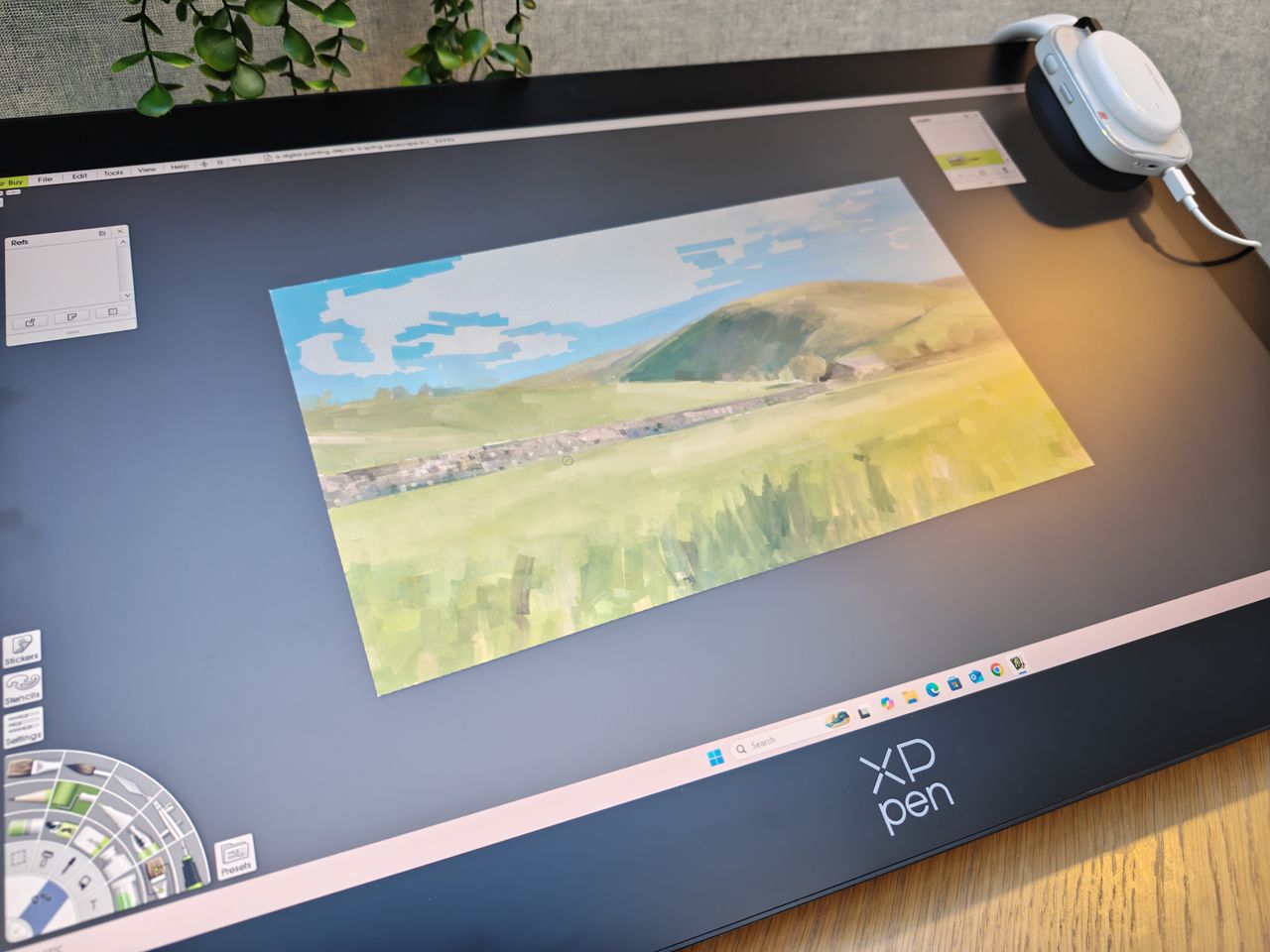
In use, the combination of 4K resolution and 120Hz refresh rate makes a real difference. The extra pixel density gives you more usable canvas space, while the higher refresh rate keeps strokes smooth and responsive. Motion blur is minimal, even during fast sketching. I noticed I could zoom in more closely on areas for detail work in a more practical way than on the previous tablets. My image below is taken with a camera phone (not a screenshot), but trust me, you can zoom right in on this display, and the detail holds up impressively.
Colour performance is excellent across the board. Wide gamut coverage and high colour volume give artwork a rich, vibrant look, especially in Adobe RGB workflows. Gradients appear smooth, with no obvious banding – I did a number of quick-stroke tests, fast circular motions, and squiggles just to see how it performs, and wasn't disappointed. The 120Hz eliminates some of the subtle lag that older 90Hz pen displays can produce.
The etched glass strikes a good balance between grip and glide, and parallax is minimal thanks to full lamination. XPPen claims a 30% improvement in light transmission over previous models, and while that’s hard to judge, what I can say is the display does feel bright and clean to use.

Touch is handled via XPPen’s X-Touch Solution, which supports gestures, custom inputs, and non-touch zones (you can program this to suit) to reduce accidental contact. It works well for navigation, with support on both Windows and macOS, though functionality can vary by software. Rebelle is fine for basic functions – menu selects, canvas rotation, etc., but struggles with zoom controls. Moving to ArtRage 6, it worked perfectly and was nice and zippy when zooming and rotating the canvas.
For a hobbyist like me, touch is great because it lets me move the canvas and access functions easily, and it feels closer to how I doodle on an iPad. But if you’re a pro who dislikes touch control, it can be toggled ‘off’ easily or adjusted in the tablet's driver setup to suit where and how its features are used, whether that's reducing the area on the display where it works or limiting finger inputs.
In practice, the Artist Pro 27 (Gen 2) is simply enjoyable to draw on. Fast strokes feel responsive, with minimal lag, and line accuracy is strong across the display. Pressure handling is smooth and predictable, even if I rarely fully exploit the upper end of the 16K range – you really need to push uncharacteristically hard against the display to hit those top pressure levels.
Speaking of which, in practice, both the styluses feel responsive and precise. The Pro Smart stylus is closer to a traditional pen display feel, while the Slim stylus is lighter and more pencil-like, which I found a little too slim for long sessions. The two styluses are excellent, though Wacom still has the edge in physical customization and expression with its latest Pro Pen 3.
Testing in Rebelle and ArtRage 6, the experience remained consistent (touch issues aside), controlled, precise, and distraction-free. Palm rejection works well, and I never felt the need to reach for the included drawing glove as I have on older displays. The ability to quickly toggle touch is useful when working on finer details. Once everything is set up and I’m happily painting away, the hardware fades into the background, which is exactly what you want.
XPPen Artist Pro 27 (Gen 2): vs Wacom
This is where things get interesting, and it’s probably why you’re here. On hardware alone, the Artist Pro 27 (Gen 2) outpaces the cheaper, smaller Wacom Cintiq 24 Touch in several areas. With the new XPPen, you get a sharper 4K display instead of 1440p, a faster 120Hz refresh rate, and broader colour coverage with higher colour volume.
Comparisons to the flagship Wacom Cintiq Pro 27 are a little closer; the Wacom wins on colour accuracy and has a much better driver ecosystem, pen support, and proven reliability, as well as on-frame ergonomically clever Quick Keys. But Artist Pro 27 (Gen 2)’s core display tech matches up – 4K, 120Hz, touch – and it includes a built-in stand, two stylus and a Quick Key remote.
Wacom still leads in software and ecosystem maturity. Its drivers are more refined, and the new Pro Pen 3 offers greater physical customization. For established studios, that reliability still counts, but for solo artists and prosumers, even hobbyists looking for a cutting-edge, larger display at a good price, the Artist Pro 27 (Gen 2) competes.
This release proves the gap has narrowed significantly, and XPPen’s new tablet meets Wacom head-on in flagship specs at a lower cost. For many freelancers and independent artists, XPPen now offers a compelling alternative to Wacom.
XPPen Artist Pro 27 (Gen 2): who's it for?

The Artist Pro 27 (Gen 2) is a professional-grade pen display, a true flagship, aimed squarely at professional artists, animators, and designers working on colour-critical projects and workflows. The specs match the need, and in use, save a few driver niggles, it really performs, and in fact, is a joy to use.
Also, its pricing and bundled accessories make it an attractive option for serious hobbyists, prosumer, or indeed pro artists who want the best-specced pen display for a little less, especially while building a first-time home studio. If you’re upgrading from a smaller display, the jump in size and resolution is immediately noticeable. But also be warned, 27 inches is large, and you need to plan your space accordingly.
Beginners may find it overkill, and personally, I really like a 22-inch display, but for anyone already committed to digital art, it strikes a strong balance between performance and value.
The XPPen Artist Pro 27 (Gen 2) is well built, thoughtfully designed, and anchored by an excellent 4K, 120Hz display that makes everyday drawing feel smooth and responsive. Driver software and pen customisation still lag slightly behind Wacom, but the gap is no longer as wide as it once was, and at $1,899 / £1,699, with a generous bundle included, the value here is hard to ignore. If you’re prioritising hardware performance over brand loyalty, this is one of the most compelling large pen displays I’ve used.