
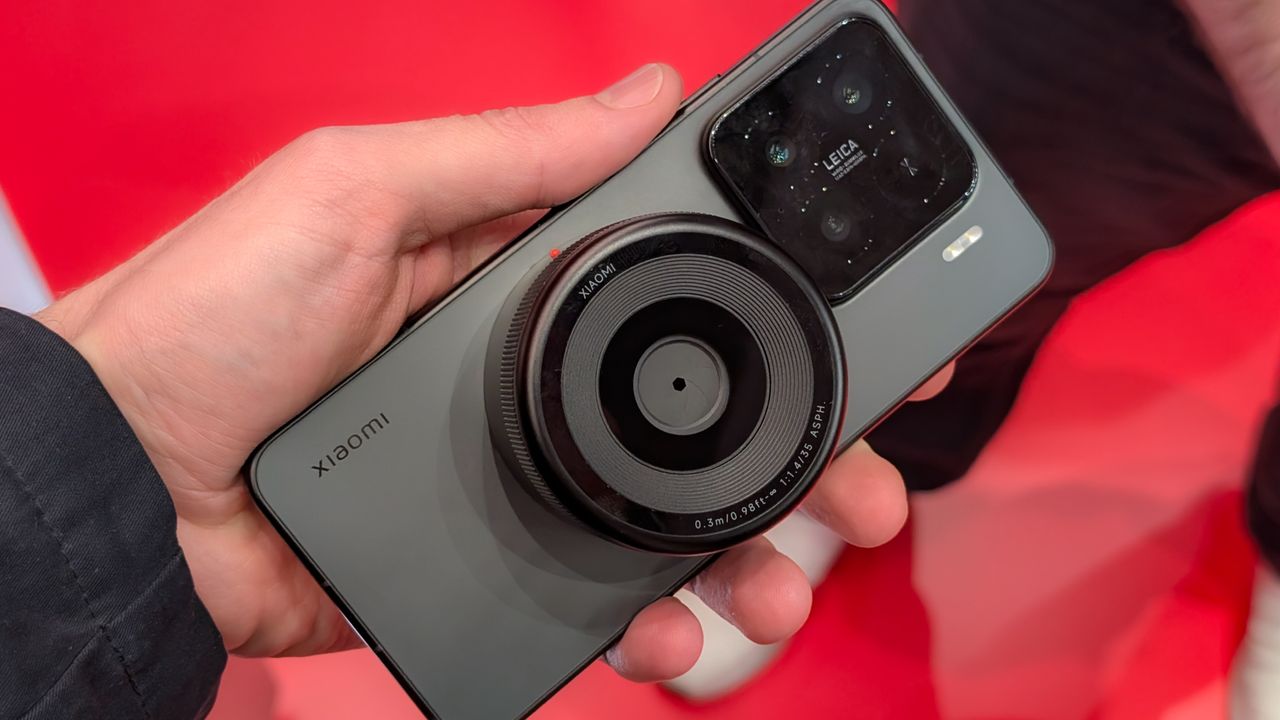
Recent reports from Digital Chat Station suggest that Xiaomi is moving its Modular Optical System, first shown off at MWC 2025, into mass production.
Given its lack of compatibility across other phone brands and limited use even within Xiaomi's own device lineup, with only a prototype Xiaomi 15 supporting the lens, I don't think any of us saw this coming. However, since MWC, it appears that Xiaomi's confidence in the hardware concept has grown significantly to the point that the lab experiment might eventually find its way to a commercial release.

This isn't the first of its kind, with the Sony QX series and Alice Camera forging the way, albeit not terribly successfully. Xiaomi's solution attempts to overcome the 'bulk' of these by utilizing a high-speed LaserLink connection to offload all image processing to the smartphone's internal ISP. That keeps the unit at a lightweight 100g, but it does come with a significant downside.
This LaserLink connection requires specific hardware for the mounting, 10Gbps optical data transfer, and power delivery. This hardware is currently restricted to Xiaomi and even then likely to only be present in a select number of as yet unreleased phones, such as the rumored Xiaomi Mix 5. So, even though it might end up in mass production, how massive the uptake will be, only time will tell.

Impressive specs for a Micro Four Thirds sensor
The Micro Four Thirds 100MP sensor is the same size as used in the best Olympus (OM System) cameras and some top cameras from Panasonic's Lumix range. Impressively, it's even larger than the 1-inch sensor powering the Xiaomi 15 Ultra’s main camera.
Beyond the sensor is a compact 35mm lens, with a max aperture of f/1.4 (min f/11), an all-6G aspherical lens assembly, and a close focus distance of around 20cm. The lens also has both autofocus and manual focus with support for face recognition.
The lens is powered via pogo pins and a magnetic ring mount (akin to Apple’s MagSafe). Our reviews editor, Gareth Bevan, had a very brief hands-on with the system and was able to confirm that the magnetic connection is impressively strong and feels really secure in use.

At MWC, the system was already very polished for a concept, so we can only imagine the refinement that has taken place in the meantime. The design is minimal, the build quality is premium, and the focus ring is nice and smooth.
Gareth says, "The lens is really simple to operate; after snapping it to the back of the phone, the lens is activated in the phone's Pro mode in the camera app menu – this then switches into a dedicated UI for the lens, which is already looking slick."
There's no doubting that Xiaomi has created an outstanding product. What's left to be seen is whether enough people are happy parting with their hard-earned money to own it.
You might also like...
Interested in upping your mobile photography? For more of the best camera phones, check out our guide. And check out the best add-on lenses for smartphones that are already on sale