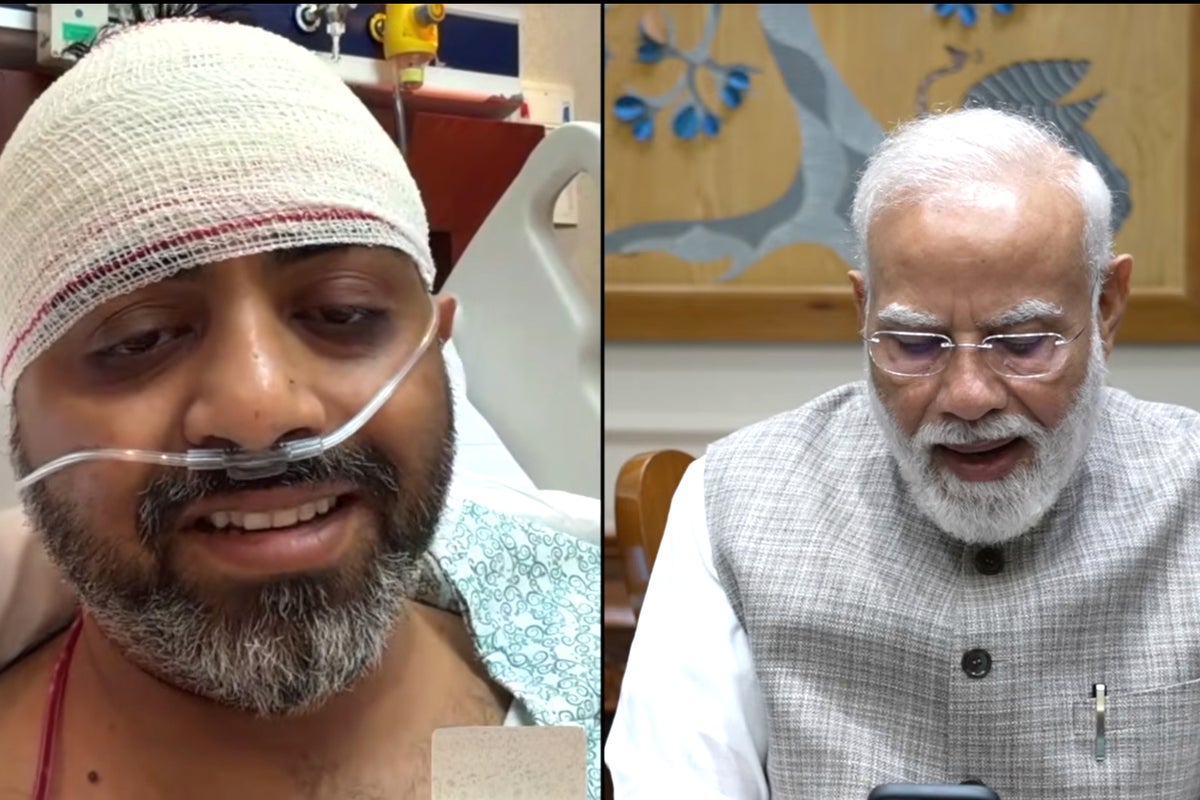
The Indian airline captain who helped thwart an apparent attempt to crash a FlyDubai flight said in a live video call that he knew he had to get back on his feet to save passengers after being stabbed by his co-pilot.
Meanwhile, a Palestinian citizen of Israel who was running in Israel’s upcoming election is withdrawing his candidacy following comments over Hamas’ Oct. 7 attack on Israel.
Here is the latest news from the Middle East on Friday. Full coverage is available here.
Wounded captain says he had to get back on feet to save passengers
The FlyDubai captain told Indian Prime Minister Narendra Modi that he knew he had to get back on his feet to save everyone on board, after he was stabbed by his co-pilot and the aircraft plunged into a steep descent.
“I had so many wounds. I had fallen down,” Capt. Smit Machchhar said from a hospital in Abu Dhabi. “I was fighting for my life. At one point I realized that if I didn’t get up … then passengers would lose their lives.”
Machchhar was seriously injured in Wednesday’s attack but managed to open the cockpit door, allowing passengers to enter and restrain the attacker as the Boeing 737 descended sharply, witnesses and Israeli authorities said.
The flight from Dubai to Tel Aviv, with 182 people on board, was diverted to Tabuk in northwestern Saudi Arabia for an emergency landing.
Israeli Prime Minister Benjamin Netanyahu said the attacker, an Omani national, was arrested in Saudi Arabia. His motive for the attack was not immediately clear.
Israel was set to begin repatriation flights to bring back passengers stranded in the United Arab Emirates after commercial travel between the two countries was suspended following the attack.
— More coverage on the attempt to crash the plane is available here.
Tanker struck in the Strait of Hormuz
A tanker was struck by an “unknown projectile” while transiting outbound through the Strait of Hormuz, the British military said Friday, adding that the attack caused a “small fire and blackout onboard.” There were no reported casualties, the United Kingdom Maritime Trade Operations Center (UKMTO) said. The fire has been extinguished and the tanker continued its transit.
UKMTO did not identify the tanker and there was no immediate claim of responsibility for the attack. Four tankers have recently been hit by projectiles in the critical waterway, bringing the total to five with Friday’s incident, UKMTO said.
Overall ship traffic remains below prewar levels in the Strait of Hormuz, as do shipments of energy products, even though Iran has lost its near-complete chokehold over the crucial waterway thanks to the U.S. Navy's efforts to shepherd oil tankers through the strait. That, along with various pipelines, has allowed Gulf countries to restore oil exports to nearly prewar levels.
Israeli strikes kill 2 people in Gaza City, local health officials say
Two separate Israeli strikes in Gaza City killed two people and wounded at least another, according to health officials at the Shifa hospital and the Palestinian Red Crescent Society.
Israel’s military acknowledged carrying out the strikes, saying that it hit militants in the areas, without elaborating. Separately, the military said that it also killed a “Hamas sniper” in an airstrike in southern Gaza’s Khan Younis area, identifying him as Tamer Hamaida. Palestinian health officials said Hamaida was killed in a strike carried out Thursday night.
The Israeli military’s chief Arabic-language spokesperson, Ella Waweya, said this week that the military targeted 70 militants from Hamas and Islamic Jihad militant groups in the Gaza Strip in September. Palestinians reported a surge in the strikes across the enclave over the past month.
Palestinian running in Israel’s upcoming election withdraws candidacy
Sami Abou Shehadeh, the chairman of the left-wing Balad party, said he would withdraw from Israel’s upcoming election after the country’s Supreme Court president said a majority of justices were prepared to uphold his disqualification.
Abou Shehadeh’s candidacy was challenged over an editorial he wrote in the newspaper Al-Araby al-Jadeed the day after Hamas’ Oct. 7 attack on Israel. The article did not condemn Hamas and argued that it was surprising violence hadn’t erupted earlier given conditions in Gaza.
In a subsequent article, Abou Shehadeh, a former member of Israel’s Knesset, called Hamas’ attack both unacceptable and a crime. He said he hadn’t known the scale of the violence when he wrote the first article.
The court weighed whether his remarks violated an Israeli law barring candidates who reject Israel’s existence, incite racism or support armed struggle against Israel. His lawyers said that barring him would reinterpret the law and create a new threshold.
About 20% of Israel's citizens are of Palestinian descent.
Israeli troops block olive harvest in West Bank
Israeli soldiers have barred Palestinian farmers and activists from harvesting olives in the northern West Bank, according to video footage obtained by The Associated Press.
The footage showed soldiers firing shots in the air and tear gas toward the Palestinian farmers and activists, while settlers were also seen in the area.
Israel's military said troops were deployed following reports of a confrontation, which was dispersed. It added that a security official at the scene fired shots into the air earlier, without elaborating. The military said no one was injured.
The olive harvest season in the West Bank is usually marred by tensions between Palestinian farmers and settlers. Israel has imposed new rules this year, prohibiting Palestinians from harvesting in what’s known as Area C, which is under Israeli security control and encompasses the majority of the territory’s agricultural lands.
Fighting in Yemen as UN raises humanitarian concerns
Intense fighting engulfed a residential area in Yemen’s Taiz City, as clashes between the Iran-backed Houthis and Saudi-backed government forces raised concerns over a worsening humanitarian situation.
The World Food Program warned that renewed fighting in Yemen is worsening an already dire humanitarian situation in a country suffering from severe hunger.
WFP director Matthew Hollingworth said that almost three out of four households are unable to meet their basic food needs.
Shelling by the Houthis on Friday on the residential neighborhood of Wadi al-Qadi in Taiz City injured several people, according to an Associated Press reporter in the city.
___
This report will be updated throughout the day as new developments emerge.