
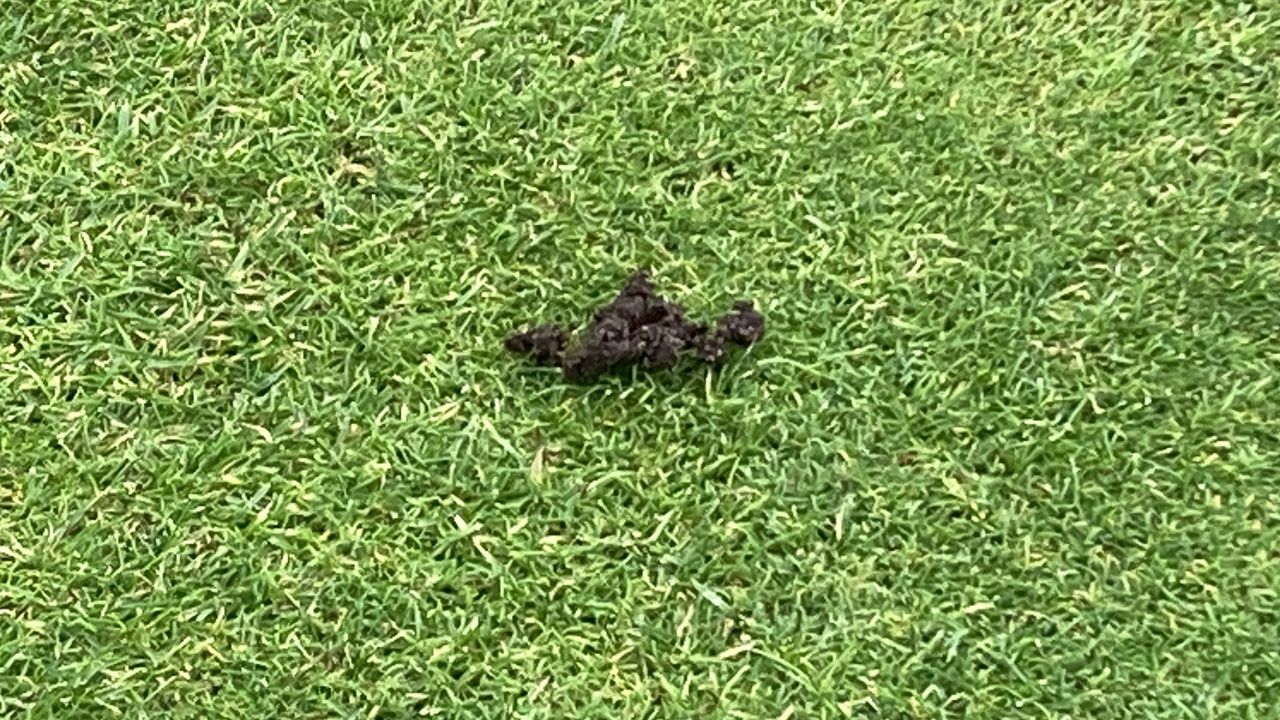
The short answer is no. However there are other things you can do to deal with them without penalty.
Worm casts are the excreted soil left on the surface by burrowing earthworms. There are most prevalent in spring and autumn, particularly in damp conditions.

The Rules of Golf forbid players to ‘press down loose soil”. So if you encounter a worm cast you cannot simply flatten it.
However the Rules of Golf do allow ‘Loose Impediments’ to be removed and the definition of these includes: “Worms, insects and similar animals that can be removed easily, and the mounds or webs they build (such as worm casts and ant hills).”
Therefore a worm cast on the fairway or green can be brushed away, or lifted and removed.
Rule 15.1a states that: “Without penalty, a player may remove a loose impediment anywhere on or off the course, and may do so in any way (such as by using a hand or foot, using a club or other equipment, getting help from others or breaking off part of a loose impediment).”

But, if the action of removing a loose impediment causes the ball to move then the player incurs a one-shot penalty, unless the ball had been at rest on the putting surface.
Local rules
Players should check before starting their round whether a local rule is in place which allows them to pick and clean balls on the fairway. Such rules are often colloquially termed “winter rules.”
Two types of ‘winter rules’ regard cleaning a ball which is on the fairway. The less common local rule is based on Model Local Rule E-2, which says that a ball’s position may be marked and the ball then lifted, cleaned and replaced in the exact same spot.
A more common winter rule, often known as Preferred Lies, allows a ball to be picked up, cleaned and replaced no nearer the hole. But it does not have to be on the exact same spot as before, merely within a defined distance of where the ball was.
It is up to the committee to determine this distance, but typically this is six inches, although the R&A suggests “one club-length, one scorecard length or 6 inches” as options.

It is recommended that you mark the position of your ball before preferring your lie, but there is no penalty if you fail to do so.
So if Preferred Lies are in operation and your ball has ended up in a worm cast, the ball can be cleaned and replaced outside of the worm cast.
But if they are not, and you ball ends in a worm cast, it’s just tough luck. Golf’s overriding principle of “play the ball as it lies” applies.