Get all your news in one place.
100's of premium titles.
One app.
Start reading
The Economic Times
The Economic Times
Trending Desk

World's largest air purifier: Inside China's 20-storey tower designed to clean 10 million cubic metres of air a day

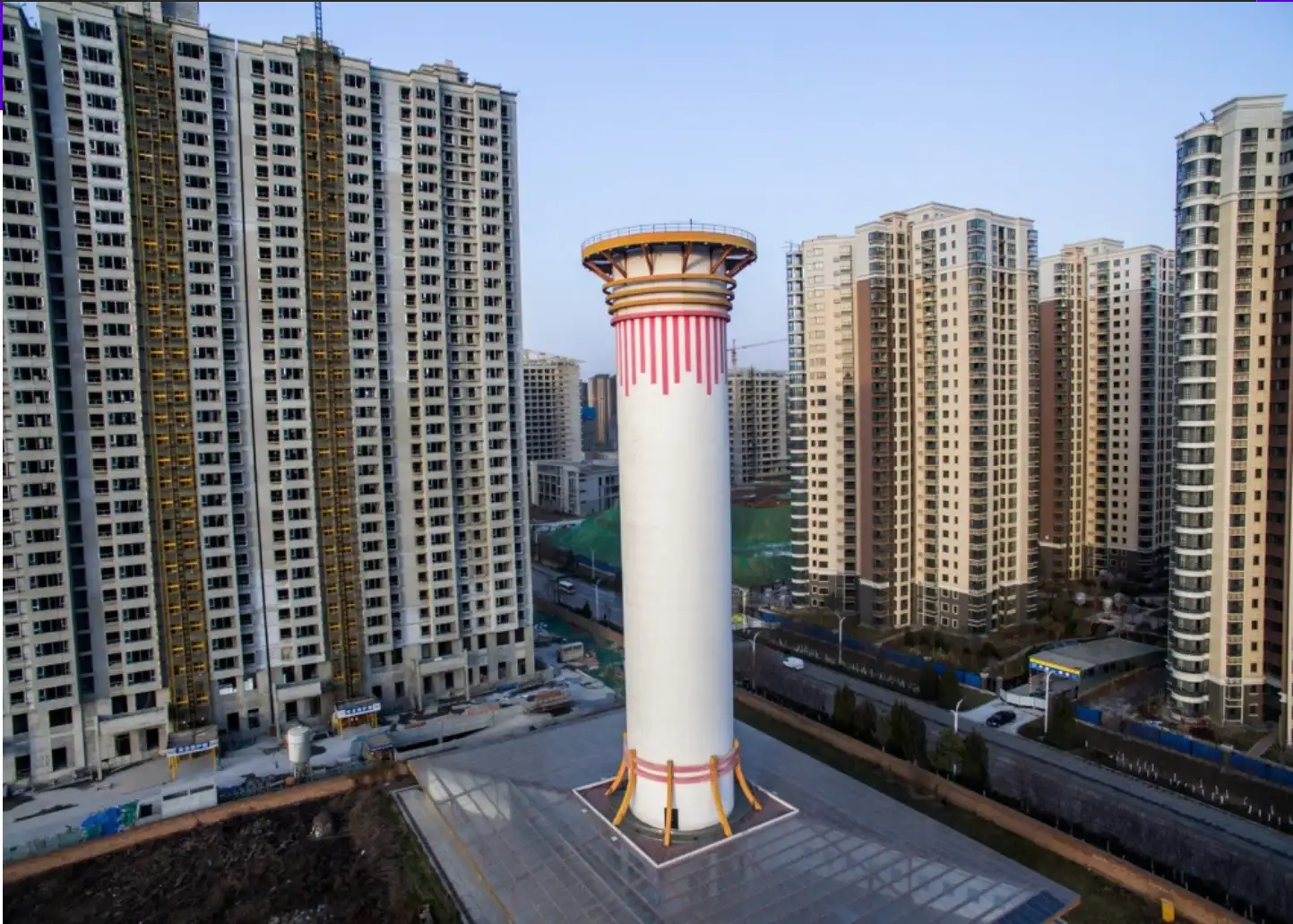
An experimental air purification tower standing more than 100 metres high in northern China showed encouraging results in improving air quality during testing in 2018, according to researchers leading the project. The facility, described by its operators as the world's largest air purifier, reportedly improved air conditions across a 10-square-kilometre area of Xian as authorities explored solutions to the country's long-standing smog problem.

The tower was built in Xian, Shaanxi province, and was undergoing testing by researchers from the Chinese Academy of Sciences' Institute of Earth Environment.

Researchers reported reduction in pollution levels

Project leader Cao Junji said the tower had produced more than 10 million cubic metres of clean air a day since becoming operational. He added that on heavily polluted days, the system was able to reduce smog to near-moderate levels.

To assess the tower's effectiveness, the research team established more than a dozen monitoring stations in the surrounding area. Data collected during periods of heavy pollution showed an average 15 per cent reduction in PM2.5 concentrations, the fine particles considered most harmful to human health.

Cao said the findings were preliminary because the experiment was still ongoing. The team planned to release more detailed data and a comprehensive scientific assessment of the facility's performance in March.

Solar-powered design filtered polluted air

The system operated through a network of greenhouses surrounding the base of the tower and covering roughly half the area of a football field.

Polluted air was drawn into the glass structures, heated by solar energy and channelled upward through the tower. As the air rose, it passed through multiple layers of filters designed to remove contaminants.

According to Cao, the tower was unmatched in scale and had delivered encouraging results during the testing phase.

Facility designed to function during winter

Xian frequently experienced severe winter pollution because much of the city's heating relied on coal.

The tower's operators said the system remained effective during colder months because special coatings on the greenhouse glass increased the absorption of solar radiation. Cao also noted that the facility required very little power during daylight hours.

Project aimed to develop low-cost pollution control technology

The Xian smog tower project was launched in 2015, and construction was completed in 2017 in the Chang'an district development zone. Researchers developed the project to identify an effective and low-cost method of removing pollutants from the atmosphere. The cost of the project was not disclosed.

At the time, the structure was significantly larger than a seven-metre smog tower installed at Beijing's 798 creative park by Dutch artist Daan Roosegaarde. That installation produced about eight cubic metres of clean air per second and operated entirely on electricity.

Residents gave mixed reviews of air quality improvements

Several residents in Xian told the South China Morning Post in 2018 that they had noticed changes in air quality after the tower began operating.

A restaurant manager located about one kilometre northwest of the facility said she had observed cleaner air during the winter months, despite not previously knowing the tower's purpose.

A student studying environmental science at Shaanxi Normal University, situated a few hundred metres from the tower, also said the improvement was noticeable. She described the structure as quiet despite its size and said she had no doubt that air quality had improved.

However, a teacher at Meilun Tiancheng Kindergarten, located near the edge of the monitored zone, said she had not experienced any difference and felt pollution levels remained comparable to those elsewhere in the city.

Researchers envisioned a larger version

The experimental facility in Xian was a scaled-down version of a much larger smog tower that Cao and his colleagues hoped to build in other Chinese cities in the future.

According to a patent application filed in 2014, the proposed full-scale tower would stand 500 metres high and have a diameter of 200 metres. The associated greenhouse structures could cover nearly 30 square kilometres and would be capable of purifying the air of a small city.

Sign up to read this article
Read news from 100's of titles, curated specifically for you.
Already a member? Sign in here
Related Stories
Top stories on inkl right now
One subscription that gives you access to news from hundreds of sites
Already a member? Sign in here
Our Picks
Fourteen days free
Download the app
One app. One membership.
100+ trusted global sources.