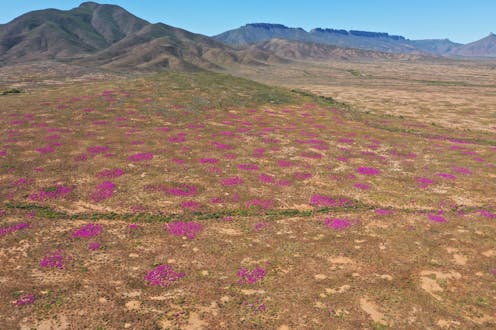
The landscape along the Buffels River in South Africa’s Namaqualand region is dotted with thousands of sandy mounds that occupy about 20% of the surface area. These heuweltjies, as the locals call them (the word means “little hills” in Afrikaans), are termite mounds, inhabited by an underground network of tunnels and nests of the southern harvester termite, Microhodotermes viator.
I’m part of a group of earth scientists who, in 2021, set out to study why the groundwater in the area, around 530km from Cape Town, is saline. The groundwater salinity seemed to be specifically related to the location of these heuweltjies. We used radiocarbon dating; dating the mounds, we reasoned, would allow us to see when minerals that were stored in the mounds were flushed to the groundwater.