Get all your news in one place.
100’s of premium titles.
One app.
Start reading
The Times of India
The Times of India
World
TOI World Desk

World’s largest iceberg A23a from Antarctica is finally breaking apart after 40 years at sea

One of the largest and oldest icebergs is now melting very quickly, ending its 40-year journey across the southern ocean. According to Dr Andrew Meijers, an oceanographer at the British Antarctic Survey, the largest iceberg on the planet, A23a, is breaking up fairly dramatically because the South Atlantic waters are too warm for it to survive. While the melting ice releases vital mineral-rich dust that triggers massive blooms of microscopic phytoplankton, essentially fertilising the marine food web, the physical presence of such a massive berg poses a threat.

If the fragments ground in shallow waters, they could block the essential "daily food run" for local seal and penguin populations, forcing them to take long, exhausting detours to find nourishment for their young. Additionally, the rapid influx of freshwater into the salty ocean currents may disrupt regional circulation patterns, potentially altering local climates.

Ecological impact after A23a breaking on South Georgia

Mostly large icebergs that reside near the islands, like South Georgia, can become a physical barrier for penguins and seals, blocking their old route, from which they used to reach feeding grounds. If these predators are forced to take long routes to reach their feeding grounds, it could lead to the starvation of their young during the breeding season. Even adult animals have to expend significantly more energy and return with less food. The BAS scientists quoted that a similar event had happened back in 2004, when the event saw the deaths of many young animals near the Ross Sea area.

The largest iceberg, A23a, weighing almost a trillion tonnes, once broke away from Antarctica’s Filchner-Ronne Ice Shelf back in 1986. But for a long time, it didn't move because it was stuck to the ocean floor in the Weddell Sea. When Iceberg A23a calved from the Filchner Ice Shelf in 1986, it took the Druzhnaya 1 research station along with it. The station had been a seasonal field camp used by Soviet scientists since 1975 for topographic and geodetic mapping. Now, it has finally started breaking apart into the warmer water of the Atlantic Ocean in 2020. And scientists from NASA and BAS have noticed that this iceberg is now rapidly breaking apart.

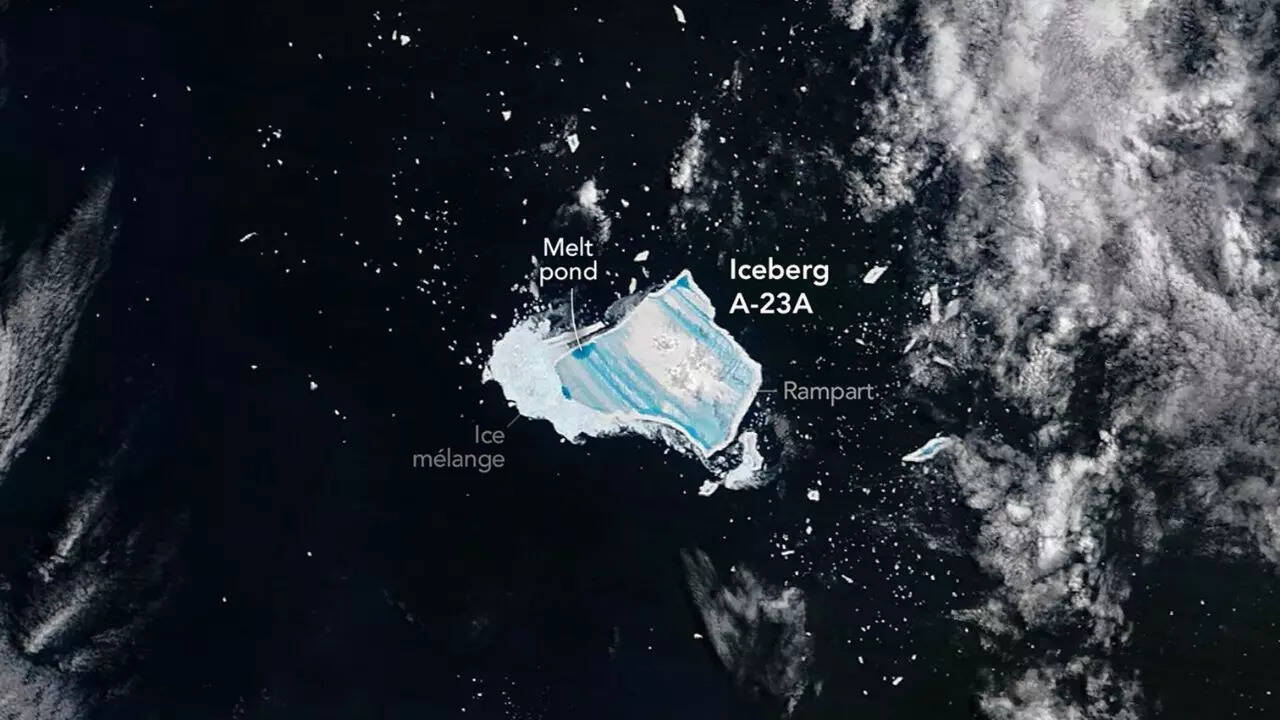
The warmer water and waves are causing the ice to crack and shrink from its original 4,000 square kilometres to just 180 square kilometres. As the iceberg is disappearing, it actually helps the ocean, as the ice dissolves, it leaves minerals and nutrients that are very useful for tiny sea creatures and plants.

NASA explains why iceberg A23a is rapidly breaking up

According to NASA and the British Antarctic Survey, satellite observations reveal that the "ailing megaberg" is now heavily waterlogged and has developed large, brilliant blue meltwater pools on its surface. This indirectly results in warmer air temperatures, which trigger a process known as hydrofracturing.

In this journey, the weight of the surface meltwater forces internal cracks to punch through the entire thickness of the ice, causing the structure to shatter into smaller fragments. Over time, this constant erosion from both warm air and 10 degree celcius ocean currents has caused the iceberg to shrink from its original 4,000 square kilometres to just a small fraction of its former size.

Sign up to read this article
Read news from 100’s of titles, curated specifically for you.
Already a member? Sign in here
Related Stories
Top stories on inkl right now
One subscription that gives you access to news from hundreds of sites
Already a member? Sign in here
Our Picks
Fourteen days free
Download the app
One app. One membership.
100+ trusted global sources.