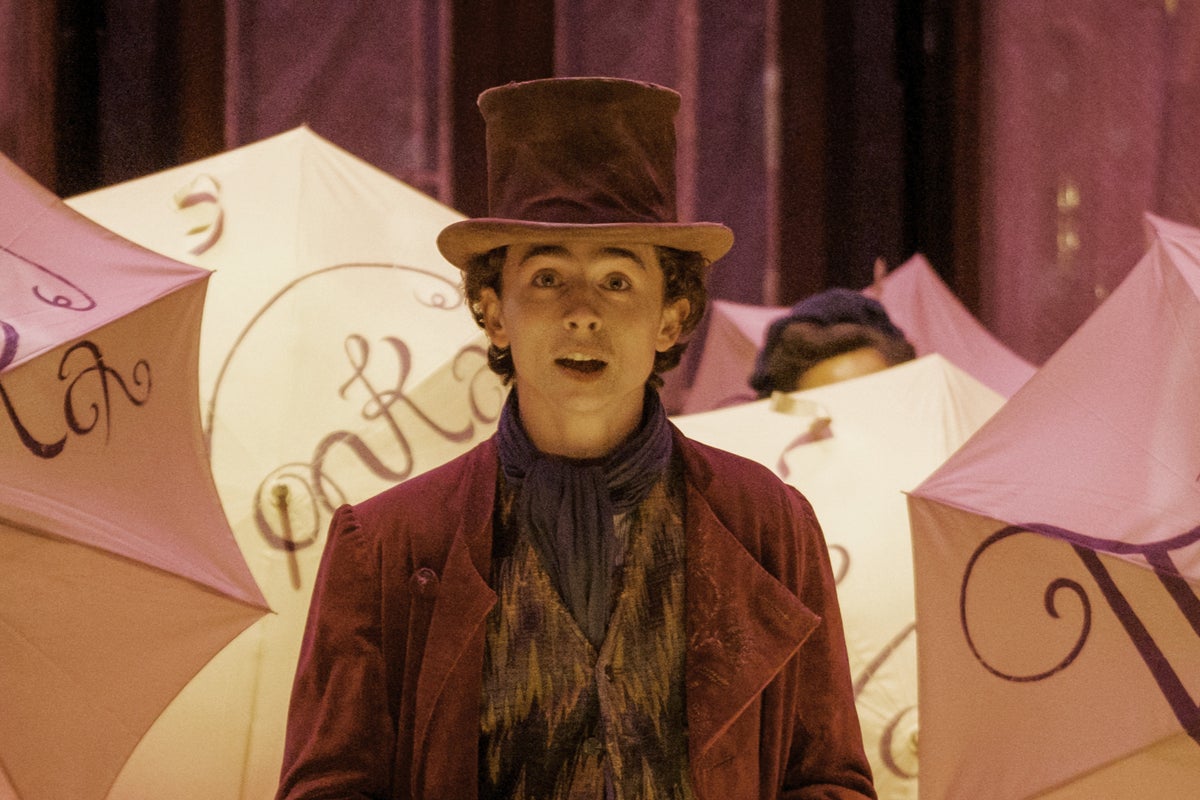
Against the odds, Wonka is a winner. It was supposed to be the prequel nobody asked for, an utterly unnecessary addendum to one of the great works of children’s fiction, Charlie and the Chocolate Factory. It seemed like it was addled by unflattering CGI. Its buzzy young star, Timothée Chalamet, was miscast – how could anyone fill Gene Wilder’s shoes? Now that critics have actually seen it, a fair portion of humble pie has been doled out. (Or perhaps some kind of humble pie-flavoured nougat bar, whipped up by the orange boys in the lab.) Wonka is a great movie. But a great Roald Dahl adaptation it is not. Instead, we have a jaunty original caper about making one’s name in the world, which bears little resemblance to the eternal morality tale that inspired it.
Dahl’s inimitable children’s fiction has come under renewed scrutiny in recent years, with some of the more problematic or bigoted elements of his writing being controversially excised from recent republishings of his books. Despite cries of “cancel culture”, however, much of Dahl’s beloved oeuvre has proved immune to any sort of scrapheaping. Amid the furore, Dahl’s work has continued to be enthusiastically adapted for the screen. In just the past few years, we’ve had Steven Spielberg’s The BFG, Robert Zemeckis’s The Witches, and Matilda the Musical, while Netflix signed a splashy long-term deal with the Roald Dahl Company. An impressive quartet of live-action shorts by Wes Anderson (The Wonderful Story of Henry Sugar, The Swan, The Rat Catcher, and Poison) have already been released on the streamer; adaptations of The Twits and two animated Charlie and the Chocolate Factory takes (the latter written and directed by Taika Waititi) are set to follow. There’s never been more interest in adapting Dahl for the screen. And as Wonka and Anderson’s shorts show, the results can be impressive. But in the flattening of Dahl’s work into a product, an Intellectual Property to be built upon, elasticised and re-interpreted, something singular and special is being lost.