Get all your news in one place.
100’s of premium titles.
One app.
Start reading
We Got This Covered
We Got This Covered
William Kennedy

Woman spots hexagons in the night sky. Then she learns she’s not the only one seeing them

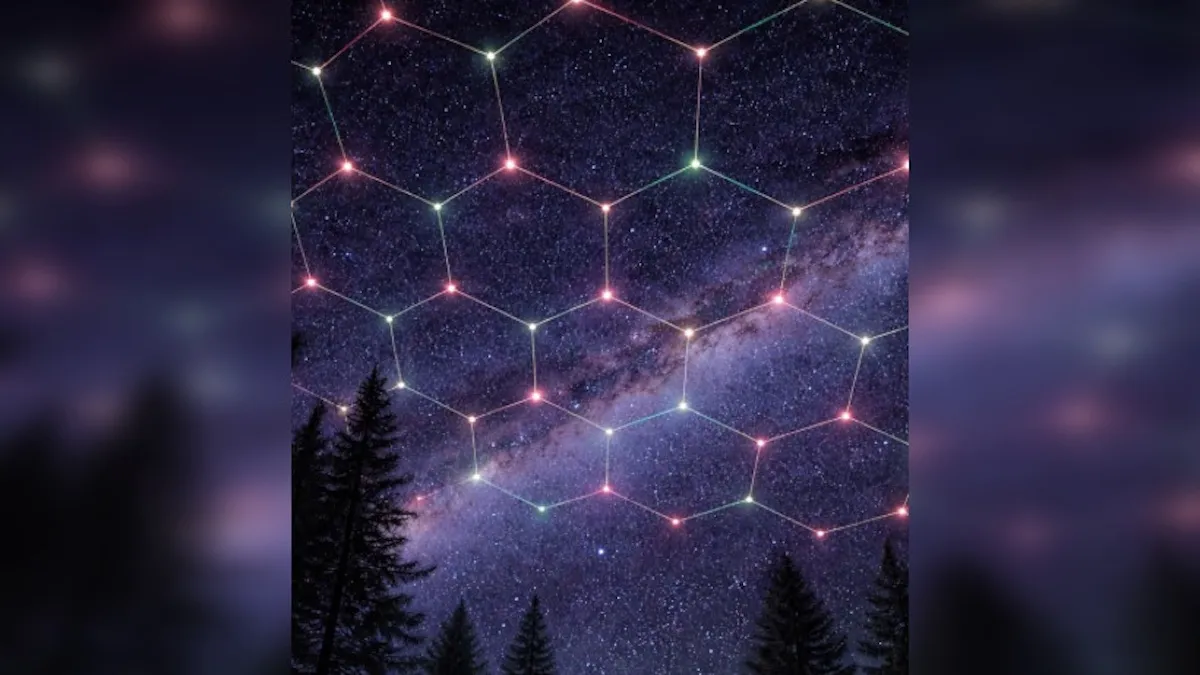
A woman has shared an AI rendering of a hexagonal pattern in the sky she saw while hiking with her boyfriend at night. Many report seeing the same thing, calling it evidence of a “flat Earth dome” or “simulation theory.” Others offer more scientific explanations.

In her post on Reddit, Marley1509 wrote in part, “Yesterday, while we were in a forest looking at the night sky, my boyfriend and I observed something that really caught our attention.” She said they both saw the same thing, as if the stars appeared to be connected by very thin lines, “like barely visible lasers,” she added, “forming a kind of mesh or geometric pattern (hexagons). It wasn’t bright or exaggerated, but rather subtle, yet clearly visible to both of us at the same time.”

“I’m attaching an image generated by AI,” the post said, “that I made only as a visual reference, since it closely resembles what we saw.”

“It’s common”

Comment chimed in, with many reporting similar sightings. One claimed, “It’s common and commonly reported as some kind of paranormal phenomenon or evidence of flat earth dome or simulation hypothesis.”

The flat Earth dome idea stems from a belief that the planet is not a sphere but a flat plane covered by a protective, dome-like structure, sometimes linked to unusual sky phenomena.

Meanwhile, the simulation hypothesis posits that our reality might be a computer-generated simulation, and anomalies in the sky or unusual visual effects are sometimes interpreted as glitches or artifacts within that system.

Both concepts, though widely debated and largely dismissed by mainstream science, often surface in discussions attempting to explain mysterious or unexplained observations.

It could be visual snow syndrome

Conspiracy theories aside, that same comment went on to add, “Here’s a neurological condition, visual snow syndrome, that creates visual noise and what would cause some people to interpret noise as patterns. Black background really enhances the effect (I have this).”

This can make ordinary patterns, reflections, or lights appear unusual or exaggerated, and for some, especially against dark backgrounds, the brain may try to make sense of the noise, leading to perceived shapes or anomalies. Many sufferers report that this visual disturbance can mimic things that others might interpret as paranormal, supernatural, or even signs of artificial constructs like a ‘simulation.’

Another comment suggested it could just be her brain looking for patterns in a place where there is little stimulus, such as a black sky at night, “or it’s something similar to the grid and other visual patterns people see when doing certain drugs.”

The comment said, “Not saying you did drugs, but that the brain generates visual patterns and a lot of that has to do with the different neurons that detect vertical lines, horizontal lines, etc., getting stimulated without other visual stimuli.”

Whether viewed through a lens of science, speculation, or personal experience, posts like Marley1509’s highlight how easily the line between the mysterious and the explainable can blur, reminding us that the night sky still has the power to intrigue, perplex, and inspire debate.

Sign up to read this article
Read news from 100’s of titles, curated specifically for you.
Already a member? Sign in here
Related Stories
Top stories on inkl right now
One subscription that gives you access to news from hundreds of sites
Already a member? Sign in here
Our Picks
Fourteen days free
Download the app
One app. One membership.
100+ trusted global sources.