Get all your news in one place.
100’s of premium titles.
One app.
Start reading
The Conversation
The Conversation
David M Watson, Professor in Ecology, Charles Sturt University

With thousands of feral horses gone, Kosciuszko’s fragile ecosystems are slowly recovering

Author supplied , CC BY-ND

In Kosciuszko National Park in Australia’s alpine region, the landscape is slowly changing. Patches of native vegetation cropped bald by horses are regrowing. Some long-eroded creek banks look less compacted along the edges. Visitors come across fewer horses standing on the roads, a real traffic hazard.

In 2023, New South Wales authorised the aerial shooting of feral horses in Kosciuszko National Park. And in late November, the government passed a bill to repeal the law that recognised feral horses as having “heritage status” in the park.
This change removed the legal protections on horses in Kosciuszko that had set them apart from other introduced species such as deer, pigs, foxes and rabbits. Now horses will be treated the same way as other invasive species across Australia, restoring consistency to managing their impact on the landscape.

The latest survey estimates around 3,000 horses remain in Kosciuszko National Park, down from roughly 17,000 a year ago. More than 9,000 horses have been culled since 2021.

The current management plan is designed to retain 3,000 horses – a compromise between ecological protection and perceived heritage values. It will remain in place until mid-2027.

So what are the environmental effects of having fewer horses in Kosciuszko? And what could the park look like in the future?

A white horse stands in a pond in an alpine landscape.
Stallion standing in an alpine sphagnum bog. Author supplied, CC BY-ND

The damage

For decades, feral horses have been a major source of ecological damage in Kosciuszko’s alpine landscapes. Their impacts have been especially pronounced in the past decade, as horse numbers within the fragile high country grew largely unchecked.

Empirical studies and analyses of satellite imagery show horses reduce vegetation cover, break down soil structure, and damage streambanks, peat beds and alpine bogs – carbon-rich soils built over tens of thousands of years.

Some of this damage results from their feeding on slow-growing alpine grasses and herbs. Horses typically eat 2% of their body mass daily, which equates to about 8 kilograms each day. Compare this to the largest native herbivore in the high country, the Eastern Grey Kangaroo, which eats roughly 600 grams per day, a 13-fold difference.

But the real damage is done by their feet. Feral horses walk up to 50 kilometres a day, and their hard hooves collapse the sphagnum moss layers and compact the deep peat soils. These plants and soils normally act like slow-release water sponges, storing snowmelt and feeding streams throughout summer. And unlike wombats, kangaroos and other native wildlife, feral horses follow each other in single file, making deep walking paths that crisscross alpine meadows, draining them dry.


Read more: Feral horses in Australia's high country are damaging peatlands, decreasing carbon stores


Those changes affect the whole ecosystem. Alpine skinks, broad-toothed rats, corroboree frogs, mountain pygmy possums, and native fish all depend on dense vegetation, intact moss beds or sediment-free streams — the very features horses degrade.

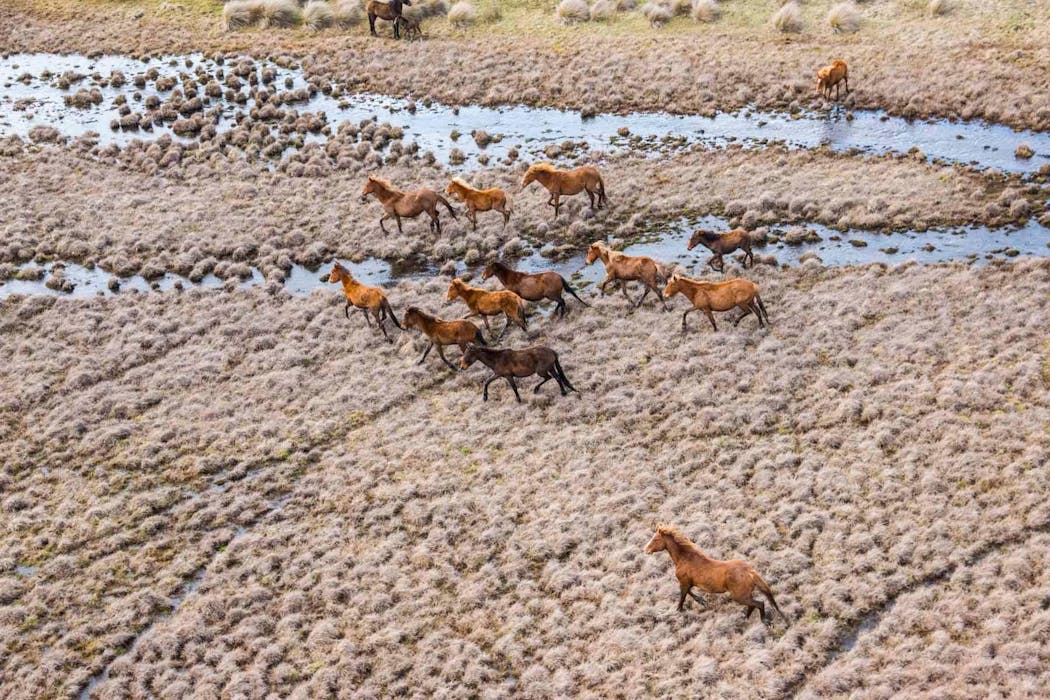
A mob of brown horses crosses an alpine river
A mob of feral horses crossing a river in Kosciuszko National Park. Author supplied, CC BY-ND

Waterways have been hit especially hard. The Australian Alps supply nearly a third of the surface water that enters the Murray–Darling Basin, yet horse trampling around waterways muddies clear streams and destabilises the slow, steady inflows on which these catchments rely.

These impacts aren’t confined to the park. In recent years, large numbers of horses have moved into adjoining areas, including state forests, where their disturbance compounds the effects of commercial logging and endangers visitors and overnight campers.

Although most attention about horse impacts have focused on Kosciuszko and alpine ecosystems more generally, almost half a million feral horses affect landscapes Australia-wide, with tropical woodlands and semi-arid rangelands hardest hit.

An alpine creek, its bank muddied by horse hoofprints.
An alpine creek bank, its peaty soil eroded from horse tracks. Author supplied, CC BY-ND

What we’ve seen so far

We have spent a lot of time working in the park over the past year. And we’ve begun to notice small shifts in the high country that align with what we’d expect from feral animal control.

We’ve spotted fewer horses during our days in the field. In areas that were repeatedly trampled, tiny pockets of vegetation are creeping into bare patches. Even some long-eroded banks look softer at the edges.

These impressions are strictly anecdotal, not formal evidence. But they hint at a landscape starting to breathe again as the pressure eases.

And there’s a safety element too. Anyone who drives the alpine roads knows the shock of rounding a bend among the snowgums to find a horse, or an entire mob, standing on the bitumen. Fewer horses mean fewer of those dangerous encounters for researchers, National Parks staff, and visitors alike.

The slow return

With far fewer horses in the high country, these pressures are beginning to ease.

As trampling declines, bogs and fens are expected to start recovering and hold water for longer. Moss beds will start to regrow and other peat-forming plants will be able to regain a foothold in soils that aren’t constantly compacted and overgrazed.

Less grazing means alpine herbs, sedges and snow-grass have room to return. Bare ground stabilises. Stream edges settle. Creeklines begin to clear.

Pebbles lie on the bottom of a clear alpine stream.
A rocky alpine stream beneath the main range in Kosciusko National Park. Author supplied, CC BY-ND

Those improvements flow upwards: more stable soils and denser vegetation creates better habitat for the frogs, skinks, small mammals and invertebrates that rely on cool, wet, structured alpine environments.

Recovery will take time – decades, not months. Long-term empirical studies will be essential to show what is changing and identify parts of the park where targeted restoration efforts will be needed to hasten recovery.

Finally, a real chance

None of this will happen quickly.

Alpine ecosystems heal slowly, and decades of damage can’t be undone overnight. Short growing seasons mean plants return gradually, not in sudden flushes. Many slopes and creeklines still show the scars of cattle grazing more than 60 years after livestock were removed. Disturbance lingers here for generations.

Lower horse numbers are only a beginning, but they’re the essential first step. And now — with fewer horses on the ground and the legal barriers removed — Kosciuszko finally has a realistic path to recovery. The coming decade will determine how much of its fragile alpine heritage can be restored.

An alpine creek snakes through small trees and snow.
The delicate alpine ecosystem of Kosciuszko National Park. Author Supplied, CC BY-ND
The Conversation

David M Watson receives research funding from the Federal Government (through ARC, DAFF, DCCEEW), and is on the board of the Holbrook Landcare Network and the Great Eastern Ranges. He served two terms on the NSW Threatened Species Scientific Committee, prior to resigning when the Wild Horse Heritage Act became law in June 2018.

Patrick Finnerty is the current director for early career ecology at the Ecological Society of Australia, the Early Career Coordinator at the Australasian Wildlife Management Society, and a council member for the Royal Zoological Society of NSW. He receives funding from the Australian Research Council.

This article was originally published on The Conversation. Read the original article.

Sign up to read this article
Read news from 100’s of titles, curated specifically for you.
Already a member? Sign in here
Related Stories
Top stories on inkl right now
One subscription that gives you access to news from hundreds of sites
Already a member? Sign in here
Our Picks
Fourteen days free
Download the app
One app. One membership.
100+ trusted global sources.