
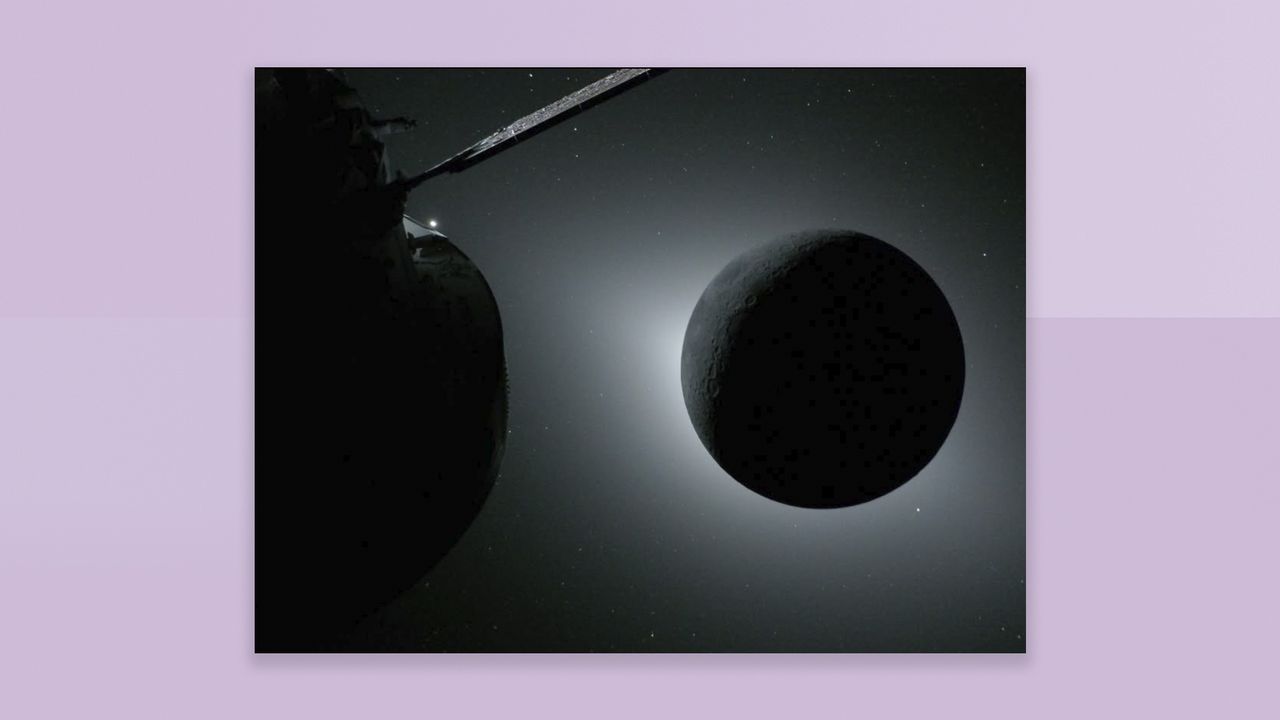
GoPro has quietly dropped some of the most striking space images we’ve seen in years, and they didn’t come from a traditional space camera.
The Artemis II mission will go down in history for a number of reasons, one of which is the variety of cameras the crew used to capture stunning photos of the Earth and the Moon.

Some of the most iconic shots we've seen so far were captured with an iPhone, while others were shot with a 10-year-old DSLR (the very capable Nikon D5) to capture those stunning space shots.
And while all images are beautiful, the ones that really blew my mind are GoPro's, which shared five photos from the mission on its social media over the last few days.
These include everything from Earthset behind the Moon to a near-total solar eclipse seen from deep space.
One frame captures the Moon in shadow with a glowing halo of sunlight, while another shows the Orion spacecraft drifting past a sharply detailed lunar surface.
There’s even a shot featuring Saturn and Mars as tiny points of light, something you’d expect from a telescope, not an action camera.
According to the captions, the footage was captured using a GoPro mounted on the Orion spacecraft during the crew’s journey.
Crucially, GoPro hasn’t confirmed which camera was used, a not-so-subtle hint at what’s coming next.
The omission that feels deliberate
As previously reported, GoPro is expected to unveil a new generation of cameras at NAB 2026 next week, powered by its upcoming GP3 chip.
The company has already teased major improvements in low-light performance, and if the space photos were taken using the next-gen GoPros, they appear to back that up.
Capturing usable footage in space is no small feat: lighting conditions shift dramatically, contrast levels are extreme, and noise can easily ruin darker scenes.
Yet these images look clean, detailed, sharp and surprisingly well-exposed.
It's worth reiterating that even though GoPros were always famous for their image quality, the photos shared by the brand are next-level stuff.
If this is indeed early output from a GP3-powered camera, it suggests that GoPro is finally addressing one of its biggest weaknesses: low-light shooting.
That said, the gorgeous photos raise more questions than they answer.
Is the camera positioned inside or outside the craft? How big is it? Does it use interchangeable lenses? Is GoPro operating it remotely, or are NASA / the astronauts responsible for the images?
The mission behind the moment
The Artemis II mission marks a major milestone for NASA, sending astronauts on a crewed journey around the Moon for the first time in over 50 years.
The Orion spacecraft has been orbiting and documenting the lunar environment, with astronauts expected to return to Earth shortly after completing their planned trajectory around the Moon.
While the mission itself is historic, it’s also becoming an unexpected showcase for consumer camera tech operating in one of the harshest environments imaginable.
And if these images are anything to go by, GoPro’s next move could be its most important in years.