
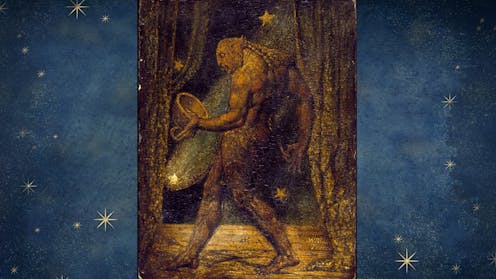
In William Blake’s painting The Ghost of a Flea (1820) a huge muscled figure fills the frame. He steps forward, the left side of his body towards the viewer. In one outstretched hand he holds a bleeding bowl (used to catch the blood released during bloodletting) made from an acorn. In the other, a curved thorn stands in for a knife. His tongue protrudes from between his teeth and his eyes bulge from his head. His ears are pointed with frills, or gills, almost reptilian.
White paint dots his eye, so that he appears to be both looking ahead and looking at us. He is stood on a stage between curtains with a backdrop of stars, one falling in a blaze of light. He is at once light and heavy, balanced on his toes as if he is engaged in a dance, or creeping towards his victim.












