Get all your news in one place.
100’s of premium titles.
One app.
Start reading
LiveScience
LiveScience
Stephanie Pappas

California's wildfire season is shifting, with more blazes after the traditional high-risk window, study finds

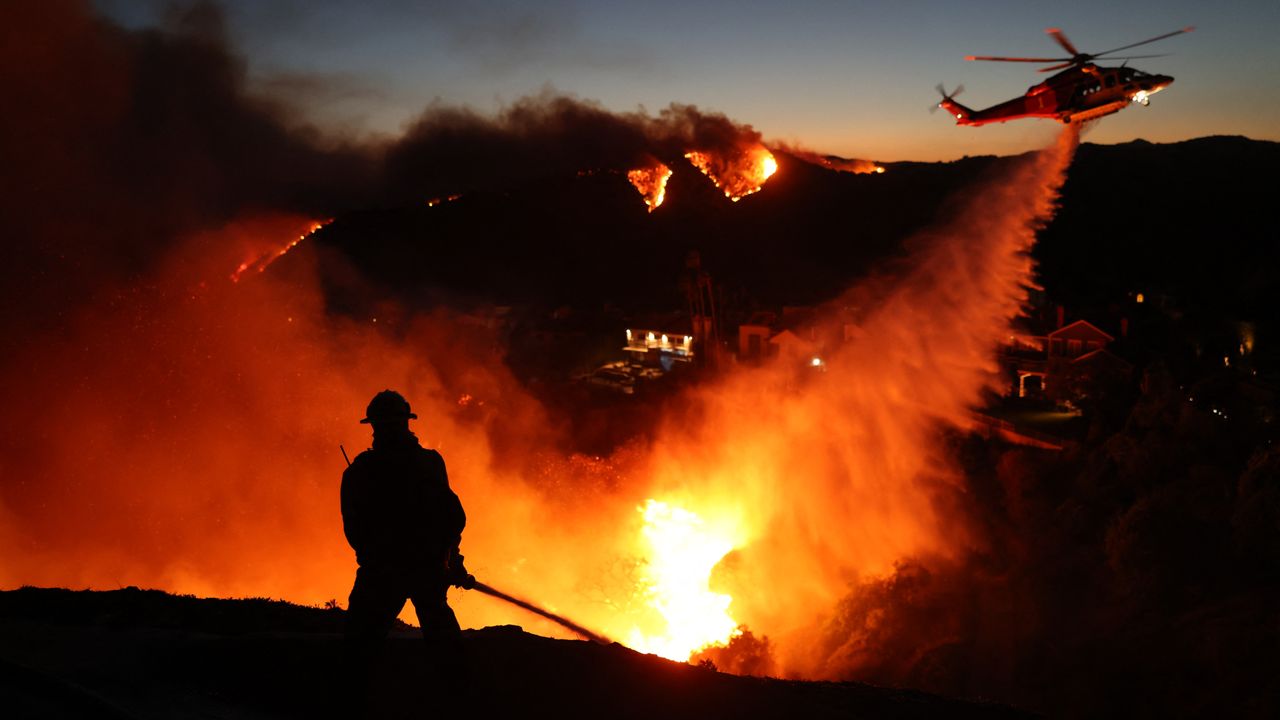
A firefighter is silhouetted in the glowing orange and yellow blaze of a wildfire as a helicopter above dumps a stream of water below.

Climate change is shifting wildfire seasons in North America, but the direction of the shift depends on the regional ecosystem, a new study shows.

The fire season in the northern boreal forests of Alaska and Canada have shifted forward, on average; prairie regions have seen little change; and the fire season in the arid West and California has extended further into late fall and winter. The findings were published Feb. 24 in the journal Geophysical Research Letters.

"It's very region-specific," said Hongliang Zhang, an environmental scientist at Fudan University in China. Understanding these specific shifts are important for managing wildfires and preparing resources for the worst parts of the fire season, Zhang told Live Science. Seasonal patterns are also important for predicting the health impacts of wildfire smoke, which can be severe.

Zhang and his colleagues used data on burn area in North America from 2001 to 2020 taken from the Moderate Resolution Imaging Spectroradiometer (MODIS) instrument on NASA's Aqua and Terra satellites. They also gathered data on meteorological variables, vegetation, lightning potential and other environmental factors at the time of the fires.

They found that the boreal forest, or taiga, of Canada, Alaska and the Great Lakes region is seeing earlier fires. This is due to earlier snowmelt, and thus earlier dryness of fuels. Canada experienced its worst wildfire season in 2023 and its second-worst just two years later.

The warm desert Southwest and the Mediterranean-like climate region of California saw a lengthening of the fire season, with more fires burning after the traditional high-risk window.

Prairies and grasslands experienced slight changes in fire season intensity and minimal change in seasonal timing. The Appalachians and Southeastern forests also saw little in the way of seasonal shifts.

The researchers also modeled future scenarios. Under a high-emissions climate change scenario, they found, the fire season in boreal forests will shift forward by about a week, while California's annual fire season could extend more than a month later than the current June-to-October window. The desert Southwest could see a similar stretching of the fire season, the researchers wrote.

This model will be useful for more detailed study, Zhang said. He and his team plan to use it to study the impacts of other factors, such as vegetation change and human activities. (According to the National Park Service, 85% of wildland fires in the U.S. are caused by human acts, such as arson or failing to extinguish a campfire correctly.) The model is also useful for predicting the pollution and carbon emissions from these fires, Zhang said.

"That model is really good at predicting wildfire," he said. "So now we want to predict the emissions of wildfire to the atmosphere."

Sign up to read this article
Read news from 100’s of titles, curated specifically for you.
Already a member? Sign in here
Related Stories
Top stories on inkl right now
One subscription that gives you access to news from hundreds of sites
Already a member? Sign in here
Our Picks
Fourteen days free
Download the app
One app. One membership.
100+ trusted global sources.