Get all your news in one place.
100's of premium titles.
One app.
Start reading
Bangkok Post
Bangkok Post
Comment

Why we face economic contraction

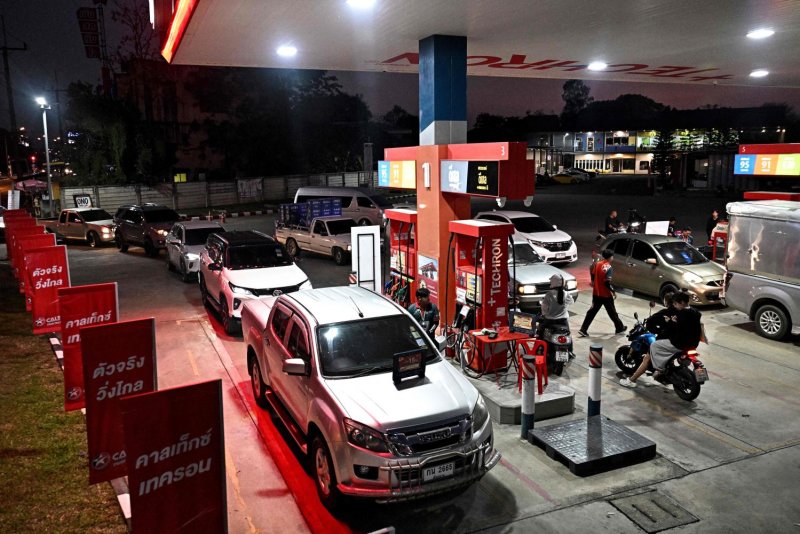
Motorists queue up at a Caltex petrol station in Chiang Rai, following import disruptions caused by the Middle East war, in this file photo dated March 17. (Photo: AFP)

I have a monumental task: convincing readers that Thailand's economy is performing poorly and is likely to contract this year.

My strongest evidence is not the abundance of statistics or economic theories at my disposal. It is far simpler: people are spending much more on energy and, inevitably, less on everything else.

If readers remain unconvinced, they need only look inside their wallets or check their bank balances. The evidence is there.

Those who dispute this argument are likely to point to 2022, when global oil prices also reached US$100 (3,378 baht) a barrel, yet Thailand's economy still grew by 2.6%. However, there are two crucial differences between 2022 and 2026.

First, Gen Prayut Chan-o-cha's government heavily subsidised fuel prices, capping diesel at 35 baht a litre. Second, private-sector credit expanded strongly, generating almost 800 billion baht in new loans.

That surge in lending helped lift private consumption by 6.3% despite high global oil prices. Neither of those conditions exists today.

As expected, I remain the odd man out.

Respected economic institutions forecast GDP growth in 2026 at 1.9% (IMF), 1.8% (Asian Development Bank), 2.3% (Bank of Thailand) and 2.0% (Kasikorn Research Centre). By contrast, freelance economist Chartchai Parasuk argues that the economy will contract rather than expand. Does he have compelling evidence to support such a view?

He does. His case rests on one critical factor: the current account deficit.

Most research institutions appear to underestimate the importance of the current account as a key determinant of GDP.

GDP is calculated using the formula Y = C + I + G + (X − M). The first three components -- consumption, investment and government spending -- represent domestic demand.

The final component, net exports (exports minus imports), represents external demand and is closely linked to the current account balance.

When the current account is in surplus, it contributes positively to GDP. When it is in deficit, it subtracts from GDP.

In 2025, Thailand's economic growth depended largely on external demand because domestic consumption grew by only 2.7%. The country recorded a current account surplus of $15.9 billion, equivalent to about 530 billion baht or 2.8% of GDP.

Had the current account merely broken even, GDP growth would have fallen to just 0.4%. That illustrates how important the current account is to overall economic performance.

Every major research institution recognises the current account will deteriorate in 2026 because of higher energy import costs. During the first five months of the year, Thailand's fuel import bill rose from $18 billion in 2025 to $25 billion, pushing the current account to a deficit of $12.4 billion, compared with a surplus of $10.4 billion during the same period last year.

What is less clear is whether this sharp deterioration has been fully incorporated into their GDP forecasts. It appears that the IMF has not done so. (See table.)

The table compares GDP growth forecasts and current account balances -- in both US dollars and baht -- for 2025 and projected figures for 2026. It includes projections from the IMF (July update), the Bank of Thailand (BoT) and my own estimates.

It is no surprise that the IMF raised its 2026 growth forecast by 0.4 percentage points from its April World Economic Outlook projection. The revision was not driven by expectations of stronger exports but by the government's 172-billion-baht Thai Help Thai stimulus programme, equivalent to 0.9% of GDP.

Despite optimistic rhetoric about Thailand becoming a major exporter in the artificial intelligence supply chain, the country's projected growth remains the weakest among its Asean peers. It is regrettable that Thailand is expected to grow more slowly than Cambodia, Laos and Myanmar. Any gains from AI-related exports are likely to be outweighed by rising import costs.

What surprises me is the IMF's estimate of a $4.1 billion current account surplus for 2026. That assumption is difficult to justify when the economy has already recorded a $12.4 billion deficit in the first five months of the year.

If the projected current account surplus is not credible, then neither is the IMF's 1.9% GDP growth forecast.

The Bank of Thailand (BoT) has adopted a less optimistic view, but its projections also appear detached from reality. It initially forecast a $4 billion current account surplus for 2026 before revising that estimate to a balanced position.

Yet, given the sizeable deficit already recorded in the first five months, it is difficult to see how the economy could generate an equally large surplus during the remainder of the year. The renewed conflict between the United States and Iran further weakens that prospect.

It is therefore highly unlikely that Thailand will end the year with a balanced current account, let alone a surplus. June's deficit is likely to reach $5 billion to $6 billion because global oil prices averaged around $95 a barrel in May.

Oil purchased in May is typically delivered and paid for in June. I simply cannot see how Thailand could generate an $18 billion surplus in the second half of the year to offset the first-half deficit.

My forecast assumes WTI crude averages $80 a barrel for the rest of the year -- arguably an optimistic assumption. Even so, Thailand would still record a full-year current account deficit of $21.9 billion.

Compared with last year's $15.9 billion surplus, that swing would reduce the amount of income available for domestic spending by about 729 billion baht, or 3.8% of GDP. On that basis, I project GDP growth of minus 0.4% in 2026.

Which scenario should readers believe?

If you believe Thailand can somehow return to a current account surplus despite persistently high global energy prices, then the IMF's forecast may be convincing.

If you believe oil prices will miraculously fall below $60 a barrel, then the BoT's projection may prove correct.

But if you believe WTI crude will average around $80 a barrel, then my forecast of -0.4% GDP growth is the more realistic outcome.

And if oil prices remain above $90 a barrel?

Then I will have to recalculate both the current account balance and GDP growth.

In fact, I already have.

The results are not encouraging.

Sign up to read this article
Read news from 100's of titles, curated specifically for you.
Already a member? Sign in here
Related Stories
Top stories on inkl right now
One subscription that gives you access to news from hundreds of sites
Already a member? Sign in here
Our Picks
Fourteen days free
Download the app
One app. One membership.
100+ trusted global sources.